The Cloud That Works Without the Cloud
Defense bases, offshore energy platforms, and emergency response zones share a common infrastructure problem: they need enterprise-grade compute and AI, but they cannot connect to the public cloud. Intermittent satellite links, contested radio environments, and strict data sovereignty mandates make traditional cloud deployments impossible.
On March 31, 2026, Microsoft and Armada announced a collaboration that directly addresses this gap. The partnership brings Microsoft’s Sovereign Private Cloud capabilities to Armada’s Galleon modular data centers, enabling customers to run secure, compliant workloads in intermittently connected, contested, and fully disconnected environments. The solution is available now, with both companies actively engaging customer deployments.
What Azure Local Delivers Inside a Shipping Container
At the core of this collaboration sits Azure Local, Microsoft’s on-premises cloud platform designed for disconnected and sovereign scenarios. Azure Local provides the same governance, policy controls, and management experience as public Azure, but everything runs inside the customer’s operational boundary with no dependency on external networks.
Microsoft’s Sovereign Private Cloud, unveiled in February 2026, unifies three components into a single stack:
- Azure Local provides the infrastructure foundation with consistent Azure governance, policy enforcement, and workload execution, all operating within the local environment when systems are isolated from external networks.
- Microsoft 365 Local runs core productivity workloads including Exchange Server, SharePoint Server, and Skype for Business Server entirely inside the sovereign boundary.
- Foundry Local enables organizations to run multimodal AI models locally on their own hardware using infrastructure from partners like NVIDIA, with local inferencing and APIs operating entirely within customer-controlled data boundaries. No traffic leaves the environment.
Azure Local disconnected operations are now available worldwide. Foundry Local is available to qualified customers who need large-model AI inference in air-gapped environments.
Armada Galleon: Ruggedized Compute From Suitcase to Megawatt
Armada, the San Francisco-based edge infrastructure company founded in late 2022 by Dan Wright (CEO) and Jon Runyan (COO), provides the physical layer that makes Azure Local deployable anywhere power exists. The company’s Galleon product line spans multiple form factors: from suitcase-sized field units to the 20-foot Cruiser and up to megawatt-scale data centers.
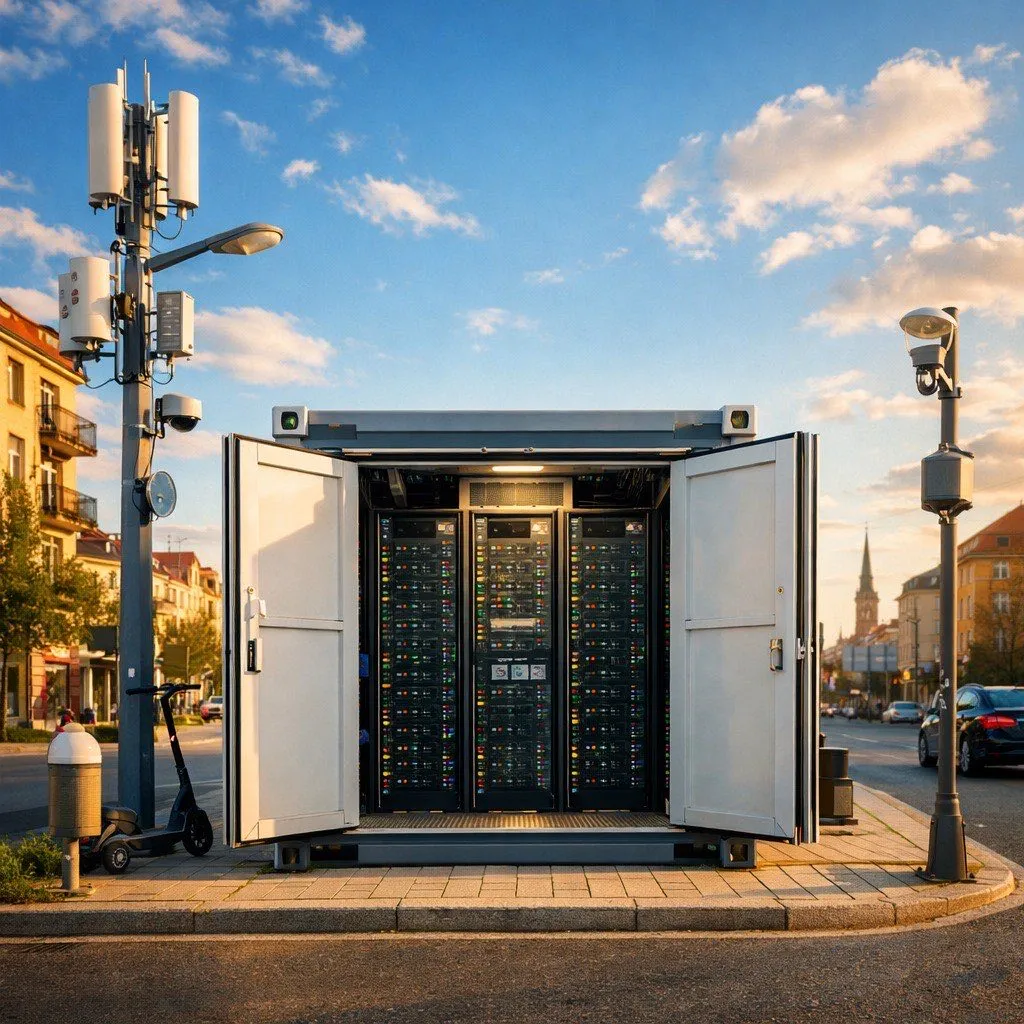
Each Galleon arrives preloaded with compute, networking, storage, heating, and cooling, configurable with CPUs, GPUs, and XPUs to match specific workload demands. The units are engineered with bulletproof exteriors, environmental sensors, and integrated cameras to withstand extreme temperatures and physical threats.
The flagship Leviathan, announced alongside Armada’s $131 million strategic funding round in July 2025, is a liquid-cooled powerhouse delivering 10x the compute capacity of the previous Triton model. Shipped in two 45-foot containers plus a smaller 20-foot container, Leviathan can be co-located with stranded natural gas, solar, nuclear, or other alternative energy sources and becomes operational in weeks rather than the months or years required for traditional data center construction.
That $131M round brought in Founders Fund, Lux Capital, Shield Capital, M12 (Microsoft’s venture fund), and Felicis, among others, bringing Armada’s total raised to over $226 million.
Advertisement
Connectivity That Bends, Not Breaks
What separates this partnership from a standard on-premises deployment is Armada’s Edge Platform (AEP), the software and control layer that manages connectivity, workloads, and fleet operations across distributed Galleon units.
AEP provides multi-network SD-WAN combining Starlink satellite, 5G, LTE, and RF links to maintain resilient connectivity where available. When connectivity drops entirely, Azure Local continues operating autonomously, with synchronization occurring only when links resume. Armada’s Atlas platform provides a single pane of glass for monitoring satellite terminals, SD-WAN, drones, private 5G networks, and edge compute nodes.
This architecture means a Galleon deployed at a remote energy site can process AI inference workloads, run Microsoft 365 productivity tools, and enforce Azure governance policies, all while operating on satellite connectivity alone or fully air-gapped.
Government Market Traction Accelerates
Armada is not waiting for demand to materialize. On April 7, 2026, the company opened its first Galleon Experience Center at Carahsoft Technology headquarters in Reston, Virginia, one of the largest public-sector IT distributors in the United States. Federal, state, and local government agencies, along with education and healthcare organizations, can now walk through a fully operational Galleon environment and test sovereign AI workloads firsthand.
By anchoring this center inside a major government IT distribution hub, Armada gains direct access to procurement decision-makers who need AI capabilities in locations where traditional cloud connectivity is limited or unavailable.
What This Means for Edge Infrastructure Strategy
The Microsoft-Armada partnership signals a structural shift in how organizations think about cloud infrastructure. Rather than extending cloud connectivity to the edge, this model brings the full cloud stack to wherever the mission requires it, connectivity optional.
For defense and intelligence organizations, this eliminates the longstanding tradeoff between operational security and modern compute capabilities. For energy operators managing remote wells, pipelines, or renewable installations, it means AI-driven predictive maintenance and operational analytics without building permanent data center infrastructure. For disaster response teams, it provides deployable compute that arrives pre-configured and operational within days.
The broader implication is that “edge computing” is no longer a compromise. With Azure governance, Microsoft 365 productivity, and Foundry Local AI inference all running inside a ruggedized container, the gap between edge and cloud-center capability has effectively closed for workloads that can operate within the Galleon’s compute envelope.
Frequently Asked Questions
What is Azure Local and how does it differ from standard Azure?
Azure Local is Microsoft’s on-premises cloud platform that provides the same governance, policy controls, and management experience as public Azure, but runs entirely inside the customer’s environment. Unlike standard Azure, it requires no internet connection to operate. Management, policy enforcement, and workload execution all remain within the local boundary, with synchronization occurring only when connectivity is available.
How quickly can an Armada Galleon modular data center be deployed?
Armada’s Galleon modular data centers are designed for rapid deployment, becoming operational in weeks rather than the months or years required for traditional data center construction. Each unit arrives preloaded with compute, networking, storage, heating, and cooling. The largest model, Leviathan, ships in two 45-foot containers plus one 20-foot container and delivers megawatt-scale, liquid-cooled compute capacity.
Can sovereign edge AI solutions run large language models without internet connectivity?
Yes. Microsoft’s Foundry Local, part of the Sovereign Private Cloud stack, enables organizations to run multimodal AI models locally on their own hardware using NVIDIA infrastructure. All inferencing and API calls operate entirely within customer-controlled data boundaries, with no traffic leaving the environment. This capability is currently available to qualified customers who need large-model AI in air-gapped or classified environments.
Sources & Further Reading
- Building Sovereign AI at the Edge: Microsoft and Armada Collaborate to Deliver Azure Local on Galleon Modular Datacenters — Microsoft Azure Blog
- Armada to Deliver Sovereign AI at the Edge with Microsoft Azure Local — PR Newswire
- Microsoft Sovereign Cloud Adds Governance, Productivity and Support for Large AI Models — Microsoft Official Blog
- Microsoft and Armada Bring Azure Local to Galleon Modular Data Centers — Data Center Dynamics
- Armada Announces $131M Strategic Funding Round — PR Newswire
- Armada and Carahsoft Open First Galleon Experience Center — GlobeNewswire