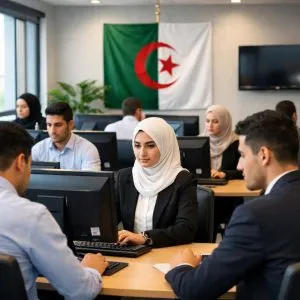
The Survey That Quantified the Talent Exodus
The State of Software Engineering in Algeria survey, conducted in February 2024 with 517 participants across Arabic, English, and French, provides the most detailed snapshot of Algeria’s developer workforce to date. The headline finding is stark: 29% of participants work for foreign companies remotely from within Algeria. Among respondents based in Algiers and Oran, that figure climbs to 56%.
This is not traditional emigration. These developers live in Algeria, spend their earnings in the local economy, and raise their families here. But the intellectual value they produce flows abroad. The phenomenon represents a new form of talent loss, one that statistics on physical emigration, which already stand at roughly 500,000 highly trained professionals who have left Algeria, fail to capture.
Of those working for foreign companies, 46% hold full-time positions, 42% work as freelancers, and 12% are part-time employees. The draw is overwhelmingly financial.
The Salary Gap Driving the Flow
The compensation disparity between local and foreign remote employment is the engine of this talent redistribution. According to the survey’s remuneration data, engineers with six to ten years of experience working remotely for foreign companies earn approximately 2,500 euros per month. Entry-level remote positions start around 500 euros, with mid-level roles averaging 1,000 euros. Some full-time remote positions exceed 60,000 euros annually.
Their counterparts at Algerian companies earn significantly less. Senior developers at local firms typically earn in the range of 800 to 900 euros monthly, roughly a third of what foreign employers offer for equivalent experience.
To contextualize these figures against the broader economy: Algeria’s guaranteed minimum wage (SNMG) was raised to 24,000 dinars per month in January 2026, approximately 156 euros at the official exchange rate. A senior developer earning 2,500 euros from a foreign employer makes roughly 16 times the minimum wage. A senior developer at a local company earning 800 euros still earns over 5 times the SNMG, but the gap between local and foreign compensation is wide enough to make local employment feel economically irrational for anyone with the skills to secure remote work.
The parallel exchange rate, which ranges from 215 to 225 DZD per euro, further amplifies the real purchasing power advantage of euro-denominated salaries for developers who convert through informal channels.
What the Talent Market Looks Like
The survey reveals a lopsided skills distribution that compounds the hiring challenge for local companies. Web development dominates: 48% of respondents are full-stack developers and 20% are front-end developers. Meanwhile, only 1% work as SRE or DevOps engineers and just 2% are system administrators.
These specialized operational roles, which are critical for running reliable production systems at scale, are nearly absent from Algeria’s developer ecosystem. Worse, every single DevOps and SRE respondent in the survey indicated willingness to leave Algeria for better opportunities abroad. The professionals who do develop these high-demand skills are precisely the ones most aggressively recruited by foreign employers.
The scarcity reflects multiple factors: university curricula that emphasize theoretical computer science over operational disciplines, few local companies operating at a scale where SRE practices become essential, and the fact that foreign employers prize operational expertise and actively poach it.
The Practical Barriers: Banking, Internet, and Soft Skills
The survey’s challenges section identifies obstacles that shape who can access foreign remote work and who cannot.
For those already working remotely for foreign companies, banking systems rank as the top challenge, followed by internet connectivity issues and banking infrastructure limitations. Receiving foreign-currency payments through Algeria’s banking infrastructure remains cumbersome, pushing many remote workers toward third-party payment solutions.
Internet quality, despite Algerie Telecom’s fiber expansion to 2.5 million FTTH subscribers by late 2025, remains a constraint. According to ARPCE data, 52% of home internet subscriptions are still ADSL, with only 17% on FTTH. Coverage reaches just 27% of Algeria’s 7.4 million households. A dropped connection during a critical deployment or client call carries professional consequences that local employment does not.
Soft skills, particularly English proficiency, communication discipline, and cross-cultural collaboration, act as a gatekeeper. More than 30% of survey participants rely on instant messaging apps for professional communication, and the survey documents issues with punctuality and transparency that have led some foreign companies to prefer on-site arrangements. Developers who overcome these barriers earn dramatically more; those who cannot remain confined to the lower-paying local market.
Advertisement
Why Local Companies Cannot Compete
The salary gap alone does not fully explain the talent challenge. Several structural factors compound it.
Algerian technology companies primarily serve the domestic market, where willingness to pay for software remains low by global standards. A SaaS company charging Algerian businesses cannot generate the per-employee revenue needed to justify European-level salaries. The arithmetic is straightforward: developing-world customer prices cannot sustain developed-world compensation.
Algeria’s startup ecosystem has historically lacked equity compensation tools. However, the landscape is evolving. A new FCPR Venture Capital Framework established in 2025 now enables private VC funds with as little as 50 million DZD. The Algiers Stock Exchange has waived IPO fees for startups through 2028. And VOLZ’s $5 million Series A in December 2025, the first exit for the Algerian Startup Fund with a 3.35x return, signals that exit markets are beginning to form. But these are early developments. Most local employers still cannot offer equity packages that credibly compete with the certainty of foreign cash compensation.
Beyond pay, foreign remote employers frequently offer working conditions that local companies struggle to match: flexible schedules, modern engineering practices, exposure to global-scale technical challenges, and professional development support. Some Algerian companies provide excellent environments, but the average experience at a well-run European technology company, even accessed remotely, carries advantages beyond salary.
The Policy Response: SNTN-2030
Algeria’s National Digital Transition Strategy (SNTN-2030), unveiled by High Commissioner for Digitalization Meriem Benmouloud, directly addresses the talent challenge. The strategy targets training 500,000 ICT specialists, reducing technology talent emigration by 40%, and boosting the digital sector’s GDP contribution to 20%.
The supply-side logic is sound: by massively expanding the pool of technology professionals, Algeria can serve both foreign remote demand and domestic company needs. India and the Philippines followed similar paths, scaling technology education until domestic and foreign employers could both draw from a deep talent pool.
But quantity without quality is counterproductive. Training programs must produce professionals with current, market-relevant skills, including the operational specializations like DevOps and SRE that the survey shows are almost entirely absent. Curriculum modernization, industry partnerships, and practical experience through internships are essential complements to enrollment targets.
What Local Companies Can Do Now
While SNTN-2030 targets play out over years, Algerian technology companies can take immediate steps.
Compete on mission. Developers building products that solve Algerian problems in healthcare, education, agriculture, or public services may accept lower compensation for visible local impact.
Embrace hybrid models. Rather than fighting remote work, offering flexible arrangements combined with periodic in-person collaboration provides the autonomy developers value while maintaining team cohesion.
Invest in engineering culture. Modern development practices, continuous integration, code review, professional development budgets, and current technology stacks differentiate employers even when compensation cannot match foreign offers.
Create career ladders. Explicit engineering progression paths from junior through senior, staff, and principal levels give ambitious developers a visible future within the organization.
Clarify freelance frameworks. Algeria lacks a dedicated regulatory system for international freelance work. Policymakers should formalize the tax, social security, and business registration requirements for remote workers, bringing a significant and growing economic activity into the formal sector.
Can Algeria Turn Brain Drain into Brain Gain?
The 29% statistic does not have to represent permanent loss. The most promising pathway runs through entrepreneurship. Developers who spend years at foreign companies accumulate technical skills, professional networks, international market knowledge, and capital savings. If Algeria creates an environment where starting a technology company is viable and rewarding, some will transition from remote employment to domestic ventures.
This has already begun. Algerian entrepreneurs who built skills through international work are founding companies serving both domestic and global markets. Their experience, including familiarity with international engineering standards and fundraising networks, gives them capabilities that purely locally trained founders may lack.
Scaling this conversion requires reducing friction in company formation, improving access to capital, and building a regulatory environment that enables technology companies to grow. The alternative, a permanent two-tier labor market where top talent serves foreign economies while domestic companies subsist on a depleted pool, is economically unsustainable. With a median age of 28.8 years and a population of 48 million, Algeria has the demographic resources and growing policy awareness to chart a different course. Execution over the next five years will determine the outcome.
Frequently Asked Questions
Why do 29% of Algerian developers work remotely for foreign companies?
The primary driver is compensation. According to the State of Software Engineering in Algeria survey (517 participants, February 2024), engineers with 6-10 years of experience earn approximately 2,500 euros monthly from foreign employers versus roughly 800-900 euros at local companies. This 3x salary gap, amplified by favorable parallel exchange rates, makes foreign remote employment the rational economic choice for developers with the English proficiency and soft skills to secure it.
What are the biggest challenges facing Algerian remote workers?
Banking systems rank as the top challenge for developers working remotely for foreign companies, as receiving foreign-currency payments through Algeria’s banking infrastructure remains cumbersome. Internet connectivity is the second barrier, with 52% of home subscriptions still on ADSL and FTTH covering only 27% of households. banking infrastructure limitations is the third most-cited obstacle, disrupting career continuity for young male developers.
How is Algeria addressing the digital brain drain through policy?
The SNTN-2030 National Digital Transition Strategy targets training 500,000 ICT specialists, reducing technology talent emigration by 40%, and boosting the digital sector’s GDP contribution to 20%. Supporting developments include a new FCPR Venture Capital Framework enabling private VC funds, the Algiers Stock Exchange waiving IPO fees for startups through 2028, and continued FTTH expansion by Algerie Telecom, which reached 2.5 million fiber subscribers by late 2025.
Sources & Further Reading
- Remote Working Insights — State of Software Engineering in Algeria
- Salaries & Remuneration — State of Software Engineering in Algeria
- Reported Challenges — State of Software Engineering in Algeria
- Cloud and DevOps — State of Software Engineering in Algeria
- Algeria Increases SNMG to 24,000 DZD — Algerian Radio
- SNTN-2030: 500,000 ICT Experts Target — Algeria Invest
- Algeria Digital Transformation Strategy 2030 — We Are Tech Africa
- Algerie Telecom Reaches 2.5M FTTH Subscribers — TechAfrica News
- Algeria Startup Ecosystem 2025 Reforms — Techpression
- Algeria Demographics 2026 — Worldometer