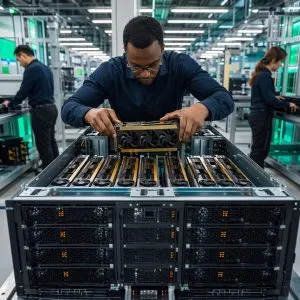
The Most Complex Platform NVIDIA Has Ever Shipped
Announced at CES 2026 and entering full production, Vera Rubin is NVIDIA’s first “extreme codesign” six-chip AI platform and the formal successor to Blackwell. It is not a single GPU — it is a coordinated stack of the Vera CPU, Rubin GPU, NVLink 6 Switch, ConnectX-9 SuperNIC, BlueField-4 DPU, and Spectrum-6 Ethernet Switch, engineered to work as one system.
Cloud deployment is already queued up. AWS, Google Cloud, Microsoft Azure, Oracle Cloud Infrastructure, CoreWeave, Lambda, Nebius, and Nscale have all confirmed Vera Rubin instances for the second half of 2026. For enterprise buyers, that means rough capacity arrives in early 2027, with priority allocated to frontier model labs and hyperscaler internal workloads first.
Rubin GPU: The Headline Numbers
Each Rubin GPU is built on 336 billion transistors and ships with:
- 288 GB of HBM4 memory (up from 192GB on B200)
- 50 petaflops of FP4 inference (vs. 20 petaflops on Blackwell — a 2.5x jump)
- 3.6 TB/s of memory bandwidth per GPU
- 260 TB/s of interconnect bandwidth via NVLink 6
For training teams, the practical implication is that trillion-parameter models that required aggressive tensor and pipeline parallelism on Blackwell can now fit into smaller Rubin clusters with less orchestration overhead. NVIDIA’s internal numbers suggest 4x fewer GPUs are needed to train mixture-of-experts models at comparable time-to-train.
The Rack-Scale Story: NVL144 and NVL576
Individual GPU specs matter less than rack-scale configurations for buyers sizing a deployment.
Vera Rubin NVL144 packages 72 Rubin GPU modules (144 compute dies) with 36 Vera CPUs into a single 72U rack. It delivers 3.6 exaflops of FP4 inference and 1.2 exaflops of FP8 training, a 3.3x gain over the Blackwell-generation GB300 NVL72. Total high-bandwidth memory: 13 TB/s, with 75 TB of fast memory per rack. Aggregate GPU-to-GPU bandwidth through NVSwitch 6.0 reaches 28.8 TB/s.
Vera Rubin Ultra NVL576, arriving later in 2026/2027, unifies eight NVL racks into a single 576-GPU NVLink domain — effectively one logical supercomputer exposed to a single training job. Power draw climbs accordingly to around 600 kW per rack, which is why many colocation facilities are retrofitting to liquid cooling as a precondition of taking Rubin capacity.
Advertisement
Rubin CPX: A Purpose-Built Long-Context Accelerator
One of the less-hyped but strategically significant pieces of the platform is Rubin CPX (Context Processing Extension). Built to accelerate million-token context workloads, CPX pairs 128 GB of GDDR7 (cheaper than HBM4) with 30 petaflops of NVFP4 compute, optimized specifically for the attention math that dominates long-context inference.
For applications that read entire codebases, legal case files, or multi-hour video streams per request, CPX offloads the context prefill from Rubin GPUs and delivers materially better tokens-per-dollar on long prompts. Expect inference-heavy service providers — coding assistants, document analysis platforms, video understanding APIs — to be among the first to adopt mixed Rubin+CPX deployments.
Co-Packaged Optics: The Networking Break Point
Rubin is also NVIDIA’s first platform to integrate co-packaged optics (CPO) at scale. The Spectrum-6 SPX rack ships a 102.4 Tb/s switch with 512 lanes and 200 Gb/s CPO, replacing pluggable transceivers. The payoff is lower power per bit, lower latency, lower jitter, and effective bandwidth close to the theoretical peak — the conditions needed to keep 576 GPUs running as one coherent system.
CPO has been the industry’s aspiration for years. Rubin is the first generation to ship it in volume to customers, and it will quickly raise the bar for competing AI networking platforms.
What Buyers Should Actually Do in 2026
1. Lock allocation early. Hyperscaler Rubin instances will be capacity-constrained through at least 2027. Enterprises with firm 2026 training roadmaps should be signing reservations now, not in Q4.
2. Plan the power and cooling step-up. A 600 kW NVL576 rack will not fit in most 2020-era colocation halls. Facilities procurement needs to run in parallel with GPU procurement — this is where many deployments will slip.
3. Model the inference cost curve. NVIDIA’s “10x lower cost per token vs. Blackwell” is a real number for workloads that are genuinely compute-bound at FP4. For memory-bound or network-bound workloads, real savings are smaller. Buyers should pilot representative models before committing capex assumptions.
4. Think in mixed configurations. Rubin + Rubin CPX combinations will be materially cheaper than Rubin-only for long-context inference services. Separate budget lines for prefill acceleration make the TCO story work.
5. Do not skip the Vera CPU. The new 88-core Vera CPU is tightly coupled to Rubin over NVLink and handles the data movement, checkpointing, and control plane that keeps GPU utilization high. Third-party x86 CPUs will work, but NVIDIA-optimized workloads meaningfully underperform without Vera.
The Competitive Context
AMD’s MI400 series and custom silicon from AWS (Trainium 3), Google (TPU v7 Trillium successor), and Microsoft (Maia 200) are all targeting 2026-2027 availability. None currently match Rubin’s combination of memory capacity, NVLink scale, and software ecosystem maturity. The frontier model labs — OpenAI, Anthropic, Google DeepMind, Mistral, Cohere, and sovereign-AI programs in Singapore, the UAE, and Saudi Arabia — will continue to dominate early Rubin allocation.
For everyone else, the practical question is not whether to buy Rubin, but when cloud capacity becomes available at a price point that beats running Blackwell workloads for one more cycle. For most enterprises, that crossover arrives in the first half of 2027.
Frequently Asked Questions
Will Algeria ever host Rubin-class infrastructure domestically?
Not at scale in the 2026-2027 window. The binding constraints are power (600 kW per rack), liquid cooling infrastructure, and sustained engineering talent to operate at cluster scale. A realistic Algerian path is a partnership with a neocloud (CoreWeave-style) or hyperscaler willing to deploy a regional zone — which in turn depends on power guarantees and regulatory clarity.
What does “10x lower cost per token” actually mean for a developer using the OpenAI or Anthropic API?
NVIDIA’s claim applies to compute-bound FP4 inference under ideal conditions. Real-world API pricing pass-through is typically 30-60% of the raw hardware improvement in the first 12 months, rising as hyperscalers amortize capex. Expect frontier-model inference prices to drop 30-50% across major APIs during 2026-2027, not a full 10x.
Should Algerian AI startups wait for Rubin before building?
No. Blackwell-era capacity is more than sufficient to build today’s products. The correct architectural decision is to abstract your inference layer (LiteLLM, OpenRouter, custom router) so that when Rubin pricing lands, you can swap providers without rewriting product code.
Sources & Further Reading
- NVIDIA Kicks Off the Next Generation of AI With Rubin — NVIDIA Newsroom
- Inside the NVIDIA Vera Rubin Platform — NVIDIA Technical Blog
- NVIDIA launches Vera Rubin NVL72 AI supercomputer at CES — Tom’s Hardware
- NVIDIA Unveils Rubin CPX for Massive-Context Inference — NVIDIA Newsroom
- NVIDIA Vera Rubin NVL144 Platform Overview — NADDOD Blog
- Infrastructure for Scalable AI Reasoning — NVIDIA Vera Rubin Platform