🧭 Decision Radar
Relevance for Algeria
Low
▾
Infrastructure Ready?
No
▾
Skills Available?
Limited
▾
Action Timeline
24+ months
▾
Ministry of Industry, large Algerian logistics and manufacturing operators, Algeria Venture
Decision Type
Educational
▾
Quick Take: Algerian manufacturers and logistics operators are not yet positioned to adopt physical AI perception systems like Lyte’s, but the funding trend is worth tracking: as robotics-perception costs fall with increased investment and competition in this category, automation options that are currently priced for advanced economies may become viable for Algerian industry within the next several years.
From Apple’s Sensing Team to Robot Perception
Lyte was founded in 2021 by Alexander Shpunt, Arman Hajati, and Yuval Gerson — three former Apple engineers who worked on the company’s advanced sensing and perception technologies. Shpunt’s background is particularly notable: he previously co-founded PrimeSense, whose 3D-sensing technology powered Microsoft Kinect before Apple acquired the company in 2013, and that same underlying sensing work later contributed to Face ID.
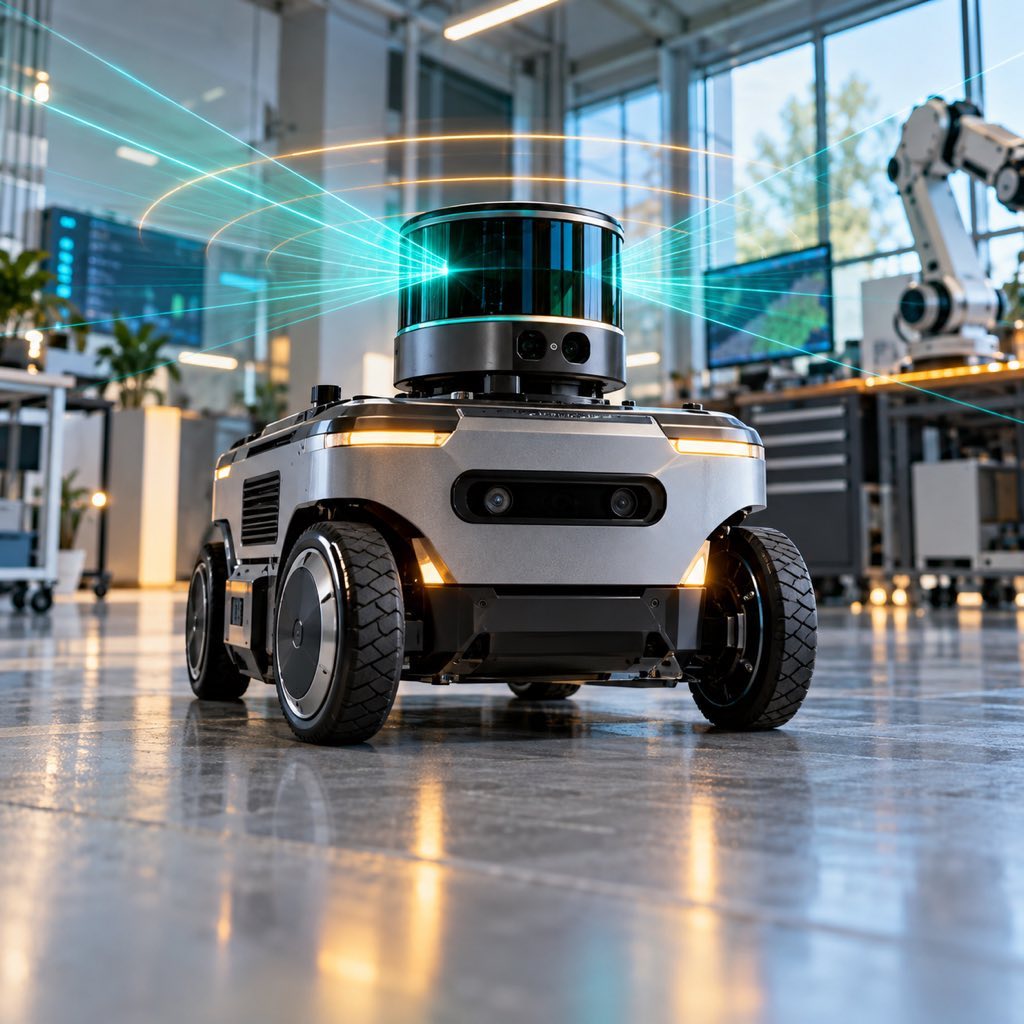
The Sunnyvale, California-based company builds custom silicon, multimodal sensors, and spatial software designed to let robots determine their location and detect movement around them — what the industry increasingly calls “physical AI,” as distinct from the large language models and generative tools that dominate most AI funding headlines. Crunchbase reports Lyte emerged from stealth mode in January 2026 and has since entered production, shipping to robotics customers in inspection, logistics, and manufacturing.
The Round and What It Signals
The $165 million Series C was led by Maverick Silicon, with participation from Fidelity Management and Research Company — which had led Lyte’s Series B — alongside Atreides Management, Key1 Capital, Ora Global (formerly Exor Ventures), and other existing and new investors. The round brings Lyte’s total funding since founding to $272 million, and Maverick Silicon partner Andrew Homan has joined the company’s board as part of the deal.
CEO Alexander Shpunt framed the investment thesis directly: “Physical AI will create entirely new categories of robots… We built Lyte to become the perception foundation for that future,” he said. That framing positions Lyte not as a robotics company itself, but as an infrastructure layer other robot builders depend on — a strategy comparable to how chip and sensor suppliers underpin entire hardware categories without competing directly with the companies that use their components.
Advertisement
Why Physical AI Perception Is Attracting Capital Now
Software-focused generative AI has absorbed the overwhelming majority of AI venture capital and public attention over the past several years. Lyte’s raise — alongside a broader wave of physical AI and robotics-perception funding in 2026 — suggests investors increasingly see hardware-adjacent AI infrastructure as a distinct, underbuilt category rather than an afterthought to the software boom. Robots operating in real-world environments (warehouses, factories, inspection sites) need reliable spatial awareness that pure software models can’t provide on their own; that gap is exactly what companies like Lyte are positioned to fill, and the fact that Lyte’s round drew both specialist deep-tech investors and a Series B lead (Fidelity) returning for the Series C suggests confidence in the company’s execution, not just the category’s promise.
For buyers of robotics systems, Lyte’s growth from stealth to production-shipping customer base in roughly eight months is also a signal that the physical AI perception market may be maturing faster than expected — meaning organizations evaluating robotics deployments in logistics or manufacturing should expect more capable, cheaper sensing options to become available on a shorter timeline than previously assumed.
Frequently Asked Questions
What does Lyte’s physical AI perception technology actually do?
Lyte builds custom silicon, multimodal sensors, and spatial software that help robots determine their location and detect movement in their environment — the perception layer robots need to operate safely and effectively in real-world settings like warehouses and factories.
How much has Lyte raised and at what valuation?
Lyte raised $165 million in Series C funding on September 2, 2026, led by Maverick Silicon, valuing the company at $1.6 billion post-money and bringing its total funding since its 2021 founding to $272 million.
Who founded Lyte and what is their background?
Lyte was founded in 2021 by Alexander Shpunt, Arman Hajati, and Yuval Gerson, all former Apple engineers who worked on advanced sensing technologies; Shpunt previously co-founded PrimeSense, whose 3D-sensing technology powered Microsoft Kinect before Apple’s 2013 acquisition of the company.
Sources & Further Reading
🔗 Related Intelligence

Odyssey’s $310M Raise: A World-Model Startup Hits Unicorn Status

Seed-Stage Unicorns: How AI Startups Hit $1B Before Shipping a Product

AI Unicorns at Seed Stage: How 25 Billion-Dollar Companies Minted in 2026

47 Seed-Stage Unicorns in Q1 2026: When AI Mints Billions Before Launch