From Borrowed Cloud Credits to Domestic Compute
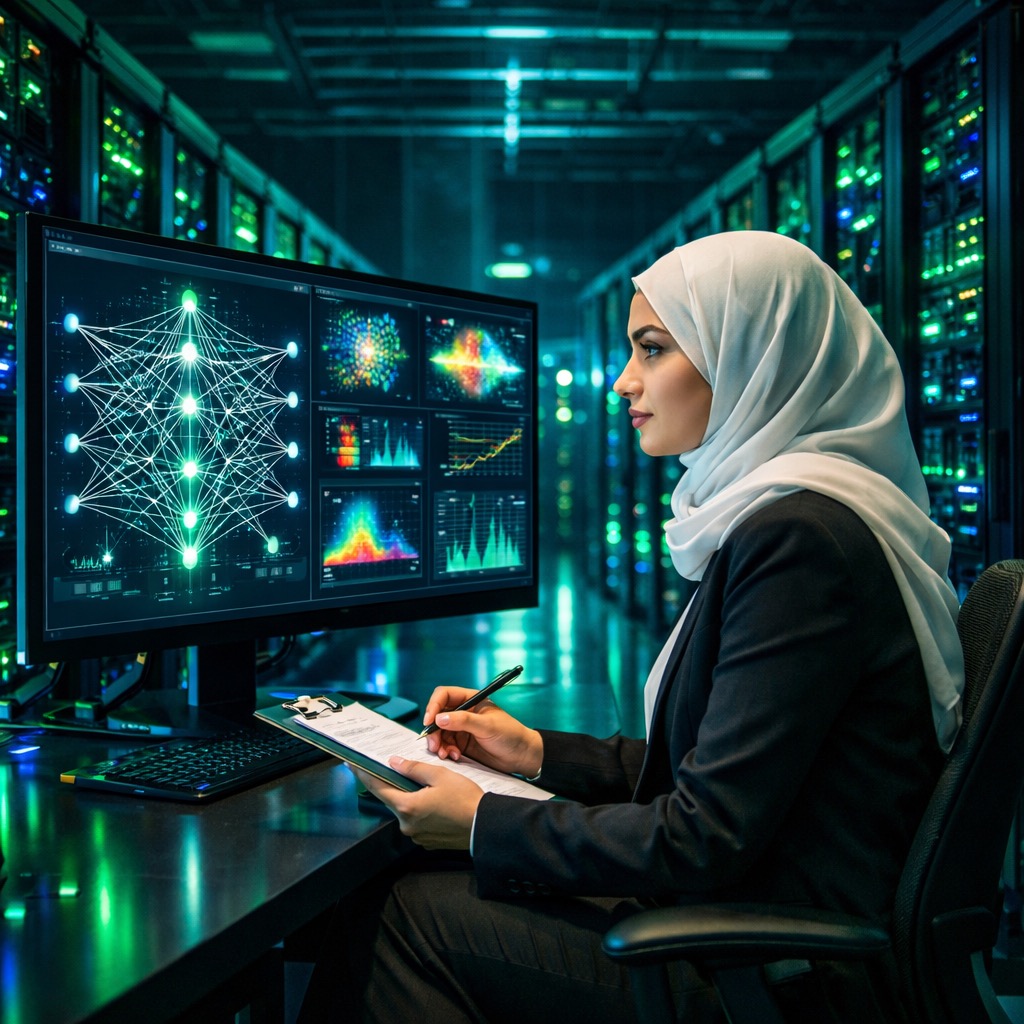
In July 2025, Minister of Higher Education and Scientific Research Kamel Baddari unveiled a high-performance computing center at the Ecole Nationale Superieure d’Intelligence Artificielle (ENSIA) in the Sidi Abdellah technology hub, roughly 30 kilometers west of Algiers. The facility houses NVIDIA H100, L40S, and A40 GPU accelerators — the first academic computing infrastructure of this class in Algeria.
The timing matters. Algeria produced 859 peer-reviewed AI publications indexed in Scopus and Web of Science during 2024, a 40 percent year-over-year increase generated by 12 dedicated research laboratories across Algiers, Constantine, Oran, Annaba, and Sidi Bel Abbes. That output was achieved almost entirely without domestic GPU infrastructure. Researchers relied on Google Colab free tiers, limited cloud credits from international partnerships, and single-GPU workstations shared among entire research groups. Training a moderately sized language model domestically was effectively impossible.
ENSIA’s HPC center changes that equation by providing shared, research-grade GPU access as a national resource.
What ENSIA Built: A Three-Tier GPU Architecture
The cluster combines three tiers of NVIDIA accelerators, each serving different computational workloads.
NVIDIA H100 (Hopper architecture) handles the most demanding training jobs. Each H100 provides 80 GB of HBM3 memory with 3.35 TB/s bandwidth and fourth-generation Tensor Cores with FP8 support. These are the same GPUs powering training clusters at Meta, Google, and Microsoft, priced at $25,000 to $40,000 per unit.
NVIDIA L40S (Ada Lovelace architecture) occupies the inference and mixed-workload tier. With 48 GB of GDDR6X memory and strong FP8 throughput, the L40S is more cost-effective than the H100 for serving trained models, running batch evaluations, and supporting visualization.
NVIDIA A40 (Ampere architecture) provides general-purpose GPU compute with 48 GB of GDDR6 memory and ECC support. This tier handles student experiments, smaller training runs, and simulation tasks that do not require H100-class hardware.
The three-tier design is architecturally deliberate. Expensive H100 time goes to demanding research workloads while routine student experiments run on A40s — avoiding the common academic problem of top-tier GPUs sitting idle while queues grow for basic tasks.
Algeria’s institutional electricity rate of approximately $0.036 per kWh — compared with $0.10 to $0.15 in most European countries — gives the facility a significant operational cost advantage for sustained GPU workloads.
National Reach: Serving 52 Universities Remotely
ENSIA’s HPC center is explicitly positioned as a shared national resource, not an exclusive ENSIA facility. This is critical because Algeria’s AI talent is distributed across 52 universities running 74 AI master’s programs with 57,702 enrolled students. Researchers in Oran, Constantine, Tlemcen, Setif, Batna, and Annaba can submit computational jobs remotely without relocating to Algiers.
The model follows international precedents. Singapore’s National Supercomputing Centre serves all national universities through a unified allocation process. France’s GENCI distributes compute across three centers, allocating resources via peer-reviewed proposals. ENSIA’s shared approach ensures that a doctoral student in Tlemcen has the same access path to H100 hardware as one in Algiers.
For startups, the facility is equally significant. Algeria’s 50 to 60 active AI startups have faced compute as their primary barrier. A company building an Arabic speech recognition system or an agricultural diagnostics tool can now access research-grade hardware without securing $50,000 to $100,000 in cloud compute funding — particularly valuable for pre-revenue companies that cannot justify cloud spending to investors.
Advertisement
Unlocking Foundation Model Research
The most transformative potential is enabling Algerian researchers to train and fine-tune large models domestically. Two projects illustrate the demand.
DziriBERT, a 124-million-parameter BERT model trained on approximately one million Algerian Arabic tweets, demonstrated the feasibility of Algerian-specific NLP despite severe compute constraints. With H100 access, researchers could scale to 7-billion-parameter models trained on larger Algerian Arabic corpora.
Hadretna, a collaboration between Algerian-French startup Fentech and AI scientist Merouane Debbah, has already built a pre-trained LLM using two billion tokens of Algerian Arabic (Daridja) and Tamazight data. The project’s crowdsourcing platform at hadretna.ai collects translations and annotations from across Algeria’s regions. Domestic compute access could accelerate this work significantly.
Beyond NLP, the HPC center enables compute-intensive computer vision experiments, large-scale benchmarks, and model fine-tuning for national priorities in healthcare diagnostics, agricultural optimization, and energy management.
Challenges That Will Determine Success
Operations and staffing. GPU clusters demand specialized system administrators with SLURM scheduling, CUDA driver management, and container runtime expertise. ENSIA needs a dedicated operations team — roles that are globally competitive and may be difficult to retain domestically.
Network connectivity. Algeria’s Academic Research Network (ARN) connects 124 institutions at 100 Mbps per university with 3.1 Gbps of international bandwidth. For researchers in southern or inland cities transferring large datasets, bandwidth constraints could degrade the remote-access experience.
Capacity versus demand. The exact GPU count has not been publicly disclosed. With 57,702 AI students representing enormous potential demand, the facility risks rapid oversubscription once awareness grows. Clear allocation policies — distinguishing exploratory student access from large-scale research projects — are essential.
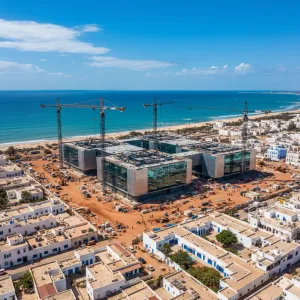
Scaling beyond ENSIA. A complementary AI supercomputing center broke ground in Oran in March 2025, targeting precision agriculture, energy management, and climate modeling. Whether Algeria builds a distributed national compute network or concentrates resources at a single facility will shape research access for years.
Where ENSIA Fits in Africa’s Compute Landscape
Morocco’s Toubkal supercomputer at UM6P — with 1,272 compute nodes, 20 A100 and 12 H100 GPUs, and 3.16 PFLOP/s of performance — ranks 356th on the global TOP500 and remains Africa’s most powerful system. South Africa’s CHPC has historically focused on CPU-based scientific computing rather than GPU-accelerated AI training.
ENSIA’s cluster is smaller than Toubkal in total compute but purpose-built for AI research and training workloads. Combined with the Oran facility under construction, Algeria is assembling dedicated AI compute infrastructure that few African countries can match.
Frequently Asked Questions
What GPUs does ENSIA’s HPC center use?
ENSIA’s cluster employs a three-tier NVIDIA architecture: H100 GPUs (Hopper, 80 GB HBM3) for large-scale AI training, L40S GPUs (Ada Lovelace, 48 GB GDDR6X) for inference and mixed workloads, and A40 GPUs (Ampere, 48 GB GDDR6) for general-purpose computing and student experiments. The heterogeneous design ensures expensive H100 time serves demanding research while routine tasks run on cost-effective hardware.
Can researchers outside ENSIA access the facility?
Yes. The HPC center operates as a shared national resource open to researchers across Algeria’s 52 universities with AI programs. Remote job submission allows researchers in Oran, Constantine, Tlemcen, and other cities to use the GPU cluster without relocating to Algiers. The model follows international precedents like Singapore’s NSCC and France’s GENCI.
How does this compare to other African HPC facilities?
Morocco’s Toubkal supercomputer at UM6P is Africa’s most powerful system with 3.16 PFLOP/s and a TOP500 ranking. ENSIA’s cluster is smaller in total compute but purpose-built for AI training and inference workloads. South Africa’s CHPC focuses primarily on CPU-based scientific computing. With the additional Oran supercomputing center under construction, Algeria is building dedicated AI compute infrastructure that positions it among the continent’s leaders.
Sources & Further Reading
- Algeria Inaugurates National AI School Data Centre — Middle East AI News
- ENSIA: Baddari visite un centre de donnees specialise dans les applications de l’IA — APS
- First High-Performance Computing Center Focused on AI in Algeria — Horizons
- Why Algeria Is Positioned To Become North Africa’s AI Leader — New Lines Institute
- Algeria Powers Up National AI Strategy with New Data Centre — MENA Startup Digest
- NVIDIA H100 Tensor Core GPU Specifications — NVIDIA
🔗 Related Intelligence
AI Infrastructure: Algeria Breaks Ground on Its First Data Center in Oran

Algeria’s 859 AI Papers: Strong Research, Weak Commercialization Pipeline
Algeria’s AI University Placement Algorithm: How 340,901 Baccalaureate Graduates Were Matched in Record Time
Algeria’s 74 AI Master Programs: Building the Workforce for Digital 2030