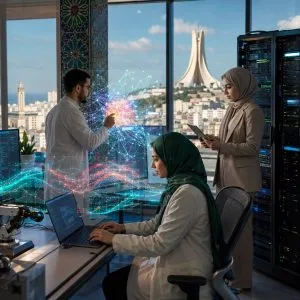
A Dedicated National School, Not a Department
Most AI engineering programs in Africa sit inside computer science departments. ENSIA — the Ecole Nationale Superieure d'Intelligence Artificielle — is different. It is a standalone "Grande Ecole" in Sidi Abdellah, Algiers, created to graduate engineers specialized exclusively in artificial intelligence and data sciences.
The school admits baccalaureate holders and runs a five-year post-bac curriculum split into two phases: a two-year preparatory cycle covering mathematics, statistics, computer science, and programming fundamentals, followed by a three-year second cycle that dives into AI specialization. Graduates receive the state engineering diploma — the credential Algerian employers and public institutions recognize for engineering roles.
The curriculum is organized around five specialization pillars: machine learning, natural language processing, computer vision, data science, and IoT with cybersecurity. Soft skills — communication, project management, entrepreneurship, problem solving — are woven through the program rather than treated as optional electives.
Industry Partnerships That Go Beyond Logos
Paper partnerships between universities and companies are common. ENSIA has moved past that phase.
In February 2023, ENSIA signed a framework agreement with Credit Populaire d'Algerie (CPA), one of the country's major public banks. The agreement specifically targets student integration into the professional environment through internships, joint AI projects applied to banking services, and continuing education programs for CPA staff. This is the kind of structured industry link that produces real internship pipelines rather than occasional guest lectures.
On April 15, 2024, ENSIA signed a second framework agreement with Algeria Post, the national postal and financial services operator. Algeria Post operates the country's largest CCP account base and is central to the Baridi Pay mobile payment rollout — giving ENSIA students exposure to live, high-volume transactional data challenges.
These two partnerships matter because Algeria's AI industry is still small. Structured access to CPA and Algeria Post gives ENSIA students the kind of applied data-rich problems — fraud detection, customer segmentation, OCR on handwritten forms, anomaly detection in payment flows — that used to require going abroad.
Infrastructure: The Data Centre and Campus Capacity
ENSIA inaugurated an on-campus data centre in 2025, giving students and researchers dedicated GPU and compute resources without having to rent cloud capacity abroad. For an AI program, local compute is not a nice-to-have — training modern vision and language models without it forces students into smaller, less realistic experiments.
The campus itself is designed for scale. Sidi Abdellah is planned as Algeria's technology cluster, co-locating ENSIA, the National School of Cybersecurity, the National School of Digital Economics, and the National School of Mathematics on the same site. The cross-pollination potential is real: an AI student can walk across campus to collaborate with a cybersecurity or cryptography peer.
Advertisement
The MobAi Hackathon and Student Culture
Beyond the classroom, ENSIA students run active clubs. The Skill and Tell scientific club organized the third edition of the MobAi hackathon from February 12-14, 2026, bringing together student teams from across Algeria to build AI projects under mentorship from industry judges. MobAi has become one of the anchor AI student events in the country.
ENSIA also sends teams to the UNESCO-IGF AI for Africa challenges and participates in the African Union-sponsored university AI networks, exposing students to continental peer competition rather than an Algeria-only bubble.
How ENSIA Fits in the 2025-2029 Digital Strategy
ENSIA is one of four specialized higher education schools Algeria has created as part of its Digital Algeria 2030 strategy. The others — Cybersecurity, Digital Economics, and Mathematics — follow the same Grande Ecole model: small, selective, applied, aligned with national economic priorities.
The government's bet is explicit. Rather than spreading AI and data science thinly across 100 general universities, concentrate talent, equipment, and industry access in a few specialized schools that can be benchmarked globally. ENSIA's early appearance in international rankings — including a Times Higher Education listing — suggests the strategy is starting to pay off.
What ENSIA does not yet solve is retention. A graduating engineer with strong ML skills and working English has obvious offers from French, Canadian, and Gulf employers. The CPA and Algeria Post agreements, and the push from the 2025-2029 digital strategy to create senior AI roles inside public institutions, are the levers Algeria is pulling to keep more of this talent at home. The outcome will be visible in the first two graduating cohorts — 2025 and 2026.
For Students, Employers, and Policymakers
For high school seniors choosing a post-bac path, ENSIA is the most direct route into AI engineering in Algeria — with national diploma recognition, real industry internships, and on-campus compute.
For Algerian employers, the school is a concrete source of junior AI engineers with applied project experience, not just theory graduates. Early engagement — internships, co-supervised final projects, guest seminars — costs little and builds a hiring pipeline.
For policymakers, ENSIA is a proof-of-concept that the Grande Ecole model can work for emerging tech fields. Scaling it will require more industry agreements, continued compute investment, and deliberate retention packages that make staying in Algeria economically viable for top graduates.
Frequently Asked Questions
How long is the ENSIA engineering program and what diploma do graduates receive?
ENSIA's engineering program is five years post-baccalaureate. It consists of a two-year preparatory cycle in mathematics, statistics, computer science, and programming, followed by a three-year specialization cycle across machine learning, natural language processing, computer vision, data science, and IoT/cybersecurity. Graduates receive the Algerian state engineering diploma in artificial intelligence and data sciences.
Does ENSIA have real industry partnerships or just paper agreements?
ENSIA has signed operational framework agreements with Credit Populaire d'Algerie (CPA) in 2023 and Algeria Post in April 2024. Both partnerships specifically structure student internships, joint AI projects on applied banking and postal-finance problems, and continuing education for partner-company staff. A dedicated on-campus data centre inaugurated in 2025 gives students real compute access rather than forcing them to rent GPUs abroad.
How does ENSIA fit into Algeria's broader Digital Algeria 2030 strategy?
ENSIA is one of four specialized Grande Ecoles — alongside the National School of Cybersecurity, the National School of Digital Economics, and the National School of Mathematics, all in Sidi Abdellah — created to concentrate talent and infrastructure in priority digital fields. Rather than spreading AI capacity thinly across every university, the state is investing deeply in a small number of selective institutions benchmarked against international engineering schools.
Sources & Further Reading
- ENSIA Official Website — Ecole Nationale Superieure d'Intelligence Artificielle
- ENSIA and CPA Partnership — ENSIA
- Agreement Signed Between AI School and Algeria Post — ENSIA
- The School — ENSIA Curriculum Overview
- National School of Artificial Intelligence — Study in Algeria
- Algeria Inaugurates National AI School Data Centre — Middle East AI News
- National School of Artificial Intelligence (ENSIA) — Times Higher Education
- The National School of Artificial Intelligence — Africa Tech Schools