Introduction
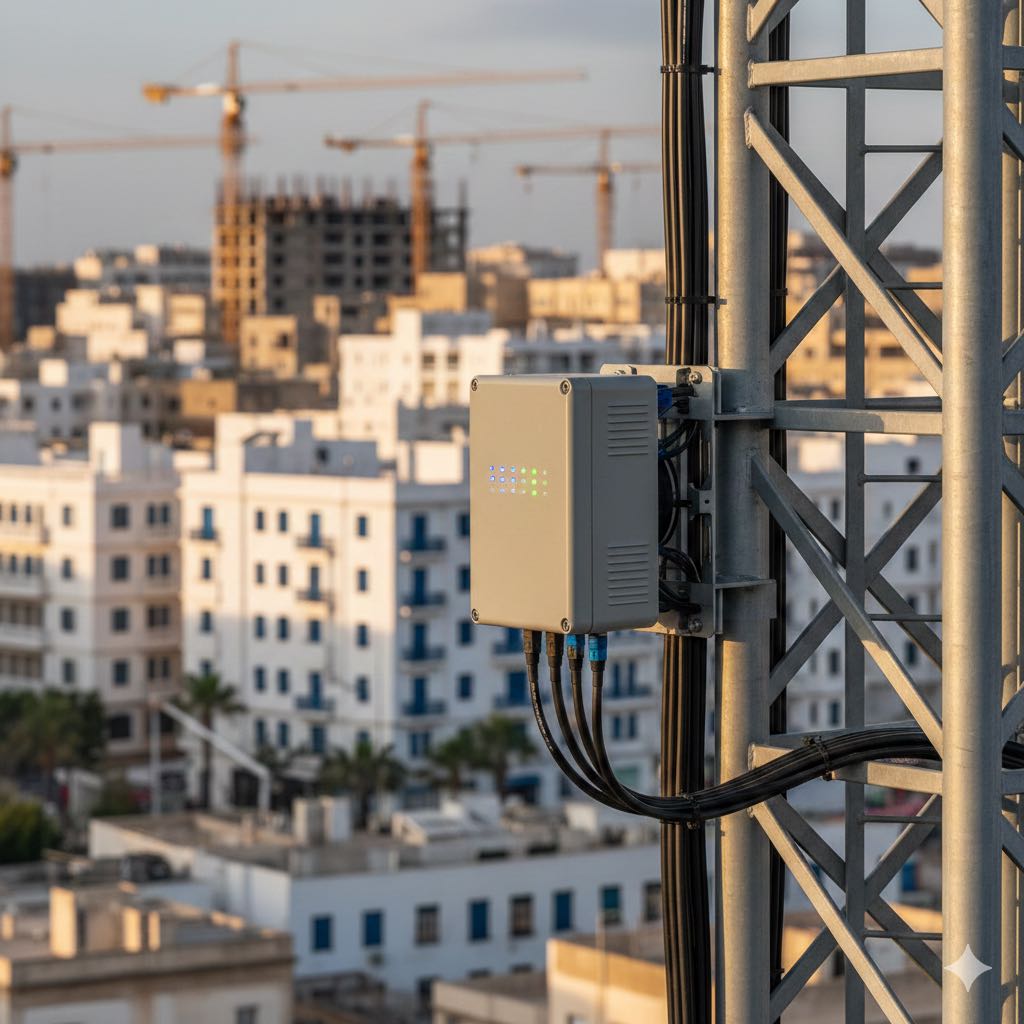
For decades, computing followed a centralizing logic: data flowed from where it was generated to distant data centers for processing. That model is breaking down. Edge computing — processing data at or near the point of generation — is becoming the architecture of choice for real-time applications: industrial automation, smart city management, connected healthcare, and autonomous systems.
In Algeria, this shift is arriving at a pivotal moment. The country launched commercial 5G in December 2025, is rapidly expanding fiber infrastructure, and has committed to sweeping digital transformation through the “Connected Algeria” strategy. The convergence of 5G, IoT, and edge computing creates a window of opportunity that could reshape how Algerian industry, agriculture, and government operate.
Algeria’s Edge Computing Market: Growth Numbers
Algeria’s edge data center market was valued at approximately $9.54 million USD in 2025. Analysts at DC Market Insights project it will reach $36.65 million by 2035, a compound annual growth rate (CAGR) of 14.26% — one of the highest in the region.
Three forces are driving this growth:
5G deployment. Algeria’s commercial 5G launch is the single most important catalyst. 5G networks are architected around Multi-Access Edge Computing (MEC) — processing nodes at base stations that deliver sub-10-millisecond latency. Without 5G, edge computing remains theoretical. With it, a new class of real-time applications becomes feasible.
Industrial IoT demand. Expanding industrial zones are generating massive volumes of sensor and machine data that cannot be efficiently routed to distant cloud servers. Local edge processing is the practical answer.
Data sovereignty requirements. A December 2024 law requires all online media and e-government services to use local “.dz” hosting. Combined with Law 18-07 on personal data protection, these regulations make edge nodes within Algerian territory a compliance-by-design architecture for government and industrial IoT deployments.
The 5G Foundation: What Changed in 2025
Algeria’s 5G rollout was not simply a speed upgrade from 4G. It represented a structural change in network architecture with direct implications for computing.
In July 2025, Algeria’s regulator awarded 5G licenses to the three mobile operators — Mobilis, Djezzy, and Ooredoo — raising 63.9 billion DZD in spectrum auctions. Commercial 5G services launched in early December 2025, with initial deployments in prioritized cities under a six-year national rollout plan.
Key 5G capabilities enabling edge computing include:
- Network slicing: Virtual dedicated networks within 5G infrastructure, giving industrial operators guaranteed bandwidth and latency for IoT traffic.
- Ultra-Reliable Low Latency Communication (URLLC): Designed for mission-critical applications requiring latency below 1 millisecond — industrial robotics, remote diagnostics, autonomous systems.
- Massive Machine-Type Communications (mMTC): Support for up to one million connected devices per square kilometer, enabling dense IoT sensor deployments in factories, farms, and cities.
The government has identified smart cities, Industry 4.0, digital health, and smart mobility as priority 5G verticals — all of which are simultaneously core edge computing domains.
Backbone and Fiber: The Physical Foundation
5G and edge computing require a robust physical backbone, and Algeria has been investing heavily.
In February 2025, Algérie Télécom and Huawei completed a 400 Gbps WDM all-optical national backbone — the high-bandwidth, low-latency core network that edge services depend on.
On the last-mile front, Algeria’s fiber-to-the-home (FTTH) rollout has accelerated rapidly. By mid-2025, approximately 2.25 million homes had fiber connections. By February 2026, that figure surpassed 3 million homes, representing 33.7% of broadband subscribers. Officials have stated the goal of reaching near-universal fiber coverage by 2027.
Advertisement
Data Centers: Building Onshore Compute Capacity
Edge computing does not eliminate the need for centralized facilities — it complements them. Algeria is expanding both.
In March 2023, Algérie Télécom inaugurated a new data center in Constantine with cloud platforms for enterprise data, expanding onshore compute capacity that can support future edge services.
In March 2025, the government broke ground on an AI research data center in Oran, intended to serve startups and academia. While focused on AI workloads, this facility represents the kind of distributed infrastructure that edge computing ecosystems need.
Meanwhile, Algeria’s cloud regulatory environment is evolving. ARPCE, the telecom regulator, now authorizes Algerian companies to offer public cloud services — firms like Issal, Ayrade, eBS, and ADEX Cloud. A digital trust law approved in November 2025 gives legal validity to electronic signatures and documents and establishes a national digital identity system linked to biometric ID cards — a foundational enabler for IoT services requiring authenticated device-to-government communication.
IoT in Action: The Guenzet Smart Village
The clearest example of Algeria’s IoT ambitions in practice is the Guenzet Smart City pilot in Setif province. Launched in February 2026 by Ooredoo Algeria in partnership with local firm DEO Electronique and Setif authorities, the project deploys IoT sensors to manage street lighting, building climate control, and school attendance — all coordinated from a central control room.
Ooredoo has framed Guenzet as one of the first projects tied to Algeria’s 5G rollout, aimed at demonstrating how connected sensors and edge processing can improve municipal services in smaller cities. If the pilot proves replicable, it offers a template for scaling smart city capabilities to Algeria’s secondary and tertiary urban centers.
Industrial IoT: The Biggest Economic Opportunity
Algeria’s industrial base — petrochemicals, steel, cement, food processing — represents the most economically significant edge computing opportunity. Industrial IoT (IIoT) sensors monitoring vibration, temperature, pressure, and flow, with edge nodes performing real-time anomaly detection, can predict equipment failures before they happen.
For a company like Sonatrach, which operates an enormous infrastructure of wellheads, pipelines, and processing facilities, predictive maintenance powered by edge computing could dramatically reduce unplanned downtime and extend equipment lifespan. Similarly, smart manufacturing facilities benefit from connected machine tools and quality inspection cameras generating data streams that edge nodes process locally for real-time quality control.
The government’s “Connected Algeria” strategy explicitly calls for accelerating AI and IoT adoption in energy, agriculture, healthcare, and manufacturing — signaling that policy support exists for these deployments.
Challenges Ahead
Despite momentum, significant obstacles remain.
Connectivity gaps. About 24.5% of Algerians live in rural areas with limited high-speed connectivity. Edge computing’s promise in agriculture and regional industry depends on closing this gap, which requires sustained investment that may not generate commercial returns on a telecom operator’s timeline.
Regulatory pace. U.S. trade analysts describe Algeria’s regulatory environment as slow to adapt to new digital trends. Streamlining approvals for IoT deployments and smart city experimentation would accelerate adoption.
Skills gaps. Edge computing is a specialized domain combining networking, systems programming, real-time computing, and domain expertise. Algeria’s engineering universities produce strong graduates, but curriculum development needs to incorporate edge-specific competencies. Industry surveys indicate relatively few Algerian engineers currently specialize in DevOps and site reliability engineering — skills closely related to edge infrastructure management.
Affordability. While fiber rollout is extensive, the cost of fixed broadband remains slightly above the ITU’s recommended 2% of income threshold, potentially limiting adoption among smaller businesses and rural users.
Conclusion
Algeria stands at an infrastructure inflection point. The 5G foundation is laid. Fiber is reaching millions of homes. Data centers are being built. IoT pilots are running. The regulatory framework for digital trust and data sovereignty is taking shape.
The question now is execution speed — whether operators, enterprises, and entrepreneurs can move quickly enough to build on this foundation before the global technology landscape shifts again. The Guenzet pilot, the Oran AI data center, the 400G backbone, and the 3-million-home fiber milestone are not aspirational targets. They are accomplished facts. What Algeria builds on top of them in the next three years will determine whether edge computing becomes a real driver of industrial competitiveness or remains a promising concept discussed at conferences.
Advertisement
Decision Radar
| Dimension | Assessment |
|---|---|
| Relevance for Algeria | High — Edge computing is directly tied to Algeria’s active 5G rollout and industrial modernization agenda, with live pilots and infrastructure already deployed. |
| Action Timeline | 6-12 months — The infrastructure foundations (5G, fiber, data centers) are in place. Organizations should begin scoping edge-enabled applications and IoT pilots now. |
| Key Stakeholders | CTOs and IT directors in industrial enterprises (oil & gas, manufacturing, utilities), telecom operators (Mobilis, Djezzy, Ooredoo), Ministry of Post & Telecommunications, municipal governments planning smart city initiatives, IoT startups, university engineering departments |
| Decision Type | Strategic — This is an architectural decision about where to process data that will shape IT investments for the next decade. |
| Priority Level | High — The convergence of 5G, fiber expansion, and regulatory support creates a narrow window where early movers can establish edge computing capabilities before competitors. |
Sources & Further Reading
- Algeria Edge Data Center Market Report 2035 — DC Market Insights
- Algeria to Get 5G as Mobilis, Djezzy and Ooredoo Commence Rollouts — Developing Telecoms
- Algeria Officially Launches 5G Network — TechAfrica News
- Algeria’s 5G Launch — Xinhua
- 400G WDM National Backbone — Huawei
- Algeria Hits 3 Million Fiber Homes — Ecofin Agency
- Algerie Telecom Data Center in Constantine — Data Center Dynamics
- AI Data Center in Oran — Data Center Dynamics
- Algeria Updates Digital Trust and e-ID Law — Ecofin Agency
- Guenzet Smart City Pilot — DZWatch
- Algeria Digital Economy Overview — U.S. International Trade Administration
- Cloud and DevOps in Algeria — State of Software Engineering
- Connected Algeria Strategy Portal





Advertisement