

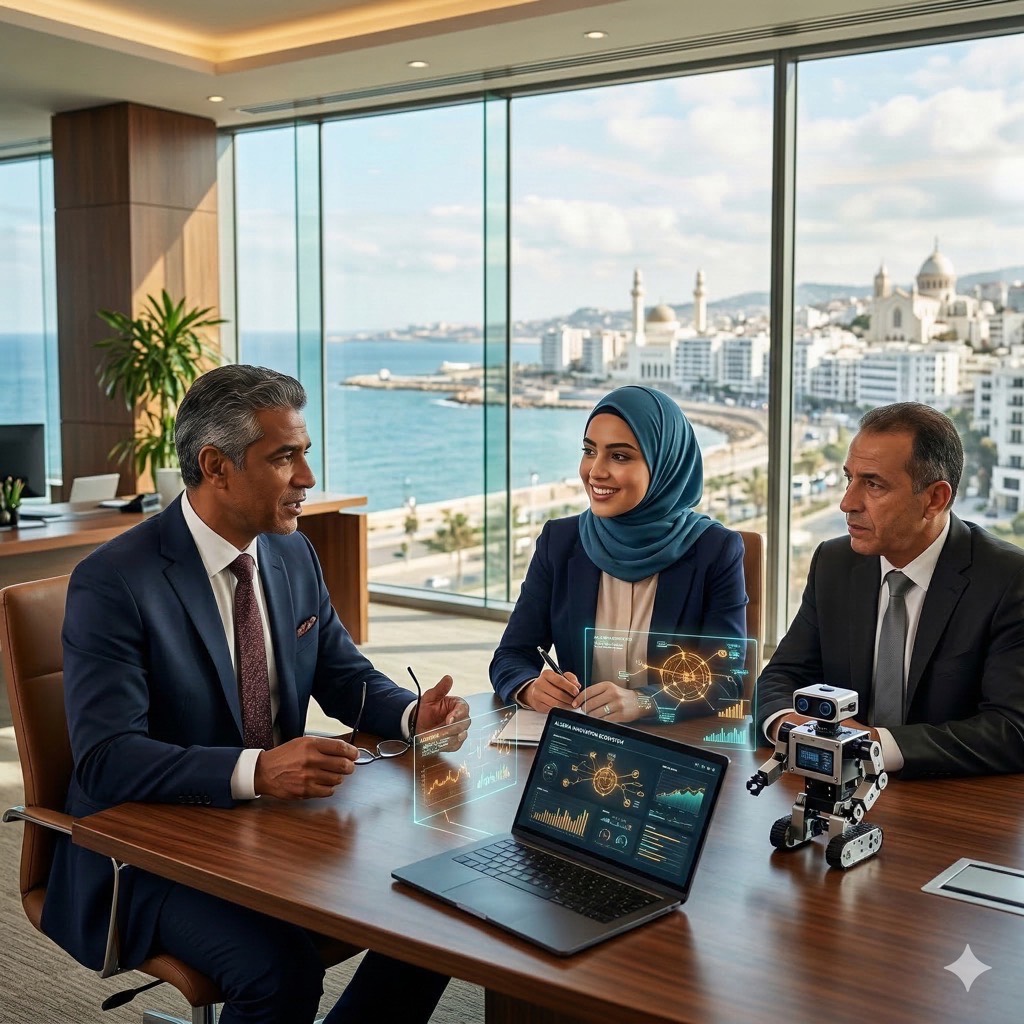
📚 Part of the Open Innovation in Algeria series — the complete framework for corporate-startup-university collaboration.
Algeria’s largest corporations control the economy. Sonatrach generates 97% of the country’s foreign currency revenue. State-owned banks hold 90% of commercial banking deposits. Mobilis and Djezzy alone serve approximately 40 million of the country’s 54.8 million mobile subscribers. When these companies innovate, the effects ripple across every sector. When they don’t, the entire economy stalls.
For decades, they didn’t. Corporate R&D in Algeria meant internal labs, closed processes, and technology purchased from foreign vendors. But between 2023 and 2026, something shifted. A convergence of regulatory reform, a maturing startup ecosystem of 2,300+ labeled companies, and competitive pressure from regional peers has pushed Algeria’s corporate giants toward open innovation — the practice of sourcing ideas, technology, and talent from outside the organization.
This shift is not theoretical. Djezzy runs challenge-based programs that put startups in front of real business problems. Algerie Telecom committed 1.5 billion DZD ($11 million) to an AI investment fund. Sonatrach signed international R&D partnerships for green hydrogen. Banks are becoming venture clients of fintech startups under a newly completed regulatory framework.
But activity is not the same as results. Algeria’s corporate open innovation ecosystem is long on programs and short on procurement conversions. The gap between a hackathon demo and a signed pilot contract remains the system’s critical failure point.
This article maps how Algeria’s corporations are practicing open innovation today — the models they use, the sectors leading the charge, the pipeline that feeds them, and the human capital bottleneck that threatens to undermine everything.
Three Models of Corporate Open Innovation
Algeria’s corporations have not adopted a single open innovation playbook. Instead, three distinct models have emerged, each suited to different corporate cultures and strategic objectives.
Model 1: Challenge-Based (Djezzy)
Djezzy pioneered the challenge-based approach through its partnership with the Algeria Startup Challenge. The Impact Challenge and TECH INNOV hackathon (November 20-22, 2025) present specific business problems — network optimization, customer experience, IoT applications — and invite startups to compete for solutions.
The model is fast and visible. The 7th edition of ASC attracted teams from 39 wilayas. Djezzy’s TECH INNOV, held in partnership with ANVREDET and the Ministry of Higher Education, focused on 5G, AI, and IoT with 9 finalist teams and prizes ranging from 200,000 to 700,000 DZD. Partners BNP Paribas El Djazair, FADERCO, and CASH Assurances each brought their own problem statements.
The limitation is conversion. Prize money of $1,500-$5,200 signals recognition, not commercial intent. The gap between winning a challenge and signing a $50,000+ pilot contract remains wide. Challenge-based innovation works best as a scouting mechanism — identifying promising startups — but it needs a procurement pathway to produce real business outcomes. Corporate AI Open Innovation examines the three flagship models in detail, including how Djezzy’s approach compares to international venture clienting standards.
Model 2: Fund-Based (Algerie Telecom)
Algerie Telecom took a different route: direct capital commitment. The 1.5 billion DZD ($11 million) AI investment fund, unveiled by Minister of Post and Telecommunications Sid Ali Zerrouki at CTO Forum Algeria, targets AI, cybersecurity, and robotics startups. The company also built Skills Centers in Setif, Annaba, and Oran in partnership with local universities (Setif-1, Setif-2) and CREA.
The fund-based model is slower but more structural. It creates a permanent institutional mechanism for evaluating and funding innovation, rather than relying on annual events. The risk is that internal bureaucracy slows deployment — a fund without deal flow and fast decision-making becomes a dormant budget line.
Model 3: International R&D Partnership (Sonatrach)
Sonatrach’s approach reflects its scale and the technical complexity of its challenges. The MoU with Spain’s Cepsa for green hydrogen R&D (signed October 2024 at the Oran Convention Center) targets an integrated hydrogen production project including electrolysis plants, solar and wind facilities, and methanol or green ammonia production for the European market. The Sonelgaz-GE Power $3 billion deal covering 11 GW of power infrastructure and the China-Algeria Joint AI Lab (MoU signed July 18, 2023, ENSIA-hosted) follow the same logic: partner with global technology leaders on problems too large for startups alone.
This model delivers deep technical capability but limited ecosystem spillover. A Sonatrach-Cepsa partnership creates knowledge within the joint venture; it doesn’t create 50 new startups. Energy and Oil & Gas Open Innovation makes the case that Sonatrach needs to complement these mega-partnerships with a startup-facing venture fund and open innovation challenges — the way Saudi Aramco’s Wa’ed Ventures ($500 million fund, 75+ companies) and ADNOC’s AI contracts ($920 million) combine both tracks.
Which Model Wins?
None of them, in isolation. The research is clear: the most effective corporate innovation programs combine scouting (challenges), investment (funds), and deep R&D (partnerships) into a unified pipeline. Algeria’s three biggest innovators have each chosen one piece. The real innovation would be combining all three.
Sector Deep Dives: Where Corporate Innovation Is Happening
Energy: The $50 Billion Question
Sonatrach’s $50 billion investment plan (2024-2028) allocates $36 billion to exploration and production. The question is whether even a fraction of the remaining $14 billion will flow toward open innovation.
The benchmarks are sobering. Saudi Aramco has invested $7.5 billion through Aramco Ventures, including Wa’ed Ventures’ $500 million dedicated to the Saudi startup ecosystem. ADNOC awarded a $920 million EPC contract in November 2024 to extend its AI-powered well digitalization program to over 2,000 wells. Equinor has committed $750 million in energy ventures, with 70% directed toward renewables. Petrobras operates CENPES, a 300,000 square meter research campus with 800+ external partnerships and 73 active startup projects.
Sonatrach has its CRD Boumerdes research center and a handful of international MoUs. The gap is not capability — Sonatrach employs over 53,000 people directly and more than 150,000 across its 154 subsidiaries. The gap is architecture. There is no Sonatrach Ventures fund, no structured challenge program, no technology scouting unit with procurement authority.
The proposed remedy — a $50-100 million open innovation fund over five years, representing just 0.1-0.2% of the total investment plan — would be transformational not just for Sonatrach but for the entire Algerian innovation ecosystem. Every startup working on predictive maintenance, pipeline monitoring, solar optimization, or CCS technology would suddenly have a credible first customer. The full energy sector analysis details what this fund could look like and which technology domains should be prioritized.
Banking and Fintech: The Venture Clienting Frontier
Algeria’s banking sector is undergoing its most significant regulatory transformation in decades. Three pieces of legislation — Law 23-09 (June 2023), Instruction 06-2025 (August 2025), and Regulation 24-04 (October 2024) — have created a complete framework for digital banking, payment service providers, and fintech licensing.
The effect on corporate innovation is direct. Banks can now legally become venture clients of fintech startups — buying solutions for digital wallets, BNPL, fraud detection, and KYC automation rather than building internally. The three-tier digital wallet system (limits of approximately $740, $3,700, and $7,400) creates a structured market that startups can build products for.
Early signals are promising. Algeria’s mobile payment ecosystem processed 12.5 million transactions in Q1 2024, a 71% surge from 7.6 million in Q1 2023, with transaction values exceeding 9.3 billion DZD (GIE Monétique data). Yinvesti received Algeria’s first crowdfunding license from COSOB in March 2025. The FCPR framework allows banks to be both venture client and venture investor in the same startup — buying the product while holding equity.
State-owned banks controlling 90% of the market means that a handful of innovation decisions by BNA, BDL, BEA, and CPA could reshape the entire sector. The proposal to allocate 15% of state bank IT budgets to fintech partnerships — roughly $150-200 million annually — would create the largest single source of startup revenue in Algeria. Fintech Open Innovation and Venture Clienting provides the complete regulatory map and implementation framework for banks ready to act.
The Pipeline: From Hackathon to Procurement
Corporate open innovation doesn’t start with a board decision. It starts with a hackathon participant building a prototype over a weekend, an incubated startup landing its first pilot, or a university researcher filing a patent. The pipeline that connects these raw inputs to corporate procurement is where Algeria’s system breaks down.
The Volume Is There
Algeria hosts hundreds of innovation events annually. The Algeria Startup Challenge alone spans 39 wilayas across 5 programs. The National Vocational Formation Hackathon (February 2026) drew 447 participants in 41 teams from 37 wilayas. Djezzy’s TECH INNOV, Algeria 2.0, Injaz El Djazair’s Young Entrepreneurs Competition, and university hackathons at USTHB, ESI, and ENP add thousands more participants.
The platform startup.dz lists 7,800+ startups, of which 2,300+ have earned the government startup label. The Algerian Startup Fund has funded 139 companies across 20 sectors and 22 provinces from over 350 applications reviewed, achieving its first exit when VOLZ raised a $5 million Series A at a 3.35x return in December 2025.
The Conversion Rate Is Catastrophic
From the approximately 2,000 projects that reach finals annually, roughly 500 teams make it to finalist stage. Of those, an estimated 20-30 incorporate within 12 months. Of those, perhaps 5-10 generate meaningful revenue within 24 months. That’s a conversion rate well below 1%.
The problem is not talent or ideas — it’s plumbing. There is no automatic pathway from winning a corporate challenge to receiving a pilot contract. There is no standard fast-track procurement process for innovation purchases. Corporate sponsors budget for event marketing, not for product testing.
CB Insights data shows that 60% of corporate accelerators globally fail within two years, with only 14% doing more activity after two years than at launch. Stryber’s research found that startups joining corporate accelerators had an 8% success rate versus an 11% baseline for those that didn’t — though the firm notes the dataset is limited. The global evidence confirms what Algeria’s numbers suggest: accelerators without procurement reform are net negative for startups.
Hackathons as Open Innovation provides the full diagnostic, including how Singapore’s Smart Nation program ($2.4 billion government investment) and France’s Station F (1,000+ startups, alumni including Hugging Face at $4.5 billion) achieve dramatically better conversion rates. Corporate Accelerator Programs offers the remedy: a four-level maturity framework from Innovation Scouting to Corporate Venture Capital, with the venture client model as the critical middle step.
The Procurement Fix
The single most impactful reform would be a fast-track innovation procurement pathway: 30 days from application to contract for innovation pilots under $200,000. Public procurement accounts for 20% of Algeria’s GDP. Even a small carve-out for innovation purchases would redirect billions of dinars toward startups.
Until that reform happens, the corporate open innovation pipeline will continue to leak between the hackathon stage door and the procurement department.
Advertisement
The Missing Operating System: Innovation Managers
Every corporate open innovation program described in this article assumes someone will design it, run it, and evaluate it. Djezzy’s challenges need someone to define problem statements, evaluate solutions, and structure pilot contracts. AT’s fund needs deal sourcing, due diligence, and portfolio management. Sonatrach’s partnerships need internal champions who understand both the corporate bureaucracy and the startup ecosystem.
That person is the innovation manager — and Algeria has almost none of them.
A 2020 survey of 138 researchers at the University of Biskra found near-zero formal industry linkages. Algerian universities offer 57,702 students places in 74 AI master’s programs, but zero programs in innovation management. Samsung Innovation Campus and Huawei ICT Academy train thousands in technical skills but not in ecosystem bridging — the ability to translate corporate needs into startup opportunities and vice versa.
International benchmarks show what’s possible. Siemens employs dedicated innovation managers who spend their entire careers connecting the company’s business units with external technology. Samsung NEXT operates as a venture arm with innovation professionals who speak both corporate and startup. Shell GameChanger has funded over 3,000 ideas and invested $350 million over three decades through a team of trained innovation scouts.
The 30% R&D tax deduction (capped at 200 million DZD under Article 171 of the Direct Taxes Code) can fund these roles. A “Head of Innovation” position at Sonatrach, Djezzy, or BNA would cost a fraction of the existing event budgets while delivering orders of magnitude more conversion.
The Innovation Manager: Algeria’s Most Needed Career provides the full career architecture, training pathways, and policy recommendations for creating this profession from scratch.
The Corporate Innovation Maturity Framework
Where do Algeria’s corporations actually sit? A four-level maturity model helps clarify the landscape and identify the next step for each company.
Level 1: Innovation Scouting (Most Algerian Corporations)
Activities: Sponsoring hackathons, attending startup events, sending executives to conferences.
Output: Awareness of the startup ecosystem, PR value, employee engagement.
Conversion to business outcomes: Near zero.
Who’s here: Most Algerian companies, including Mobilis (43.7% mobile market share, 5G trials achieving 1.2 Gbps, but no structured startup engagement).
Level 2: Innovation Challenges with Teeth
Activities: Structured problem statements, paid pilots for winners, defined procurement pathway.
Output: 3-5 tested solutions per year, some converted to vendor contracts.
Conversion to business outcomes: Moderate.
Who’s here: Djezzy (moving toward this level with TECH INNOV and Impact Challenge, but prizes still outweigh pilot contracts).
Level 3: Venture Client Unit
Activities: Dedicated team with budget and procurement authority, systematic startup scouting, standard pilot-to-contract process.
Output: 10-20 startup partnerships per year, measurable operational improvements.
Conversion to business outcomes: High.
Who’s here: No Algerian corporation has reached this level. Internationally: BMW Startup Garage, Bosch Open Innovation, 27pilots clients.
Level 4: Corporate Venture Capital
Activities: Equity investments in startups, strategic portfolio aligned with corporate roadmap.
Output: Financial returns plus strategic technology access.
Conversion to business outcomes: Very high (financial + strategic).
Who’s here: Algerie Telecom’s AI fund signals intent but hasn’t fully deployed. Internationally: Aramco Ventures ($7.5 billion total), GV (Google Ventures), Intel Capital.
The honest assessment: Algeria’s corporate innovation ecosystem is between Level 1 and Level 2. The infrastructure exists to reach Level 3 within 18-24 months — if procurement reform, innovation manager hiring, and outcome-based metrics replace the current event-driven model.
The Convergence Moment
Several forces are converging in 2026 that create a narrow window for acceleration:
Regulatory completeness. The startup labeling system, R&D tax deduction, FCPR fund framework, fintech licensing, and digital wallet regulations are all in place. For the first time, the legal infrastructure is ahead of corporate execution.
Ecosystem density. With 2,300+ labeled startups, 60+ innovation hubs (up from 14 three years ago), 124 active university incubators engaging 60,000 students, and the AOIP platform matching 500+ startups with corporate needs, there is enough supply to sustain serious corporate demand.
Competitive pressure. Global Africa Tech 2026 (March 28-30, Algiers) will convene 5,000 decision-makers including 50+ ministers, and the Africa ICT Summit 2026 (April 21-23) follows immediately after. Companies that show up without a structured innovation program will notice the gap.
The National AI Strategy (adopted December 2024) targets AI contributing 7% of GDP by 2027. Hitting that target requires corporate adoption of AI at scale — which requires exactly the open innovation mechanisms described here.
Algeria’s AI market is projected to grow from $498.9 million in 2025 to $1.69 billion by 2030 (27.67% CAGR, Statista). The companies that build innovation pipelines now will capture the partnerships and talent that fuel this growth. Those that wait will be licensing yesterday’s technology from tomorrow’s competitors.
What Needs to Happen Next
For Corporations
- Hire an innovation manager. Not as a side project for an existing executive — as a dedicated, senior role with budget authority and direct C-suite reporting. The R&D tax deduction can fund it.
- Move from events to procurement. Budget hackathon spending under R&D, not marketing. Mandate that every challenge winner receives at minimum a paid pilot opportunity.
- Set outcome metrics. Track pilots completed, procurement conversions, and revenue generated — not applications received, attendees hosted, or press mentions earned.
For Government
- Create fast-track innovation procurement. 30 days from application to contract for innovation pilots under $200,000. This single reform would transform the entire ecosystem.
- Mandate innovation reporting. Require state-owned enterprises to publish annual innovation reports covering external partnerships, startup pilots, and R&D spending on open innovation.
- Fund the AOIP matching platform properly. With 500+ registered startups and 200+ ecosystem actors across 8 industry verticals, AOIP is the infrastructure for corporate-startup matching — but it needs full-time staff and corporate engagement mandates.
For Startups
- Target the three entry points. Djezzy’s challenges, AT’s fund, and Sonatrach’s R&D partnerships are the three proven pathways to corporate revenue. Build solutions that fit their published problem statements.
- Document everything. Corporations need case studies, ROI projections, and pilot results to justify procurement. The startup that makes the business case easiest wins the contract.
- Build for procurement, not prizes. A $5,000 hackathon prize is marketing. A $50,000 pilot contract is revenue. Optimize for the second.
Advertisement
🧭 Decision Radar
| Dimension | Assessment |
|---|---|
| Relevance for Algeria | High — corporate adoption is the bottleneck between Algeria’s startup ecosystem and economic impact |
| Action Timeline | Immediate — regulatory framework is complete, Global Africa Tech 2026 creates urgency |
| Key Stakeholders | CEOs and CTOs of SOEs (Sonatrach, Sonelgaz, AT, banks), Ministry of Knowledge Economy, AOIP, innovation managers (once they exist) |
| Decision Type | Strategic — requires organizational architecture changes, not just program launches |
| Priority Level | Critical — without corporate conversion, Algeria’s 2,300+ labeled startups remain a pipeline to nowhere |
Quick Take: Algeria has built the startup supply side — labeling, funding, hubs, and regulatory frameworks are all in place. The missing piece is corporate demand. Every large Algerian company should hire a dedicated innovation manager, convert at least one hackathon winner into a paid pilot this year, and measure open innovation by procurement conversions, not event attendance. The window is open now; the companies that move first will lock in the best startup partnerships.
Sources & Further Reading
- Algerian Open Innovation Program (AOIP) — Hadina Tech
- Algeria Startup Challenge — 7th Edition
- Aramco Raises Venture Capital to $7.5B — Rigzone
- ADNOC Awards $920M AI Well Digitalization Contract — ADNOC
- Algerie Telecom Establishes $11M AI Fund — WAYA Media
- Sonatrach $50B Investment Plan 2024-2028 — APS
- Sonatrach-Cepsa Green Hydrogen MoU — Hydrogen Central
- VOLZ Raises $5M — First ASF Exit — Launch Base Africa
- Why 60% of Corporate Accelerators Fail — CB Insights
- Shell GameChanger — Shell Global
- Global Africa Tech 2026 — Official Registration
🔗 Related Intelligence

Open Innovation in Algeria: The Complete Framework for Corporate-Startup-University Collaboration

From the Sahara to the Plate: How Open Innovation Could Transform Algeria’s Agriculture

Beyond the Demo Day: Why Algeria’s Corporate Accelerators Need to Graduate from Theater to Pipeline
Hackathons as Open Innovation: Are Algeria’s Hundreds of Annual Events Producing Real Ventures or Just PR?







Advertisement