Algeria sits on one of the planet’s most extraordinary clean energy endowments. The Sahara receives over 3,000 hours of sunshine per year, with solar irradiance reaching 2,263 kWh/m2 annually in southern regions — levels that dwarf what most European countries can achieve. The country’s freshwater reserves are shrinking dangerously, with per-capita availability dropping below 300 cubic meters per year. Its cities generate over 13 million tonnes of municipal waste annually, with less than 10% recycled. And its population — young, urbanizing, increasingly digital — is waking up to the reality that hydrocarbons will not fund the future forever.
These are not just environmental statistics. They are market signals. And a growing cohort of Algerian startups is reading them clearly, building businesses around solar energy, waste valorization, and water technology. The cleantech wave in Algeria is still early — fragile, underfunded, and battling structural headwinds — but it is no longer theoretical.
This article maps the emerging cleantech startup landscape in Algeria, examines the sectors where founders are placing their bets, and asks why — despite having some of the best natural advantages on the continent — Algeria’s cleantech ecosystem still lags behind its North African neighbors.
The Solar Opportunity: Too Obvious to Ignore, Too Complex to Execute
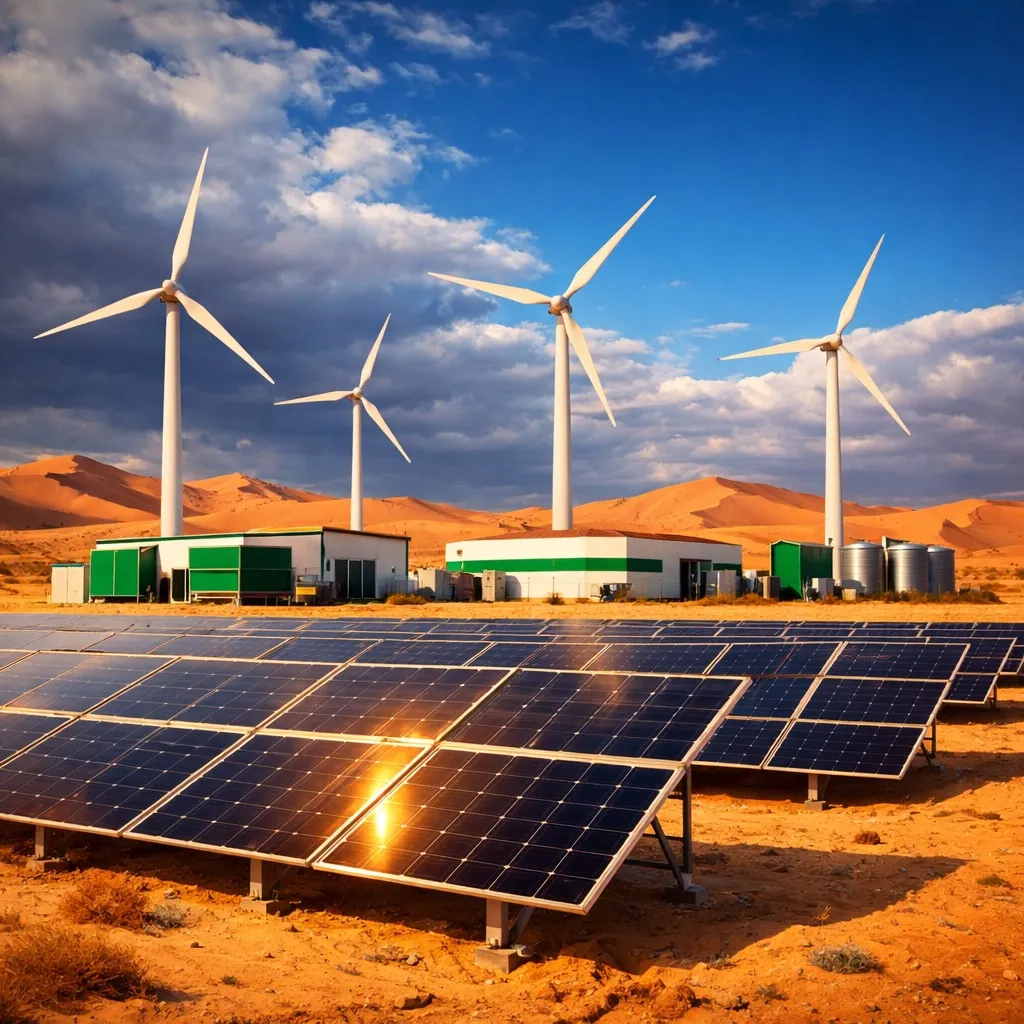
Algeria’s solar potential is almost absurdly large. The country’s irradiance ranges from 1,700 kWh/m2 per year in the north to over 2,263 kWh/m2 in the Saharan south — among the highest levels on Earth. The government has recognized this, at least on paper. Algeria’s national renewable energy program, revised multiple times since its 2011 launch, now targets 15 GW of renewable capacity by 2035, with solar photovoltaic (PV) dominating the mix. The goal is to generate 27% of electricity from renewables by that date.
The institutional framework exists. The Renewable Energy and Energy Efficiency Commission (CEREFE), created in 2019, publishes annual reviews tracking progress — its fourth report covered achievements from 2020 to 2023. The Electricity and Gas Regulation Commission (CREG) manages licensing, tariffs, and procurement for renewable projects, including feed-in tariffs for grid-connected installations above 1 MW under 20-year power purchase agreements.
But between national targets and startup execution lies a gap the size of the Sahara itself. As of late 2023, Algeria had only about 437 MW of installed solar capacity. Major tenders totaling 3 GW were awarded in 2024, and 1.48 GW is expected to be commissioned by mid-2026 — but most of this capacity is being built by large consortiums (Chinese state-owned companies, Turkish firms, and established Algerian groups), not startups.
Where Solar Startups Are Operating
The solar startup ecosystem in Algeria can be roughly divided into three segments.
Installation and system integration. The largest cohort of solar startups focuses on designing and installing PV systems for residential, commercial, and agricultural clients. Established Algerian companies like Amimer Energie — which won a 150 MW allocation in the 2024 national solar tender using JinkoSolar TOPCon modules — and Condor Electronics’ solar division have built businesses around turnkey solar installations and utility-scale projects. Smaller firms, often founded by electrical engineers returning from stints abroad, offer off-grid solutions for farms, telecommunications towers, and remote communities in the south.
Component manufacturing. Algeria has built meaningful solar manufacturing capacity. The country currently has about 500 MW of annual solar module assembly capacity across several manufacturers — Zergoun’s factory in Ouargla (200 MW), Lagua Solaire (200 MW), and Milltech in Mila (100 MW) — with targets to reach 600-700 MW by end of 2025. Solar cable manufacturers produce 1,250 km annually, and metal structure makers supply roughly 800 MW of capacity. A 2022 policy change abolished the “51/49” foreign ownership rule for renewable projects, and a local content incentive grants a 25% cost bonus per watt for projects sourcing more than 35% of materials domestically. However, imported Chinese panels remain cheaper than locally assembled modules, pushing some startups to pivot toward value-added services — maintenance contracts, monitoring software, custom configurations.
Off-grid and distributed energy. Perhaps the most promising segment for startups is off-grid solar, targeting Algeria’s southern and highland regions where grid connectivity is unreliable or nonexistent. Solar-powered water pumping for agriculture, solar street lighting for municipalities, and solar kits for nomadic and semi-nomadic communities represent real market demand. Most ventures in this segment remain small and bootstrapped, but the opportunity is genuine — Algeria’s southern territories are vast, and grid extension is prohibitively expensive.
The Fossil Fuel Paradox
The single biggest barrier to solar startup growth in Algeria is, paradoxically, the country’s existing energy wealth. Algeria subsidizes electricity heavily. Residential electricity prices average about 5.65 DZD per kWh (roughly USD 0.043 as of mid-2025) — only 26% of the world average and 34% of the African average, according to GlobalPetrolPrices data. Sonelgaz, the national utility, absorbs subsidy-driven losses that constrain its own investment capacity.
When grid electricity costs almost nothing, the economic case for rooftop solar collapses. A homeowner paying minimal monthly electricity bills has no incentive to invest hundreds of thousands of dinars in a solar installation that might take decades to pay back. The return on investment calculation that drives solar adoption in Europe, the Gulf, and even Morocco simply does not work in Algeria at current subsidy levels.
This creates a structural disadvantage for solar startups. Their addressable market is artificially compressed — limited to off-grid applications, export-oriented businesses, and the small segment of commercial users consuming enough electricity to face higher-tier pricing.
Until energy subsidy reform happens — a politically explosive topic in Algeria — solar startups will continue to operate in market niches rather than at mass-market scale.
Waste Management: The Crisis Nobody Can Ignore
If solar suffers from a subsidy problem, waste management suffers from a crisis problem — and crises, however unfortunate, create markets.
Algeria generates roughly 13.5 million tonnes of household waste per year, according to the National Waste Agency (AND). Less than 10% is recycled. Roughly 1,300 illegal dump sites have been identified and targeted for progressive closure. The rest of the waste goes to landfills — many of them poorly managed — contaminating groundwater, generating methane, and creating public health hazards.
Algerian cities are growing, consumption patterns are shifting toward packaged goods, and the waste infrastructure built in the 2000s is already overwhelmed. A significant policy shift came in February 2025 with Law 25-02, which amended the foundational Law 01-19 (2001) on waste management. The new law explicitly recognizes waste as an economic resource rather than solely an environmental burden, and formally establishes extended producer responsibility (EPR) — requiring producers, importers, and distributors to fund post-consumer recovery and recycling. The National Integrated Waste Strategy (SNGID) targets 47% valorization of household waste by 2035.
Startups Entering the Waste Space
More than 5,000 enterprises are currently active in waste-related activities across Algeria, and a new generation of startups is approaching the sector as a value chain opportunity.
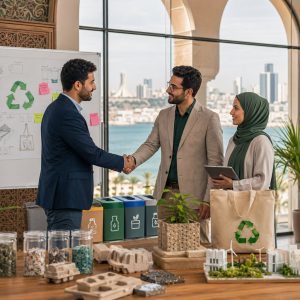
Plastic recycling and material recovery. Algeria’s plastic market is heavily import-driven — the country imported over 900 kilotonnes of plastics in 2020, up from 304 kilotonnes in 2007. Yet post-consumer recovery rates remain low. Plasticycle, a startup founded in 2011 in Constantine by Belbedjaoui, collects polyethylene terephthalate (PET) waste, grinds it, washes and dries it, and sells the resulting granules to manufacturers including Accor Hotels. The company works with six corporate partners and is profitable, demonstrating that plastic recycling can work in Algeria when tied to industrial buyers. The economics improve when oil prices are high (making virgin plastic expensive) but become precarious during downturns.
Organic waste and biogas. With over 50% of Algeria’s municipal waste being organic, composting and bio-waste valorization represent an enormous untapped opportunity. GreenAl, founded by Dr. Kheira Benaissa in Algiers, develops mobile biodigester systems that convert organic household waste into combustible biogas for cooking and water pumping, plus organic fertilizer. The household kit costs about $600 and produces two hours of biogas daily. GreenAl targets isolated farming communities in southern Algeria lacking reliable energy access, and won the Emerging Mediterranean 2022 Special Prize for Female Entrepreneurship. International companies including Mitsubishi have expressed interest in partnership.
Waste-to-energy. The most capital-intensive segment remains largely aspirational in Algeria. A few pilot projects have explored biogas generation from landfill methane capture, but no startup has yet built a commercially viable large-scale waste-to-energy operation. The regulatory framework for selling electricity back to the grid remains unclear, and the capital requirements exceed what most Algerian startups can raise.
Digital waste platforms. Several startups are attempting to build platforms connecting waste generators (households, restaurants, businesses) with recyclers — borrowing from successful models in Egypt and Kenya. The challenge in Algeria is that informal waste pickers already perform much of this function; startups need to formalize and professionalize the chain without displacing existing livelihoods.
The New Regulatory Opportunity
The passage of Law 25-02 in February 2025 is potentially transformative. With EPR now formally established, there is a legal mechanism to force manufacturers to fund end-of-life collection and recycling. This could unlock entirely new revenue streams for waste-tech startups. The recoverable waste market was valued at over 200 billion DZD in 2023 according to AND data, and the new legislation should accelerate formalization of the sector.
Water Tech: Scarcity as a Startup Driver
Algeria is classified as a water-stressed country, with per-capita renewable freshwater resources estimated at 300-450 cubic meters per year — well below the 1,000 cubic meters threshold that defines absolute water scarcity according to the World Bank. The situation is worsening: climate change is reducing rainfall in the Tell Atlas, aquifer levels in the Sahara are declining, and urbanization is concentrating demand in coastal cities that already face supply constraints.
The government has invested heavily in desalination. Algeria operates some of the largest seawater reverse osmosis (SWRO) plants in Africa, with a total desalination capacity exceeding 2 million cubic meters per day across 11 large stations. The Magtaa plant near Oran — producing 500,000 m3/day and serving over five million people — is among the largest in Africa. Algeria committed $5.4 billion to expanding desalination infrastructure for long-term water security. But these are megaprojects operated by state entities and multinational firms. The startup opportunity lies not in building desalination plants but in optimizing the broader water system.
Where Water-Tech Startups Are Emerging
Smart irrigation for agriculture. Agriculture accounts for roughly 65% of Algeria’s freshwater consumption, and irrigation efficiency is low — irrigated areas expanded from 350,000 hectares in 2000 to over 1.3 million hectares in 2020, but without corresponding efficiency gains. Irigreen, an agritech company based in Setif, has developed subsurface irrigation technology (Exu) and partnered with CNIAAG (Centre National de l’Insemination Artificielle et de l’Amelioration Genetique) and INRAA (Institut National de la Recherche Agronomique d’Algerie) to pilot smart irrigation on a 2-hectare demonstration field. FarmAI, which won second prize globally at Huawei’s Tech4Good competition and secured $100,000 in investment, uses drones and AI vision systems for precision agriculture including irrigation optimization. The technology is proven globally, but adoption in Algeria requires overcoming farmer skepticism, limited rural connectivity, and the fact that irrigation water is itself subsidized.
Leak detection and network monitoring. Algeria’s urban water distribution networks lose an estimated 40-44% of treated water to leaks, theft, and metering failures, according to L’Algerienne des Eaux (ADE). This is a staggering waste in a water-scarce country. Startups building acoustic leak detection systems, pressure monitoring networks, and smart metering solutions have a clear value proposition — but their customer is typically a public water utility (ADE or SEAAL), which means navigating public procurement processes that are slow, opaque, and often biased toward large established firms.
Water quality monitoring. With industrial pollution and agricultural runoff affecting water sources across northern Algeria, there is growing demand for real-time water quality monitoring. Startups offering portable testing kits, IoT-connected sensors, and data analytics platforms are beginning to emerge, though the market remains small and fragmented.
Decentralized water treatment. For communities not connected to centralized treatment plants — particularly in Algeria’s southern wilayas — small-scale, modular water treatment units offer a practical alternative. A handful of Algerian startups are adapting containerized treatment systems for permanent community use.
Benchmarking Against Neighbors: Where Algeria Stands
Algeria’s cleantech startup ecosystem is best understood in the context of its North African peers.
Morocco has established itself as the continent’s cleantech leader. The Noor-Ouarzazate solar complex — a 582 MW facility combining concentrated solar power (CSP) and photovoltaic capacity — is a flagship project that has attracted billions in international investment. Morocco’s Agency for Sustainable Energy (MASEN), created in 2010, provides a clear institutional framework for renewable energy development. Morocco targets 52% of electricity from renewables by 2030. Moroccan cleantech startups benefit from proximity to European markets, established free trade agreements, and a regulatory environment that actively encourages private investment.
Egypt has seen a surge of waste-tech and cleantech startups, supported by a vibrant venture capital ecosystem centered on Cairo. Bekia, the waste recycling marketplace founded in 2017, has attracted over 75,000 users. Tagaddod, which converts waste cooking oil to renewable biofuel feedstock, raised $26.3 million in a Series A round in 2025. KarmSolar, founded in 2011, delivers off-grid solar solutions for agriculture. Egypt’s larger population and more developed startup financing infrastructure give it structural advantages.
Tunisia punches above its weight in cleantech innovation, particularly in water management and energy efficiency. Tunisian startups benefit from strong links to European research institutions and access to EU-funded innovation programs.
Algeria’s disadvantage is not in natural resources — it has more sun, more land, and comparable water challenges. The gap is in ecosystem infrastructure: venture capital, regulatory clarity, institutional support, and market access. Algerian cleantech startups are building in harder conditions than their Moroccan and Egyptian counterparts.
Advertisement
Government Incentives and Institutional Support
The Algerian government offers several programs relevant to cleantech startups, though their effectiveness varies.
ANADE (formerly ANSEJ/CNAC). The National Agency for Entrepreneurship Support and Development provides subsidized loans and support for young entrepreneurs, offering up to 10 million DZD (approximately $75,000) through three financing models: self-financing with tax incentives, dual financing with interest-free ANADE loans, and triple financing combining entrepreneur equity, ANADE loans, and bank debt covering up to 70% of project cost. These programs include coaching and training, but are not specifically tailored to the capital-intensive nature of cleantech ventures.
Algerian Startup Fund (ASF). With capital of 2.4 billion DZD and a portfolio of over 100 funded startups across 20 sectors, ASF provides financing at three levels: 2 million, 5 million, and up to 20 million DZD. Algeria Venture (A-Venture), the state-owned accelerator established in December 2020, complements ASF with acceleration services. However, cleantech has not been a prominent focus for either entity.
CREG feed-in tariffs. The Electricity and Gas Regulation Commission has established guaranteed purchase tariffs for renewable electricity under 20-year PPAs, but the rates have been criticized as insufficient to attract serious private investment, and the administrative process for grid connection is cumbersome.
Incubators and accelerators. Algeria’s startup incubators — including the Cyberparc of Sidi Abdellah (a 92-hectare technology park near Algiers) and various private initiatives — occasionally support cleantech projects. But there is no dedicated cleantech accelerator comparable to what exists in Morocco or Egypt.
Continental ambitions. President Tebboune announced a $1 billion continental fund for African startups at IATF 2025, managed through the Algerian Agency for International Cooperation — signaling growing institutional awareness, even if direct cleantech allocation remains unclear.
The Financing Challenge
CleanTech startups globally face a well-documented financing gap: too capital-intensive for typical venture capital, too small for project finance, and too risky for commercial bank lending. This “valley of death” is particularly deep in Algeria.
Algerian banks are conservative lenders with limited appetite for technology risk. Venture capital is nascent — the total VC deployed in Algerian startups in any given year remains a fraction of what flows into Egyptian or Moroccan ecosystems. International climate finance mechanisms (Green Climate Fund, African Development Bank facilities) are available in theory but require institutional intermediaries and project preparation capacity that Algeria’s cleantech startups generally lack.
The result is that most Algerian cleantech startups are bootstrapped or funded through family networks, limiting their ability to invest in R&D, hire talent, and scale operations. GreenAl founder Kheira Benaissa highlighted the obstacles: registration costs of approximately $1,800, bureaucratic complexity, regulatory constraints, and difficult access to funding. The few startups that have accessed institutional funding tend to be those with strong government connections or university affiliations.
What Needs to Change
For Algeria’s cleantech startup ecosystem to move from “emerging” to “established,” several structural shifts are necessary.
Energy subsidy reform. Without it, the solar market remains artificially constrained. Even a gradual, targeted reduction in electricity subsidies for commercial and industrial users would dramatically change the economics of distributed solar.
Implementation of Law 25-02. The new waste management law’s EPR provisions are transformative on paper, but success depends on implementing decrees. Clear rules around tipping fees, recycled content mandates, and simplified procedures for waste-tech licensing would unlock private investment.
Specialized financing instruments. Green bonds, climate finance facilities, and cleantech-focused venture funds tailored to the Algerian context are essential. The Algerian Startup Fund should explicitly prioritize cleantech allocations.
Market access and export orientation. Algerian cleantech startups should not only serve the domestic market but also target export opportunities — solar equipment for sub-Saharan Africa, water treatment systems for the Sahel, recycled materials for European buyers. Morocco has shown that cleantech can be an export sector, not just a domestic one.
Talent development. Algeria’s engineering universities produce capable graduates, but there are gaps in specialized cleantech skills: power electronics for solar, environmental engineering for waste, hydrogeology for water management. University-industry partnerships and cleantech-focused graduate programs would strengthen the pipeline.
The Founders Pushing Forward
Despite the headwinds, a committed cohort of Algerian founders is building cleantech businesses. They are motivated by a combination of commercial opportunity and genuine concern about Algeria’s environmental trajectory. Many have studied or worked abroad — in France, Canada, Germany, the Gulf — and returned with technical expertise and a determination to apply it at home.
Their startups are scrappy, capital-efficient, and often creative in navigating regulatory constraints. They build solar installations while lobbying for better feed-in tariffs. They launch recycling operations while advocating for EPR implementation. They develop smart irrigation systems while persuading skeptical farmers to try something new.
These founders understand something that the broader market has not yet fully priced in: Algeria’s environmental challenges are accelerating, and the gap between the scale of the problems and the capacity of existing institutions to solve them is widening. That gap is where startup opportunity lives.
Algeria’s cleantech moment is not a question of if, but when. The natural advantages are overwhelming. The market needs are urgent. The missing ingredients — capital, regulation, institutional support — are matters of policy choice, not fate.
The question for Algeria’s policymakers, investors, and ecosystem builders is simple: will they build the conditions for these startups to scale before the environmental crisis forces their hand?
Frequently Asked Questions
What is the biggest cleantech opportunity in Algeria right now?
Off-grid solar for southern and highland regions where grid connectivity is unreliable or nonexistent. Solar-powered water pumping, street lighting, and distributed energy kits face real market demand without competing against subsidized grid electricity. The 2024 tenders for 3 GW of solar capacity are also creating opportunities for local manufacturers and service providers.
Why is Algeria behind Morocco and Egypt in cleantech?
The gap is not in natural resources — Algeria has more sun and more land. The difference lies in ecosystem infrastructure: Morocco has MASEN and clear institutional frameworks, Egypt has a developed VC ecosystem, and both have clearer regulatory paths for private investment. Algeria’s heavy energy subsidies also suppress demand for renewable alternatives.
Has Algeria’s waste management regulation improved?
Significantly. Law 25-02, passed in February 2025, amended the 2001 waste management framework to formally establish extended producer responsibility (EPR) and recognize waste as an economic resource. This creates a legal basis for manufacturers to fund collection and recycling — a potential game-changer for waste-tech startups if implementing decrees follow.
Sources & Further Reading
- A Turning Point for Algerian Solar — pv magazine
- Algeria Renewable Energy — U.S. International Trade Administration
- Waste Management Landscape in Algeria: Challenges and Opportunities — EcoMENA
- Water Resources in Algeria — Fanack Water
- Green Algeria: Turning Household Waste into Electricity — Wamda
- Algeria Charts a Path for Renewable Energy Sector Development — Middle East Institute
- Algeria Commits $5.4B to Desalination for Long-Term Water Security — Energy Capital & Power
- Irigreen & CNIAAG: Pioneering Smart Irrigation in Algeria — Irigreen
- Algeria Launches $75K Funding Program for Small Businesses in 2025 — Arab Founders
- Algeria Adopts New Law to Strengthen Waste Management — Regask