The Continent That AI Left Behind — Until Now
Africa’s position in global AI is structurally paradoxical. The continent holds 18% of the world’s population, produces a growing volume of STEM graduates, and operates increasingly digitised economies in finance, agriculture, and telecommunications. Yet only 2.5% of the global AI market originates from Africa, according to Brookings Institution analysis. African AI startups received just a fraction of the continent’s $4 billion in total tech funding in 2023. The United States alone commands $250 billion in private AI funding and houses 60% of top-tier AI researchers globally.
The structural cause of this gap is not talent or demand — it is compute. Training competitive AI models, running large-scale inference, and building AI products that process the volumes of data required for enterprise deployment require GPU-grade computing infrastructure that simply has not existed on the African continent. Companies across Africa have historically depended entirely on overseas cloud services for computational tasks, introducing latency, cost, and data sovereignty challenges that collectively make African AI development slower and more expensive than equivalent work in data-rich regions.
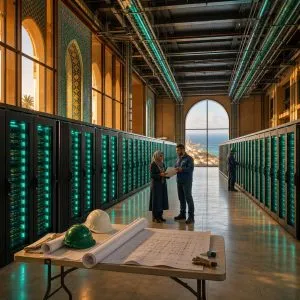
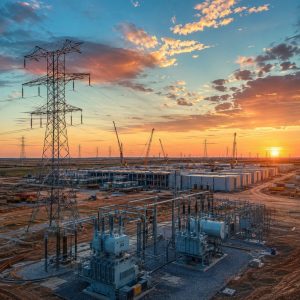
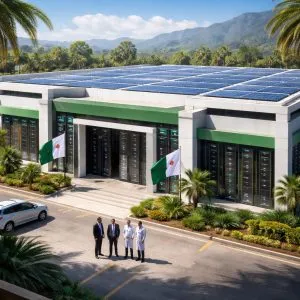
Cassava Technologies, the pan-African technology infrastructure company, and NVIDIA announced they are building an AI factory near Johannesburg, South Africa, to address this gap directly. The project represents approximately $720M in investment, with phase one delivering approximately 3,000 NVIDIA GPUs in a co-located facility designed specifically for AI training and inference workloads. Future expansion covers Morocco, Egypt, Kenya, and Nigeria — a continental footprint that would make Cassava-NVIDIA the first distributed AI compute network at African scale.
What Makes This an AI Factory, Not a Data Centre
The terminology is deliberate. NVIDIA has been evangelising the “AI factory” concept — a computing facility purpose-built not for general enterprise workloads but specifically for AI model training, fine-tuning, and high-throughput inference. The distinction matters for understanding what the Johannesburg facility will actually enable.
A conventional data centre handles diverse workloads: databases, web servers, email systems, enterprise applications. GPU utilisation in such environments is intermittent and efficiency is secondary to availability. An AI factory, by contrast, runs GPU compute at sustained high utilisation for continuous AI training jobs, provides the high-bandwidth interconnects between GPUs that make large model training efficient, and is optimised for the specific I/O patterns of AI workloads — large dataset streaming, checkpoint saving, and high-frequency batch inference.
For African AI development, the practical implication is that the 3,000 GPUs in phase one are not equivalent to renting 3,000 individual GPU instances from an international cloud provider. The factory architecture enables workloads that require coordinated GPU clusters — training large language models in African languages, running genomics analysis pipelines for healthcare research, building computer vision systems for agricultural monitoring — that cannot be efficiently distributed across geographically dispersed cloud infrastructure.
Cassava Technologies brings the distribution network. The company already operates data centres, network infrastructure, and enterprise connectivity across multiple African markets. Its existing presence in the African enterprise market — telecoms, banking, public sector — means the AI factory’s compute capacity has an existing customer base to serve rather than needing to build distribution from scratch.
Advertisement
Three Structural Signals for Africa’s AI Future
The $720M investment from Cassava and NVIDIA is not simply a data centre announcement. It contains three structural signals about the trajectory of AI in Africa that enterprise and government leaders should read carefully.
Signal 1: Sovereign AI Compute Is Becoming Infrastructure, Not Luxury
The Cassava-NVIDIA project joins a global pattern of sovereign AI compute investment: the UAE’s $1 billion+ compute investment, Singapore’s national AI compute programme, France’s Mistral-backed computing initiative. The pattern is consistent — governments and private-public partnerships are treating AI compute as foundational national infrastructure, equivalent to electricity grids and telecommunications networks, rather than as a commodity to be purchased from international providers.
For Africa, this is a pivotal shift. Countries and regions that establish domestic AI compute infrastructure gain the ability to develop AI models trained on local data, in local languages, optimised for local use cases. Countries that rely entirely on imported compute and imported models will increasingly find themselves consuming AI products designed for other markets. The Brookings analysis is blunt: African languages represent only 0.02% of total internet content, making it extremely difficult for AI models trained on global datasets to perform adequately for African language users without local fine-tuning — which requires local compute.
Signal 2: The Johannesburg Location Creates a Southern Africa Compute Hub
Johannesburg is a deliberate choice. South Africa has the continent’s most developed financial and technology ecosystem, the highest concentration of enterprise IT infrastructure, and existing subsea cable connectivity to both European and Asian networks. Locating the first AI factory here maximises near-term enterprise customer access while providing the connectivity infrastructure needed for the planned expansion across Morocco, Egypt, Kenya, and Nigeria.
Each of those expansion markets represents a distinct African AI opportunity: Morocco as a gateway to North Africa and the Francophone market, Egypt as the largest Arabic-speaking economy in Africa, Kenya as East Africa’s technology hub, and Nigeria as Africa’s largest economy by GDP. The five-country footprint, when complete, covers the continent’s five dominant digital economies — a compute network that can serve approximately 40% of Africa’s GDP within a single architecture.
Signal 3: The GPU Gap Is Being Closed by Private Capital, Not Aid
The Cassava-NVIDIA partnership is a commercial venture, not a development finance or aid programme. The $720M is private capital seeking commercial returns from African AI compute demand. This matters for two reasons. First, commercial capital moves faster and scales more aggressively than development finance — a commercial return requirement means the investors are confident that African AI demand is real, not anticipated. Second, the commercial model creates a sustainable expansion pathway: if phase one generates the demand and returns that justify the investment, the Morocco, Egypt, Kenya, and Nigeria facilities follow. Development projects that depend on grant funding have no equivalent self-reinforcing expansion mechanism.
The African Development Bank’s projection that AI could contribute $1 trillion in additional GDP to African economies by 2035 provides the demand context. If even a fraction of that value creation requires local AI development with locally trained models, the compute demand implied is orders of magnitude larger than what 3,000 GPUs in phase one can serve. The Cassava-NVIDIA investment is the opening move, not the final one.
What Enterprise and Government Leaders Should Do About It
The Cassava-NVIDIA AI factory changes the strategic calculus for African enterprises and governments that have been deferring AI investment because local compute infrastructure did not exist. The infrastructure gap excuse is expiring.
1. Map Your Sovereign Data Requirements Against Local Compute Availability
For African enterprises in financial services, healthcare, and government — sectors where data localisation requirements are either mandated or emerging — the existence of a local AI factory changes the feasibility analysis for AI deployment. Any organisation that has been told “we cannot deploy AI on sensitive local data because we would need to send it to overseas servers” should revisit that analysis with the Cassava-NVIDIA facility as a local compute option. This is not an immediate availability question — phase one is under development — but it is a planning question: which AI use cases does your organisation need to plan for local compute deployment, and are you positioned to access the Cassava-NVIDIA facility when it is operational?
2. Invest in Local AI Language Data Before the Compute Arrives
The compute infrastructure that Cassava and NVIDIA are building is a necessary but not sufficient condition for competitive African AI. What the factory will need to run, beyond enterprise inference workloads, are AI models trained on high-quality African language data. Sub-Saharan Africa’s languages represent a tiny fraction of global AI training datasets. Governments, universities, and organisations with access to large volumes of text, audio, or structured data in African languages should begin structured data collection and curation programmes now — the compute that could train a competitive Swahili, Hausa, Amharic, or Zulu language model is arriving. The data preparation is the bottleneck, and it has a multi-year lead time.
3. Build AI Governance Frameworks That Can Work With Regional Compute
The availability of local AI compute does not automatically resolve data governance challenges — it changes their shape. An African enterprise using the Cassava-NVIDIA factory to train an AI model on customer data is not sending that data overseas, which addresses one regulatory concern. But it creates others: who audits the AI factory for security and compliance? Under which legal framework does the enterprise’s AI model development occur? What data residency obligations apply when the compute crosses national borders within Africa? Governments in the five planned facility countries (South Africa, Morocco, Egypt, Kenya, Nigeria) should begin developing AI compute governance frameworks now, so they are ready when the infrastructure is operational rather than scrambling to regulate after deployment has begun.
Where This Fits in Africa’s 2026 Digital Ecosystem
The Cassava-NVIDIA AI factory is the most significant infrastructure announcement for African AI in 2026. It does not solve the continent’s AI gap — the skills deficit, the language data gap, the regulatory vacuum, and the funding gap for African AI startups all remain substantial challenges. But it removes the foundational infrastructure excuse.
For three years, the standard response to “why isn’t there more AI development in Africa?” included “because there’s no GPU compute infrastructure.” The Cassava-NVIDIA project is the first credible answer to that objection at continental scale. What happens next depends on whether African governments, universities, and enterprises use the infrastructure arrival as a trigger for the investments they have been deferring — language data programmes, AI governance frameworks, compute-ready workforce development — or whether they treat compute availability as the solution rather than the precondition.
The African Development Bank’s $1 trillion GDP projection by 2035 is achievable only if the layers above the compute infrastructure are also built. Cassava and NVIDIA have committed to building the foundation. The next investments are not theirs to make.
Frequently Asked Questions
What is an AI factory and how does it differ from a conventional data centre?
An AI factory is a computing facility purpose-built for AI model training, fine-tuning, and high-throughput inference, rather than for general enterprise IT workloads. The critical differences are GPU density (AI factories pack GPU clusters at sustained high utilisation), high-bandwidth GPU interconnects (enabling coordinated training across thousands of GPUs), and I/O architecture optimised for AI-specific data patterns (large dataset streaming, model checkpointing). For Africa, the practical distinction is that the Cassava-NVIDIA factory enables AI workloads — training large language models in African languages, genomics pipelines, large-scale agricultural computer vision — that cannot be efficiently run on dispersed international cloud infrastructure due to latency and cost.
Why does Africa’s AI market represent only 2.5% of the global total despite having 18% of the world’s population?
The primary structural cause is compute infrastructure — until now, no GPU-grade AI factory has existed on the continent, forcing African AI developers to use international cloud providers at significantly higher cost, latency, and with data sovereignty constraints. Secondary causes include: language data gaps (African languages represent 0.02% of global internet content, making AI models trained on global datasets poor performers in African language contexts), funding gaps (African AI startups captured a fraction of the continent’s $4B in total tech funding in 2023), and skills concentration (the US alone houses 60% of top-tier AI researchers globally). The Cassava-NVIDIA factory addresses the compute constraint; the other gaps require separate intervention.
Which African countries will have access to the Cassava-NVIDIA AI compute network?
Phase one is located near Johannesburg, South Africa. Planned expansion covers Morocco, Egypt, Kenya, and Nigeria — five countries that collectively represent the dominant digital economies in their respective African sub-regions. The five-country footprint covers approximately 40% of Africa’s GDP. The timeline for expansion beyond Johannesburg depends on commercial performance of phase one, but the multi-country architecture signals an intent to build a continental compute network rather than a single-market data centre. Countries not in the initial five — including Algeria — would need to negotiate access to the Morocco facility or engage Cassava about additional expansion markets.
—
Sources & Further Reading
- Cassava Technologies and NVIDIA Plan AI Infrastructure Expansion in South Africa — Discourse Channel
- Leveraging AI and Emerging Technologies to Unlock Africa’s Potential — Brookings Institution
- Africa’s AI Revolution: African Development Bank Projects $1 Trillion Additional GDP by 2035 — AfDB
- AI Regulation Africa 2026: New Laws, Compliance, Startup Opportunities — Tech in Africa