A Small Segment Posts the Market’s Biggest Growth Number
Algeria’s insurance sector crossed a symbolic line in 2025: total premiums reached 200.5 billion dinars (about $1.5 billion), the first time the market has surpassed the 200-billion-dinar threshold, up 8.8% year-on-year. But inside that headline, one segment grew at roughly ten times the market’s pace. Takaful — cooperative, Sharia-compliant insurance — saw contributions climb 84.3% to around 1.4 billion dinars (~$10.5 million), according to figures published by the National Insurance Council (CNA).
That makes takaful the standout growth story of the Algerian insurance market, even though it still represents under 1% of total premiums. The growth was broad-based, spanning both lines of the product family: General Takaful (covering property, auto, and liability) and Family Takaful (the protection-and-savings line analogous to life insurance). CNA data cited by Maghreb-focused financial press shows General Takaful adding 452.8 million dinars and Family Takaful adding 209.2 million dinars over the year.
The momentum is structural, not a one-off. Takaful operates on a participatory model: policyholders contribute to a shared pool, surpluses can be redistributed, and investments avoid interest-bearing and non-compliant assets — a design that resonates with a large segment of Algerian households and businesses that have historically stayed out of conventional insurance on faith grounds. As that latent demand converts into policies, the segment’s small base means percentage growth stays high.
Two Moves That Define the 2026 Inflection Point
Two corporate developments in the first half of 2026 turned takaful from a niche experiment into a competitive growth race.
First, on January 28, 2026, GAM (Générale Assurance Méditerranéenne) relaunched its takaful window under a new commercial identity, “Takafulia Li Taaminat”. GAM’s window had already operated for four years and was the first to receive Ministry of Finance approval for takaful operations, with Sharia compliance certified in 2022 by the National Sharia Authority for the Islamic Finance Industry. The rebrand came bundled with an explicit roadmap: progressive expansion of the agency network, consolidation of strategic partnerships, accelerated digital transformation of takaful services, and deeper ties with Islamic banking actors.
Second, on June 8, 2026, Alliance Assurances — one of Algeria’s largest private insurers — announced the launch of its Alliance-Takaful window, approved unanimously at an extraordinary general assembly. Alliance-Takaful spans the full risk spectrum: auto, housing, and family-asset protection for individuals; business-activity cover for professionals and SMEs; and fleet, civil-liability, and industrial-risk products for enterprises. The window is governed by a Sharia compliance committee of three Islamic finance specialists plus a dedicated Sharia controller.
These moves sit on top of a market still led by the public-sector pioneer. El Djazair Takaful, the state-owned specialist, federated nearly 58,000 participants by the end of 2025 and holds an estimated 60% share of the takaful segment, having grown around 70% over the year. The arrival of well-capitalized private windows alongside the incumbent is exactly the kind of competitive density that pulls a segment from infancy to scale.
Advertisement
Why Digital Distribution Is the Open Lane
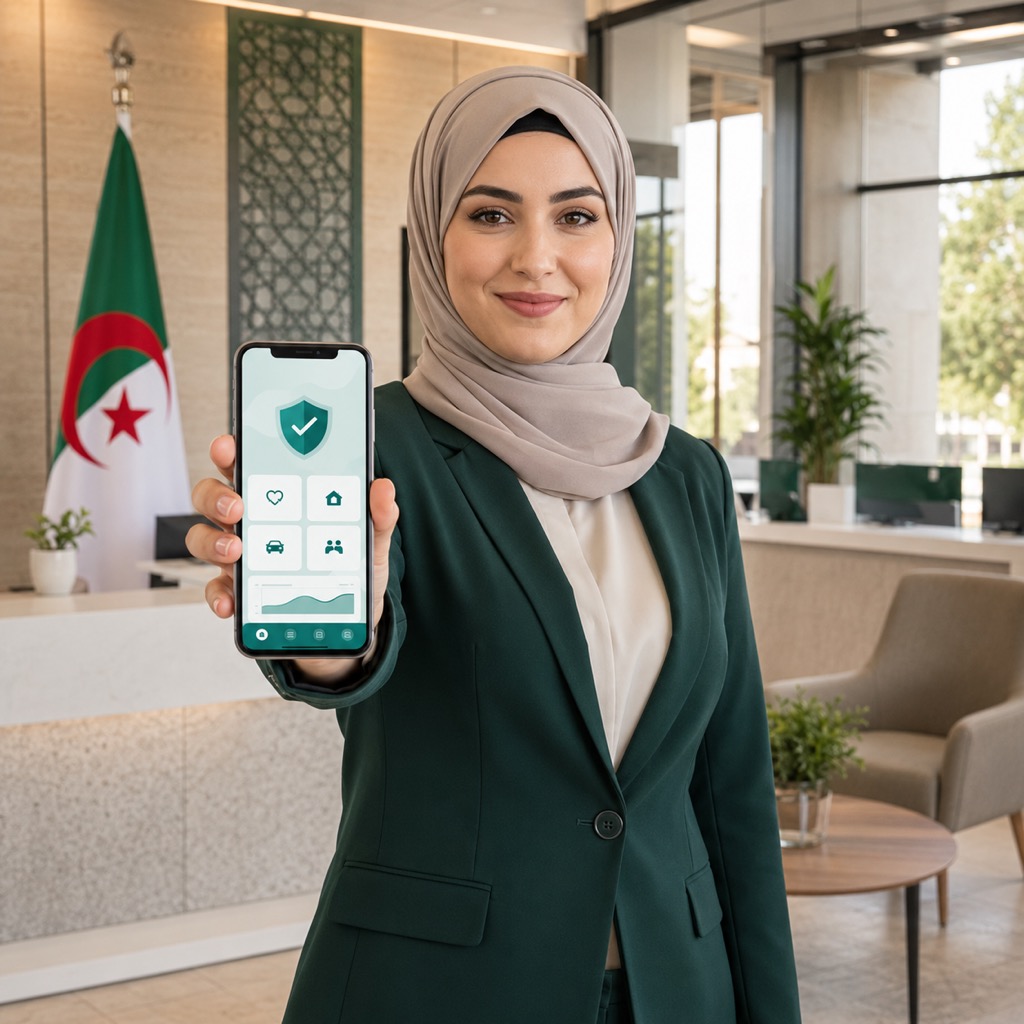
The most interesting part of the takaful story for the technology ecosystem is not the product — it is the channel. Conventional Algerian insurance still runs largely through physical agency networks and counter-based bancassurance. Takaful, as a younger product line being built almost from scratch, has far less legacy distribution to defend. That makes it the natural testing ground for digital onboarding, app-based policy management, and online claims — the insurtech-driven digitalization that market analysts describe as an accelerator for the whole sector.
Both new windows have written digital ambition into their plans — GAM explicitly cites “digital transformation acceleration for takaful services,” and Alliance is launching at a moment when Algeria’s broader fintech rails (instant payments, mobile wallets, e-payment expansion) are maturing fast. For founders, the gap is obvious: there is no dominant digital-first takaful distributor yet. Whoever builds the cleanest mobile onboarding flow for a Sharia-compliant product — with transparent surplus-sharing explanations and integrated Islamic-banking payment — has room to define the category.
What Insurtech Founders and Digital Insurers Should Do
1. Build digital onboarding purpose-built for takaful, not retrofitted from conventional insurance
A conventional motor-insurance funnel will not work unchanged for takaful. The participatory model requires explaining the shared-pool mechanics, surplus redistribution, and Sharia governance in plain language during onboarding — trust in the compliance structure is the conversion driver. Design a mobile flow that surfaces the Sharia controller, the certification body (the National Sharia Authority), and the surplus policy upfront, then collapses quoting and payment into a few screens. The window operators (Alliance, GAM, El Djazair Takaful) need this layer and are unlikely to build best-in-class UX in-house — that is the white-space for an insurtech partner.
2. Partner with Islamic banking windows and instant-payment rails for embedded distribution
Takaful and Islamic banking are natural cross-sell partners — both GAM and Alliance name Islamic-finance and banking actors as target partners. The highest-leverage move is embedding takaful purchase at the point of an Islamic-banking transaction: a financed car gets a takaful auto quote inline, a home-finance contract triggers a housing-takaful offer. Integrating with Algeria’s expanding instant-payment and mobile-wallet infrastructure lets you settle contributions digitally and Sharia-compliantly, removing the cash-and-counter friction that throttles conventional policy sales.
3. Target the SME, freelancer, and household segments that conventional insurance underserves
The 84% growth is coming off a base of households and small businesses that abstained from conventional cover on faith grounds — a segment conventional insurers never reached. Build products and distribution for exactly these buyers: micro-takaful for freelancers and gig workers, simple business-activity cover for SMEs, and family-protection plans sold through digital channels rather than agency visits. Pricing and packaging for first-time insurance buyers — short policies, clear pricing, instant digital proof — converts the latent demand that the segment’s growth rate is already signaling.
The Bigger Picture: Algeria’s Fintech-Insurtech Convergence
Takaful’s surge is one visible edge of a wider convergence. Algeria spent the past few years standing up the rails of a digital financial economy — instant interbank payments, e-payment growth, Islamic-banking windows across public and private banks. Takaful is the insurance layer that snaps onto those rails, and its 84% growth shows demand was waiting for compliant products to exist. The segment is still under 1% of a $1.5 billion market, which is precisely why the opportunity is large: the runway from sub-1% to the double-digit shares seen in mature takaful markets is long, and almost all of that journey will be won or lost on digital distribution. For Algerian insurtech founders, the takaful window operators have effectively created the product; the open question — who owns the digital channel that scales it — is still unanswered. That is the frontier worth building on in 2026.
Frequently Asked Questions
What is takaful and how is it different from conventional insurance?
Takaful is cooperative, Sharia-compliant insurance built on a participatory model: policyholders contribute to a shared pool, surpluses can be redistributed to participants, and the pool’s investments avoid interest-bearing and non-compliant assets. In Algeria it is regulated by the Ministry of Finance and certified by the National Sharia Authority for the Islamic Finance Industry, and it comes in two lines — General Takaful (property, auto, liability) and Family Takaful (protection and savings).
How fast is Algeria’s takaful market growing in 2026?
Takaful contributions grew 84.3% in 2025 to roughly 1.4 billion dinars (~$10.5 million), according to the National Insurance Council — far above the overall insurance market’s 8.8% growth. The segment is still under 1% of Algeria’s $1.5 billion insurance market, which means the high percentage growth reflects a small base and a long runway as latent demand converts into policies.
Why is takaful a digital opportunity for Algerian insurtech founders?
Because takaful is a young product line with little legacy agency distribution to defend, it is the natural testing ground for digital onboarding, app-based policy management, and online claims. No dominant digital-first takaful distributor exists yet, and both Alliance and GAM have named digital transformation and Islamic-banking partnerships as priorities — leaving the digital channel that scales the segment open for founders to define.
Sources & Further Reading
- Further Reading
- Algeria: Insurance Market Exceeds $1.5 Billion in Premiums in 2025 — Financial Afrik
- Takaful Insurance Posts Over 70% Growth in 2025 — APS
- Alliance Assurances Launches Its Takaful Window — Algérie Éco
- GAM Unveils New Takaful Commercial Identity “Takafulia Li Taaminat” — El Watan
- El Djazair Takaful Records 70% Growth in 2025 — National Insurance Council (CNA)
- Insurtech: An Accelerator for the Digitalization of the Insurance Market — Algeria Invest
🔗 Related Intelligence

Algeria Digital 2026: 47 Million Internet Users and the Mobile Commerce Surge

Algeria’s E-Commerce Boom: 92% Annual Growth and What Comes Next for Digital Merchants

Algeria’s $317B Economy: The Digital Investment Window Opening for Foreign Tech Capital
Embedded Insurtech in Algeria: Micro-Insurance for Deliveries, Rides, and Gig Workers in 2026