Three Ministries, One Crisis
On March 18, 2026, Algeria’s Ministry of Knowledge Economy, Start-ups and Micro-enterprises launched a national call for projects aimed at deploying artificial intelligence and smart technology to solve the country’s most pressing infrastructure challenge: water. In a country where up to 50% of treated water never reaches consumers due to leaking pipes, and where climate change is intensifying drought cycles across the Mediterranean rim, this initiative represents a convergence of political will, technical ambition, and existential necessity.
The call was issued jointly with the Ministry of Water Resources and Water Security and the Ministry of Higher Education and Scientific Research. It targets startups, scale-ups, micro-enterprises, incubators, accelerators, university researchers, and Algerian talent based abroad. The message is clear: Algeria is betting on its own innovators to solve a problem that imported infrastructure alone has failed to fix.
The Scale of the Problem
Algeria’s water crisis is structural and worsening. The country sits in an arid to semi-arid climatic zone where water resources depend on irregular rainfall and overexploited groundwater reserves. Non-revenue water — the gap between what enters the distribution system and what is billed to consumers — has hovered around 40-50% for years, driven by aging pipe networks, inadequate maintenance, and rapid urbanization.
The government has responded with massive capital expenditure on desalination. Algeria currently operates 19 desalination units along its Mediterranean coastline, with a current capacity of approximately 3.7 million cubic meters per day. In February 2026, Bloomberg reported that Algeria was fast-tracking a $1 billion investment to add facilities in Tlemcen, Mostaganem, and Chlef, targeting 900,000 additional cubic meters of daily capacity. This is part of a broader $5.4 billion desalination plan that includes seven new plants under construction through 2030. The long-term goal: desalinated water meeting 60% of the country’s drinking water needs by 2030, up from approximately 42% today.
But desalination is energy-intensive and expensive. Algeria’s plants still run predominantly on natural gas. The innovation call explicitly prioritizes solutions that improve energy efficiency in desalination — a recognition that brute-force infrastructure expansion is unsustainable without smarter operations.
What the Call Asks For
The national call targets five priority domains:
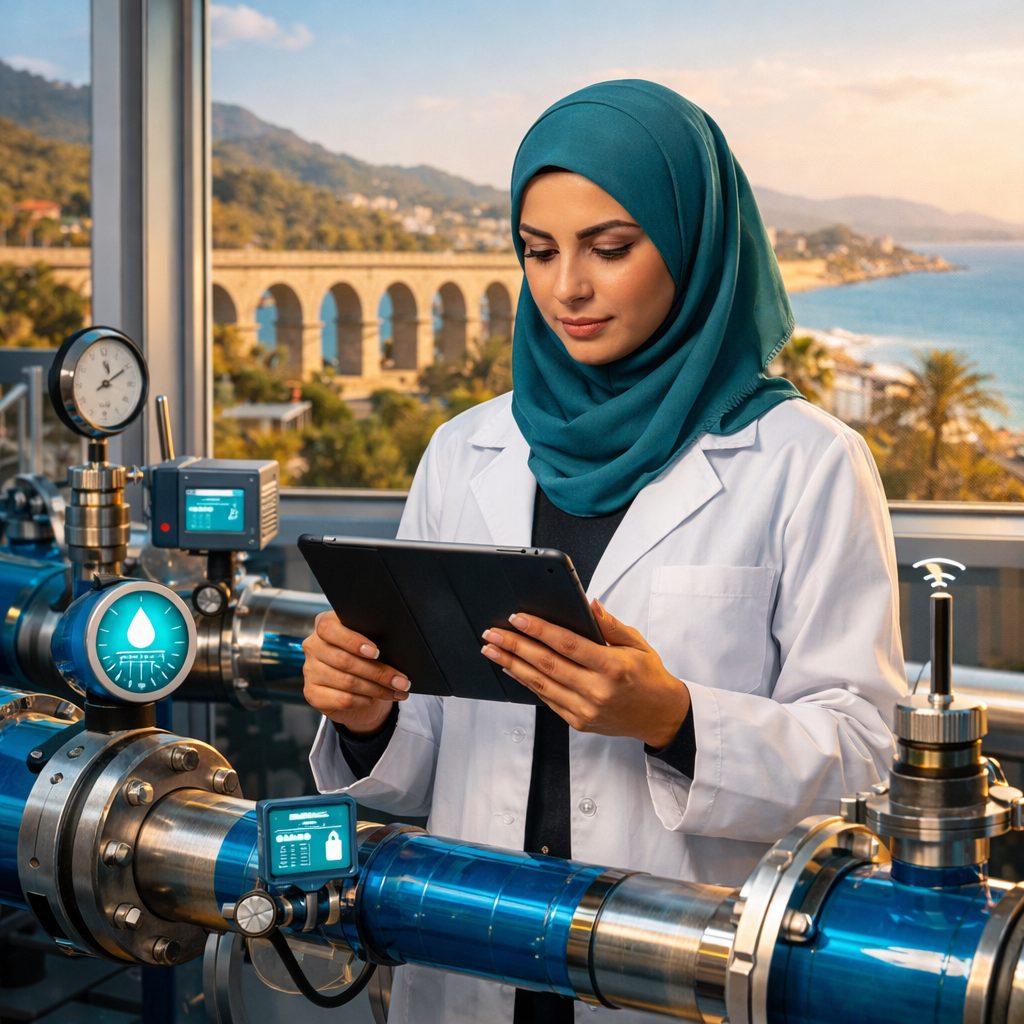
- Leak detection and water loss reduction — AI-powered anomaly detection systems, IoT sensor networks for real-time pipe monitoring, and predictive maintenance algorithms that can flag failures before they become floods.
- Smart irrigation and sustainable agriculture — Precision irrigation systems using soil moisture sensors, weather data integration, and machine learning models to optimize water use in Algeria’s expanding agricultural sector.
- Desalination efficiency — Solutions that reduce the energy cost per cubic meter of desalinated water, including AI-optimized reverse osmosis operations and renewable energy integration.
- Water reuse and recycling — Technologies for treating and repurposing wastewater for agricultural or industrial use, extending the lifecycle of every liter entering the system.
- Climate adaptation technologies — Predictive models for drought forecasting, reservoir management optimization, and groundwater monitoring systems. Research combining AI with geophysics and GIS is already demonstrating how machine learning can map aquifer behavior and redirect drilling efforts in Algeria’s arid regions, saving millions in dry-hole costs.
The government’s stated objective goes beyond collecting project proposals. The call is designed to build a national database of water-sector expertise, connecting innovators with institutional stakeholders and preparing the ground for future incubation, acceleration, pilot testing, and technological partnerships.
Advertisement
Why This Time Might Be Different
Algeria has announced technology initiatives before. What distinguishes this call is the convergence of three factors that were not simultaneously present even two years ago.
First, the talent pipeline is real. Algeria now has 57,702 students enrolled across 74 AI master’s programs at 52 universities, according to Ministry of Higher Education data. The National School of Artificial Intelligence (ENSIA), established in Sidi Abdellah in 2021, has produced its first cohorts of specialized graduates and recently inaugurated a high-performance computing centre equipped with NVIDIA H100, L40S, and A40 processors. Research output in AI-adjacent fields — geophysics, hydrology modeling, IoT systems — is growing, with Algerian researchers publishing on topics directly relevant to this call.
Second, the funding infrastructure exists. The Algerian Startup Fund (ASF) has processed over 130 startup applications and made 37+ investments, achieving its first exit in December 2025 — a 3.35x return on a travel-tech investment in Voelz, which raised $5 million in the largest Algerian startup round denominated in local currency. Algerie Telecom launched a dedicated 1.5 billion DZD ($11 million) fund targeting AI, cybersecurity, and robotics startups. The new FCPR venture capital framework, introduced in 2025, allows private VC funds to launch with as little as 50 million DZD, and Afiya Investments became the first approved fund under this structure. The capital may not match Gulf or European levels, but the channels exist.
Third, the institutional coordination is unprecedented. Three ministries co-signed this call. That cross-ministerial alignment is rare in Algeria’s governance structure and signals genuine top-level priority. The inclusion of diaspora talent in the eligibility criteria also reflects a pragmatic acknowledgment that some of Algeria’s best AI expertise currently works abroad.
The Hard Questions
The initiative raises legitimate questions that will determine whether it produces deployable solutions or another database of proposals.
Pilot pathways remain unclear. The call collects information on innovative projects, but the mechanism for moving from submission to funded pilot to scaled deployment has not been publicly detailed. Algeria’s water utilities — primarily the Algerie des Eaux (ADE) for urban water and the Office National de l’Irrigation et du Drainage (ONID) for agricultural water — operate as state enterprises with procurement processes that can be slow. Startups that build compelling AI solutions may still face years of institutional friction before deploying them.
Data access is the hidden bottleneck. AI-powered leak detection requires granular, real-time data from sensor networks embedded in pipe infrastructure. Smart irrigation needs soil data, weather station integration, and crop-specific models. Algeria’s water data infrastructure is fragmented, with limited digitization of existing monitoring systems. Without a parallel investment in data infrastructure, the AI solutions this call seeks will lack the input they need to function.
The energy equation cuts both ways. Improving desalination efficiency through AI is a strong use case, but Algeria’s broader energy transition — including the planned 15 GW of renewable capacity by 2035 — will ultimately determine whether desalination can scale sustainably. AI optimization alone cannot solve a fundamentally energy-intensive process running on fossil fuels.
What Comes Next
The national innovation call is a starting point, not a solution. Its value will be measured by what happens after submissions close: whether selected projects receive funding, whether utilities grant data access and pilot sites, and whether successful pilots are scaled across Algeria’s 69 wilayas rather than confined to showcase projects in Algiers.
For Algeria’s AI and startup ecosystem, this is a significant signal. Water is not an abstract research problem — it is a daily reality for millions of Algerians who experience rationing, low pressure, and supply interruptions. If homegrown AI can demonstrably reduce the 40-50% water loss rate, optimize irrigation in the Mitidja Plain, or cut desalination energy costs by even 10-15%, the return on investment — both economic and political — would be enormous.
The question is no longer whether Algeria has the talent or the technology. It is whether the institutional machinery can move fast enough to deploy them before the next drought cycle hits.
Frequently Asked Questions
What is Algeria’s national innovation call for AI-powered water solutions?
It is a joint initiative launched on March 18, 2026 by three Algerian ministries — Knowledge Economy, Water Resources, and Higher Education — inviting startups, researchers, micro-enterprises, and diaspora talent to propose AI and IoT-based solutions across five priority domains: leak detection, smart irrigation, desalination efficiency, water reuse, and climate adaptation. The call aims to build a national database of water-sector innovation expertise.
How severe is Algeria’s water infrastructure problem?
Algeria loses an estimated 40-50% of treated water through infrastructure leaks before it reaches consumers, one of the highest non-revenue water rates in the Mediterranean region. The country currently operates 19 desalination plants producing 3.7 million cubic meters daily and is investing $5.4 billion to expand capacity to 5.8 million cubic meters per day by 2030, targeting 60% of drinking water needs from desalination.
Does Algeria have enough AI talent to deliver on this initiative?
Algeria has 57,702 students enrolled across 74 AI master’s programs at 52 universities, plus the National School of Artificial Intelligence (ENSIA) which recently inaugurated a high-performance computing centre with NVIDIA H100 GPUs. The Algerian Startup Fund has made 37+ investments with its first successful exit, and Algerie Telecom launched an $11 million fund specifically for AI startups — creating a pipeline from research to commercialization.
Sources & Further Reading
- Algeria Launches National Initiative for Technological Solutions in Water Sector — APS
- Ministry of Knowledge Economy Launches National Open Call for Water Innovation — TechAfrica News
- Algeria Launches National Innovation Call to Deploy AI and Smart Technology in Water Management — iAfrica.com
- Algeria Commits $5.4B to Desalination for Long-Term Water Security — Energy Capital & Power
- Algeria Speeds $1 Billion Water Fix for Drought-Prone Regions — Bloomberg
- Why Algeria Is Positioned To Become North Africa’s AI Leader — New Lines Institute
- Algeria Bets Big on AI Startups with New Investment Fund — LaunchBase Africa
- How AI, Geophysics, GIS, and ICT Help Combat Groundwater Loss in Dry Areas of Algeria — The Water Diplomat
- Algeria’s Public Startup Fund Scores First Exit as Travel-Tech Voelz Raises $5M — LaunchBase Africa
- The New Algeria: How Latest Fintech and VC Laws Could Redraw North Africa’s Tech Map — LaunchBase Africa