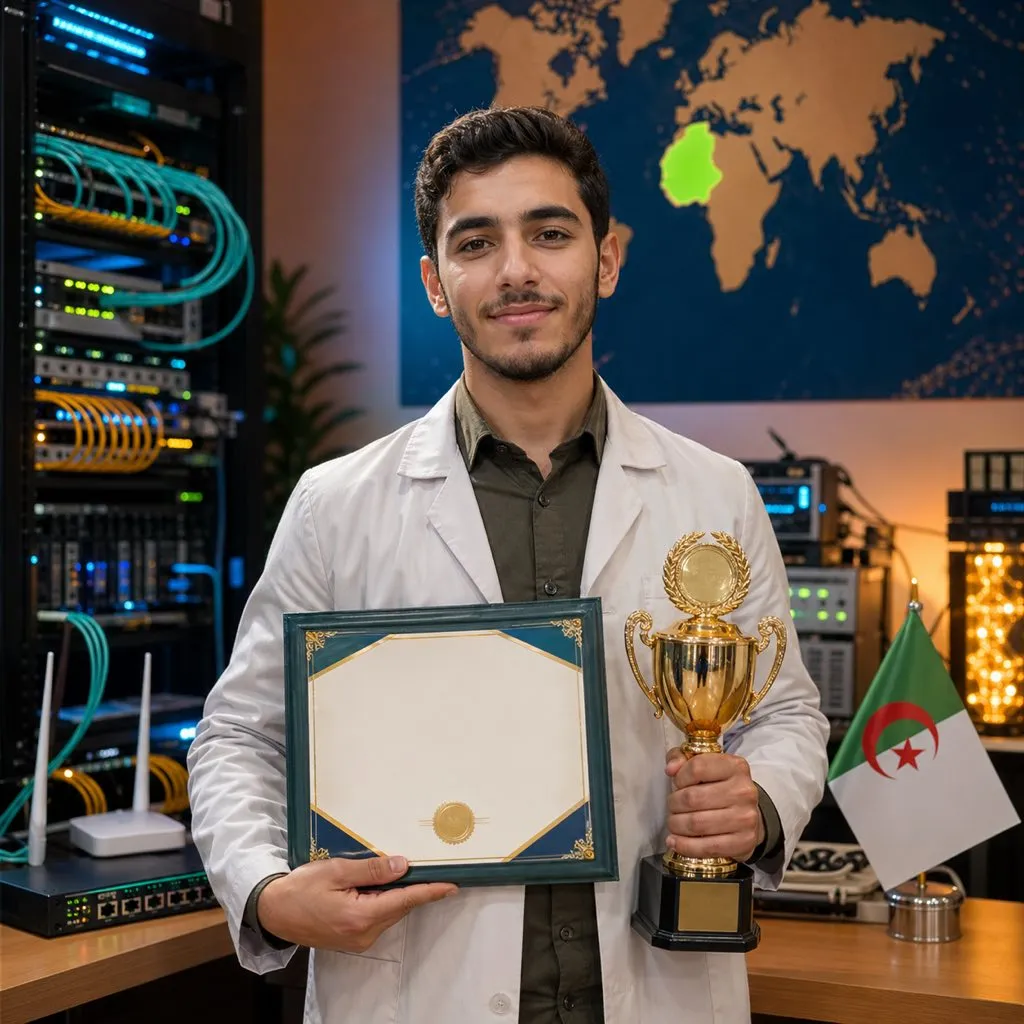
Six Years of Consistent Results on a Global Stage
When global ICT skills competitions rank student performance, most observers expect to see entries from Singapore, South Korea, or Brazil. Algerian teams have been quietly challenging those assumptions for half a decade.
The Huawei ICT Competition — launched globally to develop next-generation technology talent and recognized by UNESCO’s Global Skills Academy — draws university teams from over 80 countries each year. The competition runs in three phases: a national stage, a regional stage, and a global final. It tests participants across three core domains: Cloud, Network, and Computing. Since its introduction in Algeria, domestic teams have consistently advanced past national rounds and earned multiple awards at the global level across six successive editions.
The 2025-2026 edition was formally launched by Huawei Algeria in October 2025, in Algiers, with registration open through December 15, 2025. The launch took place in collaboration with Algeria’s Ministry of Higher Education and Scientific Research and the Ministry of Post and Telecommunications — a coordination arrangement that reflects how seriously both the public sector and the private technology industry are treating this program. This is not an extracurricular activity run out of a single university; it is a nationally backed skills mobilization effort.
For students, the competition is more than a certificate. It is a direct pathway into Huawei’s global talent network, exposure to enterprise-grade cloud and networking architectures, and a benchmark that carries weight with technology employers across the region.
What the Competition Actually Tests
Understanding the competition structure helps contextualize why Algerian student performance matters beyond headline rankings.
The Huawei ICT Competition evaluates both theoretical and hands-on technical competence. The Cloud track covers cloud architecture, storage, networking, and AI-enabled services. The Network track tests skills in routing, switching, enterprise network design, and network security fundamentals. The Computing track — newly emphasized in the 2025-2026 edition — addresses data center hardware, high-performance computing infrastructure, and heterogeneous computing environments.
Beyond the three main technical domains, the 2025-2026 edition added two specialized tracks: a Teaching Innovation track for faculty members developing new pedagogy around emerging technologies, and an Innovation Competition track for student teams proposing applied technology solutions to real-world problems. The second track is particularly significant for Algeria’s startup ambitions: it asks competitors to move from abstract technical knowledge to actionable, deployable ideas.
Huawei’s global program is not merely an examination. It is a credentialing pathway that feeds directly into the Huawei Certified ICT Associate (HCIA), Huawei Certified ICT Professional (HCIP), and Huawei Certified ICT Expert (HCIE) certification hierarchy. Students who perform well in the competition gain access to mentoring, internship pipelines, and partner-university ecosystems that extend far beyond the competition itself.
Advertisement
What Algerian Students Should Take Away from Six Years of Progress
1. Treat the Competition as an Enterprise Audition, Not a Student Exercise
The Huawei ICT Competition is evaluated by Huawei’s global talent acquisition network. Employers across the Gulf, Europe, and North Africa actively recruit from Huawei’s competition alumni pools. Algerian students who advance to the regional or global finals are not just winning a trophy — they are creating a verifiable, internationally recognized credential that bypasses the noise of a crowded CV.
The key shift in mindset is to prepare as if you are auditioning for a technical role at a multinational, not studying for a university exam. This means solving past competition challenges under timed conditions, building lab environments using Huawei’s free online simulation tools (ENSP and HedEx), and forming teams that specialize across the Cloud, Network, and Computing domains rather than trying to cover all three as individuals. The strongest Algerian teams in past editions have been cross-functional: one student owns Cloud architecture, another owns Network design, and a third anchors the Computing infrastructure. This mirrors how enterprise teams actually work.
2. Use the ICT Academy Network to Close the Gap Between Theory and Practice
Algeria now has a growing network of Huawei ICT Academy campuses embedded in universities across the country. In May 2025, Algeria’s Ministry of Higher Education and Huawei formalized an agreement to expand specialized training academies focused on artificial intelligence and advanced digital technologies. These academies offer Huawei-aligned curriculum, lab access, and instructor certification — free or heavily subsidized for enrolled students.
Students at universities without an ICT Academy affiliation should not wait for their institution to set one up. Huawei’s online learning platform (Huawei Talent Online) provides free preparation modules for all three competition tracks. The 29% of Algerian professionals who work remotely for foreign companies — per the State of Algeria Developer Survey — overwhelmingly started their international career with a certification or competition result that created a first point of trust with a foreign employer. The ICT Competition is one of the most direct paths to that first credential.
3. Build Around the Innovation Track to Connect to Algeria’s Startup Ecosystem
The 2025-2026 Innovation Competition track is an underutilized opportunity for Algerian student teams. It requires building a working technology prototype that addresses a domain-specific problem — a requirement that maps almost perfectly onto the early stage of a startup pitch. Algeria Venture, the public startup accelerator, and several private investors active in the local ecosystem have explicitly stated interest in student-led teams that emerge from international technology competitions.
Algerian student teams that treat the Innovation track as a prototype lab — not just a competition entry — can simultaneously build competition credentials, develop a minimum viable product, and create a narrative for early-stage funding conversations. The SNTN-2030 national strategy targets training 500,000 ICT specialists; the students who compete at Huawei’s global level are precisely the kind of profiles those policy goals are designed to produce and retain.
The Structural Lesson: Why Competition Results Signal More Than Talent
Algeria’s consistent performance in a multi-country, UNESCO-recognized technology competition is a leading indicator of something structural, not accidental. The country graduates tens of thousands of STEM students each year from a public university system that, while resource-constrained, has maintained a strong mathematics and engineering curriculum tradition. That foundation, combined with the competitive intensity that comes from a young, connected, and motivated student population, produces teams that can hold their own against well-funded university programs from wealthier economies.
The challenge is converting competition results into retained talent. Algeria ranks 111th globally in startup ecosystem rankings and 4th in Northern Africa — a position that creates genuine opportunity for students who want to build locally. The SNTN-2030 strategy targets a 40% reduction in tech emigration, and competition ecosystems like Huawei’s are one of the levers that can keep top-performing graduates engaged at home by giving them international visibility without requiring them to leave.
For university career offices, employers, and policymakers, the lesson is to pay attention to competition alumni and treat them as a talent pipeline worth investing in. For students, the message is simpler: six years of global results prove that the baseline talent is there. The question is what each cohort does next with it.
Frequently Asked Questions
What is the Huawei ICT Competition and who can participate?
The Huawei ICT Competition is an annual global student technology skills program recognized by UNESCO’s Global Skills Academy. It tests university students in Cloud, Network, and Computing domains across three phases: national, regional, and global finals. Algerian students enrolled at any university can participate, with the national stage organized in collaboration with Algeria’s Ministry of Higher Education and Scientific Research.
How have Algerian students performed in past editions of the competition?
Algerian university teams have earned multiple global awards across six consecutive editions of the Huawei ICT Competition, establishing Algeria as a recognized ICT talent hub in Africa. This sustained performance reflects both the strength of Algeria’s STEM graduate pipeline and the growing infrastructure of Huawei ICT Academy campuses embedded in Algerian universities.
How does winning or placing in the competition benefit students’ careers?
Top performers gain access to Huawei’s global talent network, internship pipelines, and internationally recognized certifications (HCIA, HCIP, HCIE). Competition results function as verifiable credentials that carry weight with technology employers across the Gulf, Europe, and North Africa — and are particularly valuable for students seeking remote employment or international roles, where a competition award signals technical competence to a foreign employer who cannot otherwise assess local university qualifications.
—
Sources & Further Reading
- Huawei Launches the ICT Competition 2025-2026 to Empower Algerian Students — MEATech Watch
- Huawei Seeds for the Future — Official Program Page
- Algeria Partners with Huawei to Launch Specialized Training Academies — Startup 3lmashi
- Africa Tech Talent and Diaspora Return Initiatives — AlgeriaTech
- State of Algeria Developer Survey — Remote Working Insights