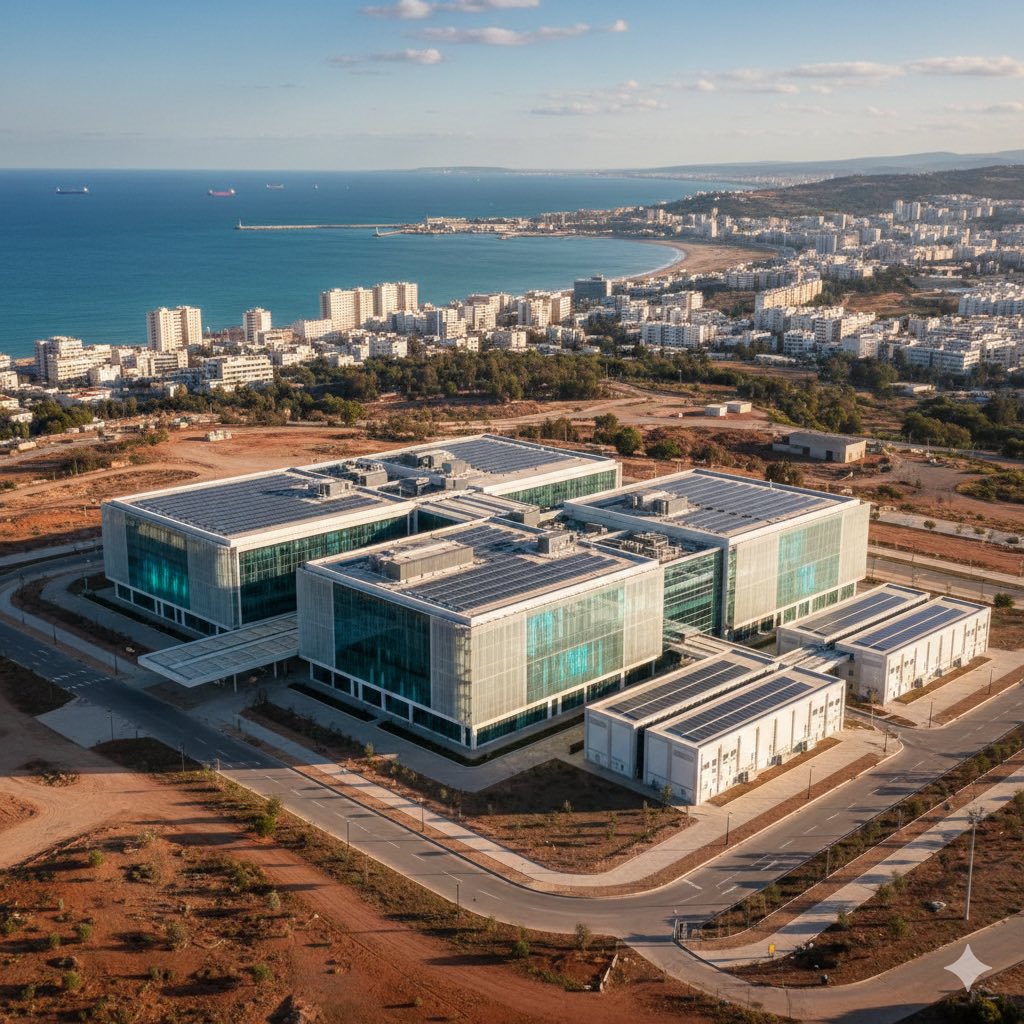
Algeria’s data center and cloud infrastructure market is set to nearly double over the next decade. According to DC Market Insights, the market will grow from approximately $218 million in 2025 to $447 million by 2035 — a compound annual growth rate of 7.39%. Driving this expansion is a convergence of government-led digitization, 5G deployment, enterprise modernization, and the country’s first dedicated AI data center. For cloud vendors and investors evaluating African technology markets, Algeria in 2026 represents an early-mover opportunity.
The Government’s 500-Project Digital Sprint
The Algerian government has committed to executing over 500 digital transformation projects between 2025 and 2026, with roughly three-quarters aimed at digitizing and simplifying public services. This push is part of the broader “Digital Algeria 2030” national strategy, which targets 100% of public services available online by 2030.
The High Commission for Digitalization (HCD) — which reports directly to the Presidency — oversees the entire portfolio, from e-government portals and digital identity systems to a unified national administrative portal. A 2024 progress report showed that 67% of administrative procedures had already been dematerialized, cutting processing time for foreign trade clearance from 15 days to three. Each new project generates demand for compute, storage, and connectivity — pushing Algerian public-sector cloud consumption into a new tier.
The Oran AI Data Center
In March 2025, Algeria broke ground on a dedicated AI data center in Oran — the country’s second-largest city and an emerging technology hub. The state-owned facility is designed to provide GPU-accelerated high-performance computing to researchers, universities, startups, and public institutions.
The project fits within a national AI ambition: the government has set a target for AI to contribute 7% of GDP by 2027. To support the broader ecosystem, Algérie Télécom has established a 1.5 billion dinar (~$11 million) investment fund for startups in AI, cybersecurity, and robotics. With no global hyperscaler currently operating a data center in Algeria, government-owned facilities like the Oran center are essential infrastructure for data-intensive workloads.
5G as the Cloud Delivery Layer
Late 2025 marked Algeria’s transition to 5G. In December 2025, the Ministry of Post and Telecommunications awarded 5G licenses to all three major operators — Mobilis, Djezzy, and Ooredoo — with initial rollout in eight pilot provinces and a mandate for nationwide coverage within six years.
Early tests by Mobilis achieved speeds of 1.2 Gbps, demonstrating 5G’s potential as a delivery layer for mobile cloud, IoT, and edge computing. Minister Sid Ali Zerrouki called the launch a “decisive step” to accelerate AI, cloud computing, smart healthcare, and Industry 4.0.
The 5G rollout builds on an already-transformed fixed connectivity picture. Algérie Télécom surpassed 2.9 million FTTH subscribers by late 2025 — up from just 53,000 in 2020 — and the government plans to completely phase out the legacy copper network by 2027. International connectivity is also improving: a new subsea cable partnership with Sparkle (Italy) will add redundancy alongside the Medusa submarine cable expected to go live in 2026.
Advertisement
Enterprise Modernization and Digital Banking
The private sector is accelerating its cloud migration. In March 2025, the Bank of Algeria issued Instruction 02-2025, establishing licensing rules for fully digital banks. Legacy on-premise core banking systems cannot support mobile banking, digital account opening, or real-time payments — making cloud migration a business necessity.
Consumer digital adoption is climbing: 8.2% of Algerians made online purchases in 2023, with credit card penetration at just 2.8% and debit cards at 22.9%. The gap between digital intent and financial infrastructure represents a significant runway for cloud-based fintech platforms. Meanwhile, telecom operator Djezzy launched enterprise cloud services in February 2025, signaling that MNOs are entering the cloud market to compete with traditional IT providers.
Data Sovereignty: Opportunity in Disguise
Algeria’s strict data-localization policies create a protected market for domestic providers. Law 18-07 (December 2024) mandates that digital audiovisual and media content be hosted on servers physically located in Algeria under the “.dz” domain. A December 2025 Presidential Decree (25-350) further established a national data governance framework treating public data as a sovereign asset.
In practice, no major global hyperscaler (AWS, Azure, Google Cloud) currently operates a data center in Algeria. Organizations subject to data residency requirements must use local providers — and the list is short. Groupe Telecom Algérie (parent of Algérie Télécom and Mobilis) has launched domestic cloud services from facilities in Algiers and Lakhdaria. The edge data center segment is also growing fast, projected to rise from $9.54 million in 2025 to $36.65 million by 2035 at a 14.26% CAGR.
This regulatory environment effectively guarantees demand for in-country data center capacity — making Algeria an attractive emerging market for infrastructure investors.
What Could Slow Things Down
Infrastructure gaps remain. Power reliability outside major urban centers requires heavy investment in redundant systems (diesel generators, UPS). Cooling in Algeria’s Mediterranean and Saharan climate adds to operating costs. And the specialized talent pool for data center operations — from cooling engineers to network architects — does not yet exist in sufficient depth.
The human capital challenge is being addressed. The government is investing between $550 million and $850 million in digital skills development. A partnership with Huawei will launch vocational programs in AI, cybersecurity, and cloud computing in 2026, while partnerships between Algeria’s National Higher School of Artificial Intelligence and international universities are building research capacity. Still, closing the skills gap will take years.
The Investment Case
Algeria’s cloud and data center market is small today but structurally positioned for sustained growth. Rising internet penetration (72.9% of 46 million people as of early 2024), 95.2% mobile penetration, enforced data localization, and over 500 government digitization projects create a demand floor that exists regardless of economic cycles.
For international vendors, local partnerships are essential — Huawei and other Chinese and European firms already have significant project footprints. For infrastructure investors, the combination of data sovereignty requirements and limited current capacity makes a compelling case. For Algerian entrepreneurs, the managed cloud services layer represents the most accessible entry point into a market that will more than double over the next decade.
| Key Milestone | Date |
|---|---|
| Law 18-07 enacted (data localization) | December 2024 |
| 500+ digital projects announced | December 2024 |
| Oran AI data center groundbreaking | March 2025 |
| Digital banking regulations issued | March 2025 |
| 5G licenses awarded (8 provinces) | December 2025 |
| National data governance decree | December 2025 |
| Copper network phase-out target | 2027 |
Advertisement
Decision Radar
| Dimension | Assessment |
|---|---|
| Relevance for Algeria | High — directly maps Algeria’s cloud infrastructure trajectory and the policy drivers creating guaranteed demand |
| Action Timeline | 6-12 months — 5G rollout is live, 500+ government projects are underway, and data sovereignty laws are already enforced |
| Key Stakeholders | Cloud/IT infrastructure CTOs, government digital transformation leads (HCD), telecom operators (Mobilis, Djezzy, Ooredoo), startup founders in cloud/SaaS, infrastructure investors, banking IT directors |
| Decision Type | Strategic — market entry, partnership, and investment decisions need to be made now before capacity fills |
| Priority Level | High |
Quick Take: Algeria’s cloud market is entering a structural growth phase backed by enforceable data sovereignty laws and 500+ government projects creating predictable demand. IT leaders and cloud vendors should prioritize local partnerships (especially with Algérie Télécom and the three MNOs) within the next 6-12 months, while investors should evaluate the data center capacity gap as the most immediate infrastructure opportunity.
Sources
- Algeria Data Center Market Size & Forecast Report 2035 — DC Market Insights
- Algeria to launch over 500 digital projects — SAMENA Council
- Algerian govt breaks ground on AI data center in Oran — DCD
- Algeria launches 5G rollout — Connecting Africa
- Algeria Digital Economy — US Trade.gov
- Algeria national data governance framework — SAMENA Council
- Digital Algeria 2030 Strategy — WebServices.dz
- The Digital Transition in Algeria — ASJP
- Algérie Télécom reaches 2.9M FTTH subscribers — Algérie Télécom
- Algeria targets 7% GDP from AI by 2027 — WeAreTech.Africa
- Algeria 5G rollout — Developing Telecoms
- Bank of Algeria digital banking regulations — Revue Zaouli
- Djezzy launches cloud services — Telecoms Chamber
- Algeria Edge Data Center Market — DC Market Insights
- Algeria as North Africa’s AI leader — New Lines Institute
- Algeria Data Center Market — Research and Markets





Advertisement