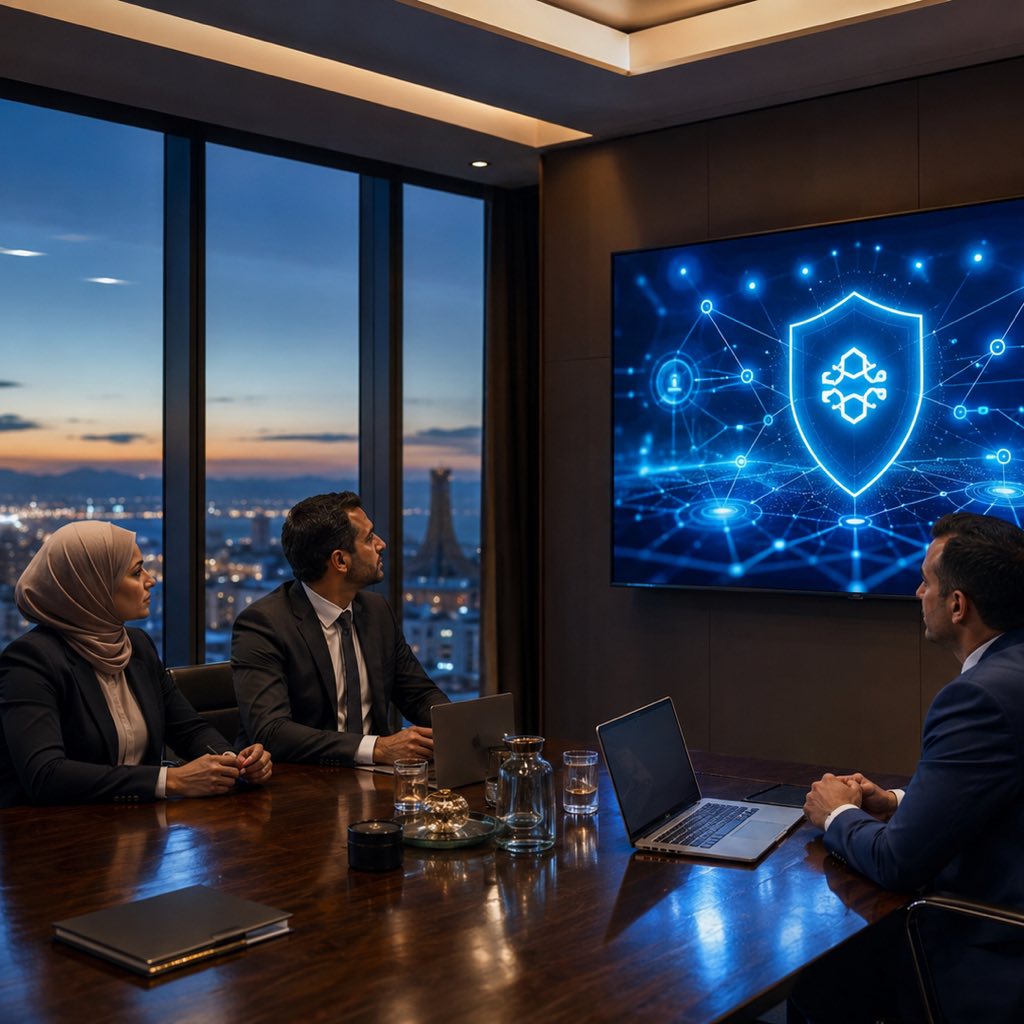
When Cyber Risk Stops Being an IT Ticket
For a long time, a data breach was something the IT team handled quietly, patched over a weekend, and rarely mentioned upstairs. That era is ending. Across Africa, cyber risk has been reclassified as an enterprise risk that belongs on the same board agenda as liquidity, supply chains, and regulatory exposure — and the shift is backed by hard numbers.
The Internal Audit Foundation’s “Africa Risk in Focus 2026” report, which surveyed audit leaders across the continent, found that 62% of African audit leaders rank cyber incidents as the number-one risk facing businesses on the continent — ahead of financial, human-capital, and regulatory risk. In North Africa specifically, 64% flagged cyber as a major concern. Business resilience ranked second at 49%, and “digital disruption” jumped to 44% from just 10% in the prior survey — the sharpest increase of any risk category. The cybersecurity consultancy Serianu has estimated cybercrime losses across Africa at roughly $10 billion in 2023.
Algeria sits squarely inside this trend. The country recorded more than 70 million cyberattacks in 2024, according to Kaspersky data that ranked it the 17th most-targeted nation globally, alongside more than 13 million intercepted phishing attempts. For an Algerian board director, the question is no longer whether the company will be probed — it is whether the board will find out about a serious incident from its own dashboard or from a customer, a regulator, or the press.
What Board-Level Cyber Governance Actually Looks Like
The strongest evidence that board oversight changes outcomes comes from the World Economic Forum’s Global Cybersecurity Outlook 2026, produced with Accenture. Among organizations the report classifies as highly resilient, 99% report active board involvement in cybersecurity. That involvement is concrete, not ceremonial: 52% of these boards receive regular cybersecurity updates, 48% are actively engaged with the security function, and 45% have a clearly defined role in overseeing cyber risk. Board engagement is one of the specific indicators — alongside structured AI security reviews, supply-chain risk integration, and sustained skills investment — that separates resilient companies from fragile ones.
The threat picture the board must track is also changing. Chief executives in the WEF study now rate cyber-enabled fraud as their top concern, displacing ransomware, while 91% of the largest organizations have adjusted their cybersecurity strategy in response to geopolitical volatility. Boland Lithebe, Accenture’s security lead in South Africa, framed the continental shift plainly in an analysis of cyber resilience moving from an IT issue to a board risk: attacks are now “well-resourced, persistent and designed to exploit gaps,” and board-level accountability is emerging as standard practice rather than a nice-to-have.
There is a governance template close to home. Algeria’s public institutions moved first: Presidential Decree 26-07 of January 2026 requires each public body to create a dedicated cybersecurity unit — separate from IT management — reporting directly to the head of the organization. Private-company boards do not fall under that mandate, but they can voluntarily adopt the same principle that gives it force: elevate cyber oversight above the IT department, and make one senior person answerable for it at the top of the house. Boards that adopt this structure now, before any sector-specific rule reaches them, convert a compliance chore into a first-mover advantage.
Advertisement
The Insurance Blind Spot Boards Keep Missing
One number should give every Algerian board pause. A GlobalData survey of more than 2,000 SMEs across 14 countries found that 34.7% of SMEs experienced a cyber incident in the past three years, yet only 16.8% carry standalone cyber insurance. The gap between exposure and financial protection is a governance question, not a purchasing one: it is the board’s job to ask whether the company’s residual cyber risk is transferred, retained knowingly, or simply ignored. In a market where cyber insurance is still maturing, directors who understand the coverage gap can make deliberate risk-transfer decisions instead of discovering the shortfall during a live incident.
What Algerian Company Boards Should Do Now
Board oversight of cyber risk does not require directors to become engineers. It requires a small number of disciplined, repeatable practices. Here are four that private-company boards in Algeria can adopt this year.
1. Put a standing cyber item on every board agenda, not just after an incident
Resilient boards treat cyber as a recurring line item, the way they treat cash flow — not a fire drill triggered by a breach. Schedule a short cyber briefing at every board or audit-committee meeting, with a consistent one-page dashboard: number and severity of incidents, patch and detection timelines, phishing-test results, and the status of the top three risks. The WEF finding that 52% of resilient-organization boards receive regular updates is the benchmark to match. Regular exposure builds the directors’ fluency so that in a crisis they are asking sharp questions rather than learning the vocabulary.
2. Name one accountable executive and give the board a direct line to them
Ambiguous ownership is where cyber governance fails. Designate a single senior owner — a CISO, or in a smaller firm a security-responsible executive — and give the board or its risk committee a direct reporting line to that person, not one filtered entirely through general IT. This mirrors the reporting-to-the-top principle already written into Algeria’s public-sector Decree 26-07. The point is accountability: when the board can name who owns cyber risk and can question them directly, oversight becomes real rather than nominal.
3. Translate cyber into money and decisions the board already understands
Directors govern in the language of financial exposure, not CVE numbers. Ask management to express cyber risk in business terms: the revenue at risk if the e-commerce platform is down for 48 hours, the cost of a customer-data breach, the fraud loss from a compromised payment flow. With cyber-enabled fraud now the top concern of global CEOs, this framing lets the board weigh security spending against quantified downside — and decide, consciously, how much residual risk to accept, mitigate, or transfer through insurance.
4. Rehearse the incident response before you need it
A resilience plan that has never been tested is a document, not a capability. Commission at least one tabletop exercise a year in which directors, the security owner, legal, and communications walk through a realistic breach scenario — a ransomware hit, a supply-chain compromise, a business-email-compromise fraud. The exercise reveals decision bottlenecks (Who authorizes paying? Who talks to regulators? Who notifies customers?) while they are cheap to fix. The WEF’s resilient organizations run ecosystem-wide incident simulations for exactly this reason: the first time a board debates these questions should never be during a live attack.
Where This Fits in Algeria’s 2026 Landscape
The direction of travel is unmistakable. Cyber risk is being reclassified from a technical cost center into a core enterprise risk, and the organizations pulling ahead are the ones whose boards treat it that way. For Algerian private companies, this is a moment of opportunity rather than pressure. The public sector has already set a governance precedent with dedicated cyber units reporting to the top; the continental data shows peers across Africa naming cyber as their leading risk; and the tools — a standing agenda item, a named owner, business-language reporting, and annual rehearsals — are inexpensive and available today.
Boards that build this muscle in 2026 will not only be readier when an incident comes; they will be better positioned to win enterprise customers, partners, and lenders who increasingly ask about cyber governance before they sign. Cyber resilience has reached the boardroom. The Algerian companies that welcome it there, rather than waiting to be pushed, will lead their sectors.
Frequently Asked Questions
Why is cyber risk now considered a board-level issue instead of an IT problem?
Because the impact is now enterprise-wide: financial loss, fraud, regulatory exposure, and reputational damage all land on the business, not just the IT team. The World Economic Forum found that 99% of highly resilient organizations have direct board involvement in cybersecurity, and 62% of African audit leaders rank cyber as their top business risk. Oversight of that level of risk is a governance responsibility that sits with directors.
What is the minimum a board should do about cyber risk?
At a minimum, a board should put a standing cyber briefing on every meeting agenda, receive a consistent one-page risk dashboard, name a single accountable security owner with a direct reporting line, and run at least one incident-response tabletop exercise per year. These four practices require no new technology and can be started immediately — they mirror the habits the WEF associates with resilient organizations.
Do Algerian private companies have to follow the public-sector cybersecurity decree?
Presidential Decree 26-07 (January 2026) applies to public institutions, requiring each to create a dedicated cybersecurity unit reporting to the head of the organization. Private companies are not bound by it, but they can voluntarily adopt the same principle — elevating cyber oversight above the IT department and making one senior person accountable at the top. Doing so early positions a company ahead of any future sector-specific requirements.
Sources & Further Reading
- Cyber Resilience Moves From IT Issue to Board Risk — IT News Africa
- Cyber Risks: Top Concerns for African Businesses in 2026 — Ecofin Agency
- Global Cybersecurity Outlook 2026: The Trends Reshaping Cybersecurity — World Economic Forum
- Low Cyber Insurance Uptake Leaves SMEs Exposed — Insurance Journal
- Algeria Strengthens Cybersecurity Framework to Protect National Infrastructure — TechAfrica News
🔗 Related Intelligence

Algeria Banking Cybersecurity: Building Resilience Under Decree 26-07 in 2026

Decree 26-07: Algeria’s Cybersecurity Units Mandate — What Enterprises Must Do Now

Decree 26-07 Six Months In: How Algerian Public Bodies Are Standing Up Cybersecurity Units in 2026

Phishing, Ransomware, and Social Engineering: The Top Cyber Threats Targeting Algerian