Research Output That Outpaces the Ecosystem
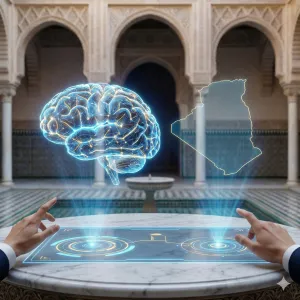
In 2024, Algerian researchers published 859 AI-related papers indexed in Scopus and Web of Science. That figure places Algeria among the top five African nations for AI scholarship, alongside South Africa, Egypt, Nigeria, and Tunisia, according to the New Lines Institute’s analysis of the country’s AI positioning.
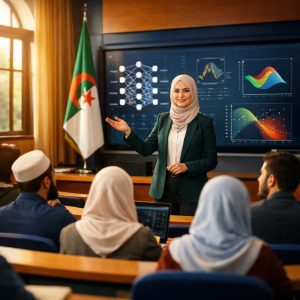
The institutional base driving this output is substantial. Algeria now operates 12 dedicated AI research laboratories across major academic centers in Algiers, Constantine, Oran, Annaba, and Sidi Bel Abbes. The country offers 74 AI master’s programs across 52 universities, enrolling approximately 57,702 students in AI and computer science disciplines. Several Algerian researchers appear in Stanford University’s Top 2% Scientists database by citation impact — in 2024, 68 Algerian researchers across all disciplines earned that distinction.
But publication volume alone does not build an industry. Fewer than 15% of Algeria’s estimated 50-60 active AI startups have received government financial support. The gap between what Algerian researchers produce in laboratories and what reaches the market remains the country’s defining AI challenge.
Where the Research Concentrates
Algerian AI research clusters around domains where local expertise creates genuine comparative advantage.
Natural Language Processing stands out as the strongest domain. Algeria’s linguistic complexity — a population that code-switches between Algerian Arabic (Darja), French, and Tamazight, using both Arabic and Latin scripts — creates research problems that cannot be solved by researchers elsewhere. DziriBERT, a BERT-based language model pre-trained on approximately one million Algerian tweets, demonstrated that a model trained on a modest 150 MB dataset could outperform larger models on Algerian text classification tasks. The project, hosted on HuggingFace under the alger-ia organization, has been cited internationally and remains a foundation for downstream Algerian Arabic applications. More recently, Hadretna, developed by Fentech in partnership with Professor Merouane Debbah (president of Algeria’s National AI Council), has pre-trained a large language model on two billion tokens of Darija and Tamazight data.
Computer vision research focuses on agricultural monitoring — olive tree disease detection, date palm quality assessment, wheat yield prediction from satellite imagery — and medical imaging, particularly chest X-ray interpretation and retinal disease detection. Both domains address real national needs: agriculture accounts for roughly 12% of GDP, and AI-assisted diagnostics could help extend specialist capacity across underserved regions.
Machine learning theory and optimization benefits from Algeria’s strong mathematical tradition, producing papers on novel optimization algorithms, ensemble methods, and feature selection techniques. IoT and edge computing research targets smart grid optimization and agricultural sensor networks relevant to Algeria’s economic priorities.
Advertisement
The Structural Bottlenecks
The research-to-market pipeline fails at multiple points.
Funding remains scarce. The Algerian Startup Fund (ASF) has reviewed over 350 startup applications and supported startups across 22 provinces since its creation, but total disbursement remains modest relative to demand. Algeria Venture, the national public accelerator, provides support but cannot substitute for a mature venture capital ecosystem. The FCPR (Fonds Commun de Placement a Risque) framework was established to enable regulated venture capital vehicles, but adoption has been slow. International VC participation is deterred by foreign exchange controls and regulatory complexity. In February 2025, Algerie Telecom announced an $11 million fund for AI, cybersecurity, and robotics startups — a positive signal, but small relative to the ecosystem’s needs.
Technology transfer infrastructure is virtually absent. Algerian universities perform none of the standard tech transfer functions — patent filing, licensing negotiation, startup incubation, industry partnership brokerage — that convert research outputs into products. Commercially valuable algorithms, trained models, and domain-specific datasets remain trapped in academic papers.
Market access is constrained. Algeria’s private sector has limited AI adoption, reducing domestic demand. Trade barriers limit cross-border activity within the Maghreb. Regulatory compliance requirements (GDPR, EU AI Act) create barriers for European market entry. Foreign exchange controls make it difficult for startups to receive international payments or pay for foreign cloud services.
Brain Drain Compounds the Problem
The most damaging consequence of structural bottlenecks is talent loss. Algerian AI researchers are actively recruited by French institutions (INRIA, CNRS labs, Paris-Saclay), Canadian universities (Montreal’s Mila ecosystem has significant Algerian representation), and Gulf technology companies where salaries can be significantly higher than Algerian academic positions. The salary differential between domestic academic positions and equivalent roles abroad — particularly in France, Canada, and the Gulf — creates persistent pressure that structural interventions alone may not fully counteract.
This diaspora represents both a loss and a potential asset. Structured engagement programs — visiting professorships, remote research supervision, startup mentorship — could channel diaspora expertise back toward Algeria’s ecosystem without requiring permanent return.
Infrastructure Investments Show Promise
Recent infrastructure moves suggest the government recognizes the gap. ENSIA’s new high-performance computing center, inaugurated with NVIDIA H100, L40S, and A40 GPUs, provides the compute resources that competitive AI research demands. CDTA’s first national electronic chip design and production laboratory, inaugurated in December 2024 at Baba Hassen, adds hardware capability to the research ecosystem. The government has set a target of 7% GDP contribution from the digital economy by 2027, with the national AI strategy for 2025-2030 coordinated by the National Scientific Council for Artificial Intelligence.
The critical missing pieces are technology transfer offices at major universities, a dedicated AI startup grant program in the $50,000-$200,000 range, and structured diaspora engagement. Algeria’s 2,300-plus labeled startups ecosystem, built under the 2020 Startup Act, provides a framework — but AI commercialization requires specialized instruments that the general startup infrastructure does not yet provide.
Frequently Asked Questions
How does Algeria’s AI research output compare to other African countries?
Algeria published 859 indexed AI papers in 2024, placing it among Africa’s top five alongside South Africa, Egypt, Nigeria, and Tunisia. Algeria’s particular strength is Arabic NLP, where projects like DziriBERT represent globally cited contributions. The country’s 12 research laboratories and 74 AI master’s programs across 52 universities provide institutional breadth that most African nations lack. However, citation impact lags behind South Africa and Egypt, partly because some Algerian publications appear in lower-visibility venues.
What is DziriBERT and why does it matter for Algerian AI?
DziriBERT is a BERT-based language model pre-trained specifically on Algerian Arabic (Darja) using approximately one million tweets. Standard Arabic NLP models perform poorly on Darja because it incorporates heavy French and Tamazight code-switching and uses both Arabic and Latin scripts. Despite its modest training dataset (150 MB), DziriBERT outperforms larger models on Algerian text classification tasks. It demonstrates that Algerian researchers can produce globally relevant NLP contributions by leveraging unique local linguistic expertise that is difficult to replicate elsewhere.
What would close the gap between Algeria’s research output and startup creation?
Three structural interventions are most critical: establishing technology transfer offices at Algeria’s top AI-producing universities to convert research into patents and licensed products; creating a dedicated AI startup grant program providing $50,000-$200,000 in non-dilutive funding for researcher-led ventures; and building structured diaspora engagement programs that channel the expertise of the estimated thousands of Algerian-origin AI professionals abroad back into the domestic ecosystem through mentorship, visiting positions, and co-investment.
Sources & Further Reading
- Why Algeria Is Positioned To Become North Africa’s AI Leader — New Lines Institute
- DziriBERT: A Pre-trained Language Model for the Algerian Dialect — arxiv
- Algeria Inaugurates National AI School Data Centre — Middle East AI News
- Algerie Telecom Creates $11 Million AI Startup Fund — Middle East AI News
- Inside Algeria’s Startup Labelling System: Over 2,300 Now Labeled — LaunchBase Africa
- Algeria Shines Globally: 68 Researchers in Stanford Top 2% — Jazair Hope
- Algeria Targets 7% GDP from AI by 2027 — WeAreTech Africa
🔗 Related Intelligence

Algeria’s Emerging AI Regulation: Balancing Innovation with Accountability
Algeria’s 74 AI Master Programs: Building the Workforce for Digital 2030

Algeria Builds Sovereign AI Models Faithful to National Values and Languages

AfDB’s $10B AI Initiative: New Opportunities for Algerian Startups and Researchers