En bref : AI operates in two fundamentally different modes: training (building the model) and inference (using it). Training is a massive, one-time capital expenditure — GPT-4 cost over $100 million to train. Inference is the ongoing operational cost every time a user sends a query, and it now accounts for the majority of AI compute spending globally. Understanding this distinction is essential for anyone making decisions about AI investment, deployment, or strategy, because the economics of each mode are entirely different.
Two Modes, Two Economies
There is a common misconception about AI costs. People see headlines about hundred-million-dollar training runs and assume that the big expense in AI is building models. That was true in 2022. It is no longer true.
By 2025, inference — running trained models to serve user requests — consumed more compute globally than training. Every ChatGPT conversation, every Copilot code suggestion, every AI-generated image, every automated customer service response is an inference workload. Training happens once. Inference happens billions of times per day.
This shift has profound implications. The companies winning the AI race are not necessarily those with the biggest training budgets. They are the ones that have figured out how to serve inference efficiently at scale — how to answer a million questions per minute without burning through their revenue in GPU costs.
Training: Building the Brain
Training a large language model is one of the most computationally intensive tasks humans have ever undertaken.
What Training Actually Does
During training, a neural network processes enormous datasets and adjusts its internal parameters (weights) to minimize prediction error. For a language model, this means reading trillions of tokens of text and tuning billions of parameters so the model becomes increasingly accurate at predicting the next token.
The process is iterative. The model makes a prediction, compares it to the actual next token, computes the error (loss), and propagates adjustments backward through all its layers. This cycle — forward pass, loss computation, backward pass, weight update — repeats hundreds of billions of times across the training dataset.
The Capital Cost
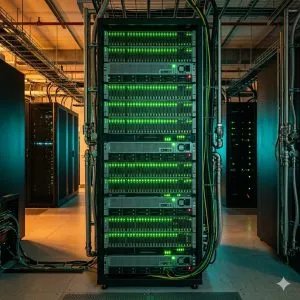
Training a frontier model requires an enormous concentration of specialized hardware. GPT-4 reportedly used around 25,000 Nvidia A100 GPUs running for approximately 90 to 100 days. At current cloud GPU rental rates, this represents north of $100 million in compute alone — not counting the engineering team, data preparation, failed experiments, and infrastructure.
The hardware demand is intensifying. TSMC’s $56 billion in capital expenditure for 2025 is driven substantially by demand for AI training chips. The GPU economy has created a supply bottleneck where access to training compute is a strategic constraint.
But here is the crucial economic point: training is a one-time cost. Once GPT-4 is trained, the resulting model weights can be copied indefinitely at essentially zero marginal cost. The $100 million investment is amortized across every user query over the model’s productive lifetime. This makes training a capital expenditure — a fixed cost that does not scale with usage.
The Data Challenge
Training requires data at an extraordinary scale. GPT-3 was trained on roughly 300 billion tokens. GPT-4 used an estimated 13 trillion tokens. The dataset must be carefully curated — filtering for quality, removing harmful content, balancing domains and languages, deduplicating to prevent memorization.
The “data wall” is a growing concern. Some researchers argue that the supply of high-quality text data on the internet is finite, and frontier models are approaching the point where all available data has been consumed. This has driven interest in synthetic data generation — using AI to create training data for other AI models — and in more data-efficient training methods.
Inference: Using the Brain
Inference is what happens when a trained model processes a user’s input and generates a response. It uses the same neural network architecture as training but operates fundamentally differently.
How Inference Works
During inference, data flows in one direction only — forward through the network. There is no backward pass, no gradient computation, no weight update. The model’s parameters are frozen. Input goes in, computation happens through all layers, and a prediction comes out.
For a language model, each generated token requires a full forward pass through the entire network. Generating a 500-token response requires 500 forward passes. Each pass involves matrix multiplications across all the model’s layers and attention heads, consuming both compute and memory.
The Operational Cost
Inference cost scales with three factors: model size (larger models require more computation per token), output length (more tokens = more forward passes), and throughput (more concurrent users = more hardware needed).
For GPT-4, estimates place the inference cost at roughly $0.01-0.06 per 1,000 tokens, depending on whether the tokens are input (cheaper, processed in parallel) or output (more expensive, generated sequentially). This sounds cheap, but at OpenAI’s scale — processing billions of tokens per day — inference costs dominate the company’s compute spending.
The critical difference from training: inference costs are variable. They scale linearly with usage. Double the number of users and you roughly double the inference cost. This makes inference an operational expenditure — a recurring cost that directly follows revenue.
Latency: The User Experience Constraint
Training can be slow and nobody notices — the model trains for months in a data center, then emerges ready to use. Inference must be fast because users are waiting.
For a chatbot, acceptable latency is under 200 milliseconds for the first token (time-to-first-token, or TTFT) and roughly 30-60 tokens per second for the remaining output (tokens per second, or TPS). Missing these targets makes the experience feel sluggish.
Meeting these targets for a 500-billion-parameter model serving millions of concurrent users is an extraordinary engineering challenge. The solutions involve model parallelism (splitting the model across multiple GPUs), batching (processing multiple requests simultaneously), KV-cache optimization (avoiding redundant computation on previously processed tokens), and quantization (reducing numerical precision to speed up computation).
Advertisement
The Great Inference Optimization Race
Because inference is the recurring cost, optimizing inference efficiency is where the economic leverage is. A 2x improvement in inference efficiency is equivalent to cutting the compute bill in half — permanently.
Quantization
Training typically uses 32-bit or 16-bit floating-point numbers for maximum precision. Inference can often use lower precision — 8-bit or even 4-bit integers — with minimal loss in output quality. This reduces memory usage and speeds up computation by 2-4x.
The breakthrough insight is that model weights do not need to be stored at full precision for inference. The subtle numerical differences between a 16-bit weight and its 4-bit approximation are negligible for most outputs. Quantization-aware training takes this further, training models to be robust to low-precision inference from the start.
Model Distillation
Model distillation transfers knowledge from a large “teacher” model to a smaller “student” model. The student is trained to match the teacher’s outputs rather than learning from raw data. The result is a smaller model that captures most of the larger model’s capability at a fraction of the inference cost.
DeepSeek’s approach exemplified this: by distilling from larger models and combining with innovative training techniques, they produced models that rivaled GPT-4’s performance while running on significantly less hardware. The cost implications are dramatic — what costs $100 to run on a frontier model might cost $5 on a well-distilled alternative.
Mixture of Experts
Mixture-of-experts (MoE) architectures represent a structural approach to inference efficiency. Instead of activating all parameters for every input, MoE models route each token through only a subset of specialized “expert” subnetworks. A model with 1 trillion total parameters might activate only 100 billion for any given token, dramatically reducing per-token compute while maintaining the quality benefits of a larger parameter count.
Mistral’s Mixtral and Google’s Switch Transformer demonstrated that MoE can deliver frontier-level performance at a fraction of the dense model’s inference cost. This architecture is increasingly the default for new model development.
Test-Time Compute
An emerging paradigm called test-time compute deliberately increases inference cost for difficult problems. Rather than generating a single response, the model generates multiple candidate responses, evaluates them, and selects or synthesizes the best one.
This inverts the traditional trade-off: instead of spending more on training to get a better model, you spend more on inference to get better outputs from an existing model. The economics are favorable because inference compute is applied selectively — only on the hard problems — while easy queries still get fast, cheap responses.
The Strategic Calculus
The training-vs-inference distinction creates different strategic considerations depending on your position in the AI ecosystem.
For AI labs building frontier models: Training cost is the barrier to entry. Only organizations that can fund $100M+ training runs can play at the frontier. But the competitive moat comes from inference efficiency — the lab that serves the same quality at lower cost captures the market.
For enterprises deploying AI: Training cost is largely irrelevant — enterprises use pre-trained models. Inference cost is the line item that determines ROI. This is why the choice between a frontier API (like GPT-4) and a smaller fine-tuned model is fundamentally an inference cost decision.
For countries building AI strategies: Training capabilities represent strategic autonomy — the ability to build models aligned with national values and languages. Inference infrastructure determines how widely AI can be deployed across the economy. Both require investment, but in different types of infrastructure.
For developers building AI applications: Understanding the training-inference split helps with architecture decisions. Should you call a large model’s API or deploy a smaller model on your own hardware? The answer depends on your volume, latency requirements, and budget — all of which are inference variables.
The Numbers That Matter
As of early 2026, here are the rough economics:
- Frontier model training: $100M-$500M per run, requiring 10,000-50,000 GPUs for 2-4 months
- Fine-tuning a pre-trained model: $1,000-$100,000 depending on dataset size and model
- Inference (GPT-4 class): $0.01-0.06 per 1,000 tokens
- Inference (distilled/quantized): $0.001-0.005 per 1,000 tokens
- Self-hosted inference (open-source): $0.50-$3.00 per GPU-hour, serving 10-100 requests per second depending on model size
The trend is clear: training costs are rising (bigger models, more data) while inference costs are falling (better optimization, hardware improvements, architectural innovations). The crossing point — where it became more expensive to train AI than to run it — happened around 2024. The gap continues to widen.
Frequently Asked Questions
What is ai training vs ai inference?
AI Training vs AI Inference: The Two Economies of Artificial Intelligence covers the essential aspects of this topic, examining current trends, key players, and practical implications for professionals and organizations in 2026.
Why does ai training vs ai inference matter?
This topic matters because it directly impacts how organizations plan their technology strategy, allocate resources, and position themselves in a rapidly evolving landscape. The article provides actionable analysis to help decision-makers navigate these changes.
How does training: building the brain work?
The article examines this through the lens of training: building the brain, providing detailed analysis of the mechanisms, trade-offs, and practical implications for stakeholders.
Sources & Further Reading
- Scaling Laws for Neural Language Models — Kaplan et al., OpenAI (2020)
- Training Compute-Optimal Large Language Models (Chinchilla) — Hoffmann et al., DeepMind (2022)
- Efficient Large Language Model Inference: A Survey — Miao et al., arXiv (2024)
- The Economics of Large Language Models — a16z blog, Andreessen Horowitz
- LLM Inference Performance Engineering — Databricks Technical Blog