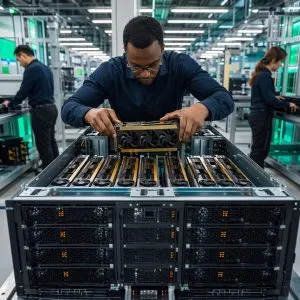
When most organizations think about AI infrastructure, they think about Nvidia. The H100 GPU has become the default unit of AI compute — a $30,000 chip that powers everything from model training at OpenAI to inference pipelines at enterprise software companies. But training a model and running it in production are fundamentally different problems. And two specialized challengers — Groq and Cerebras — have built entirely different silicon to solve the inference half of that equation.
The results are striking. On real-world benchmarks, Groq’s LPU delivers Llama 2 70B at 300 tokens per second — ten times faster than an H100 cluster running the same model. Cerebras’ WSE-3 broke the 1,000-token-per-second barrier for the 405-billion-parameter Llama 3.1 model, a scale of throughput that GPU arrays struggle to match. These are not marginal improvements. They represent a structural rethinking of what inference hardware should look like.
Why Inference Is Now the Defining AI Workload
For the first three years of the LLM era, training dominated the AI compute conversation. The race to build GPT-4, Llama 3, and Gemini consumed billions of dollars in GPU time and shaped the public narrative around AI infrastructure.
That balance has shifted decisively. In 2023, inference accounted for roughly one-third of all AI compute. By 2025, it had grown to half. Analysts project that by 2026, inference will represent approximately two-thirds of total AI compute spending — a reversal driven by the explosion of production AI deployments. Every chatbot session, every API call to an LLM, every document processed by an AI pipeline is an inference job. Training happens once; inference happens billions of times a day.
The global AI inference market reflects this reality. Valued at $103 billion in 2025, it is projected to reach $255 billion by 2030 at a 19% CAGR. Cloud AI inference chips alone are expected to grow from $49 billion in 2025 to $288 billion by 2032. The commercial pressure to run inference faster and cheaper has never been higher.
The Memory-Bandwidth Bottleneck That GPUs Cannot Escape
To understand why Groq and Cerebras exist, you need to understand one fundamental insight: LLM inference is not a raw compute problem. It is a memory-bandwidth problem.
Running a language model requires loading billions of model weights from memory into processing units for every single token generated. On a GPU like the H100, those weights live in high-bandwidth memory (HBM) — physically separate chips attached to the GPU die. Even the fastest HBM has latency, and when you are generating tokens one at a time in a sequential chain, that memory round-trip cost accumulates into the latency floor.
Groq’s Language Processing Unit (LPU) attacks this bottleneck directly. Instead of HBM, the LPU uses on-chip SRAM — memory baked directly into the processor die. On-chip SRAM is orders of magnitude faster to access. Combined with a deterministic execution model that eliminates shared-bus contention and context-switching overhead, the LPU can sustain consistent, predictable throughput that GPU clusters cannot match on latency-sensitive workloads.
Cerebras takes a different but related approach. Its Wafer-Scale Engine 3 (WSE-3) is literally a single silicon wafer the size of a dinner plate: 46,255 mm² of silicon containing 4 trillion transistors and 900,000 AI-optimized cores. Because the entire model fits on a single piece of silicon with 44 GB of on-chip SRAM, the memory-bandwidth gap that plagues GPU inference disappears. Cerebras reports 7,000 times more effective memory bandwidth than the Nvidia H100 — and its benchmark results confirm the advantage at scale.
Groq: Sub-Millisecond Latency as a Product
Groq’s commercial product is GroqCloud, an API-first inference service that developers can access without buying any hardware. Since its public launch, GroqCloud has attracted over 1.9 million developers and enterprise customers including Dropbox, Volkswagen, and Riot Games.
The performance numbers are well-documented by third-party benchmarkers. ArtificialAnalysis.ai clocked Groq’s Llama 2 70B API at 241 tokens per second in independent testing — placing it far ahead of any GPU-based competitor on throughput. Time-to-first-token sits below 300 milliseconds for most models, with sub-millisecond latency achievable for smaller, optimized configurations.
Pricing reflects the competitive pressure building in the inference market. As of late 2025, Groq charges $0.11 per million input tokens and $0.34 per million output tokens for Llama 4 Scout — positioning it well below premium GPU-based providers. Llama 3 70B runs at $0.59/$0.79 per million tokens. For teams running high-volume inference workloads, these rates can materially change the unit economics of an AI product.
The signal from larger players is unambiguous about Groq’s strategic position: Nvidia signed a $20 billion licensing deal with Groq, an acknowledgment that specialized inference silicon represents a durable market, not a temporary novelty.
Advertisement
Cerebras: When the Model Is Too Big for Any GPU
Where Groq optimizes for latency, Cerebras optimizes for raw throughput on the largest models. Its WSE-3’s 2025 benchmark of 969 output tokens per second for Llama 3.1-405B — a 400+ billion parameter model — demonstrated inference performance that GPU clusters cannot replicate without massive parallelism across dozens of H100s.
The enterprise traction is real. Mayo Clinic announced a genomic foundation model partnership with Cerebras at the January 2025 J.P. Morgan Healthcare Conference. ZS integrated Cerebras’ CS-3 systems into its MAX.AI platform in April 2025. Most significantly, OpenAI signed a deal in January 2026 for Cerebras to deliver 750 megawatts of computing power through 2028 — a contract valued at over $10 billion that places Cerebras directly inside the AI ecosystem’s most critical workflows.
Cerebras is also approaching a public market test: an IPO is targeted for Q2 2026, which will provide the first clear public valuation benchmark for specialized inference infrastructure companies.
The Competitive Landscape in 2026
Groq and Cerebras are not operating in a two-player market. The inference hardware landscape has become crowded and genuinely competitive.
Google’s TPU Trillium v6 delivers LLM inference latency in the 5–20ms range at costs approximately 30% lower than Nvidia H100. AWS Inferentia2 has pushed further, claiming 70% lower costs than H100 with 4x the throughput for deployments within the AWS ecosystem. In February 2026, SambaNova unveiled the SN50 chip with claims of 5x faster inference than competitors and 3x lower total cost of ownership than GPUs. Google’s forthcoming TPU v7 Ironwood benchmarks at 4,614 TFLOPS per chip — analysts placing it on par with Nvidia’s Blackwell generation.
Meanwhile, the number of inference providers ballooned from 27 in early 2025 to 90 by year-end. This competitive pressure has driven one of the most dramatic cost deflations in technology history: GPT-4 equivalent inference that cost $20 per million tokens in late 2022 now runs at approximately $0.40 per million tokens — a 50-fold reduction in three years.
Nvidia is not standing still. The Blackwell architecture (B100/B200) delivers roughly twice the inference performance of Hopper H100, and the CUDA software ecosystem — two decades of developer investment — remains the most powerful moat in AI infrastructure. Switching away from CUDA-native tooling is a real engineering cost that most teams are not eager to absorb.
Which Workloads Actually Benefit
Not every inference use case should migrate to purpose-built silicon. The practical calculus depends on workload characteristics.
Groq’s LPU is best suited to latency-sensitive, real-time applications where response time directly affects user experience: chatbots, voice AI, real-time search, interactive document assistants. If time-to-first-token is a product metric, Groq’s deterministic sub-millisecond performance is a competitive advantage worth evaluating.
Cerebras targets the highest-parameter model tier — scenarios where running Llama 3.1-405B or similarly massive models in production is a requirement, not a choice. Healthcare AI, legal document processing, and enterprise agents that need deep reasoning capability at speed are the natural fit.
For flexible, multi-model deployments, mixed batch-and-real-time pipelines, or teams deeply embedded in existing cloud ecosystems (AWS, Google Cloud), GPU-based infrastructure with Inferentia or TPU augmentation often remains the pragmatic choice. Flexibility carries real value.
The inference cloud market entering 2026 is not a winner-take-all competition. It is a segmentation: purpose-built silicon wins specific workload profiles convincingly, while GPU platforms retain the advantage of ecosystem breadth. The question for any AI team is whether their specific workload sits in the segment where specialized inference hardware delivers returns that justify the integration cost.
Frequently Asked Questions
What is groq vs cerebras 2026?
Groq vs Cerebras 2026: AI Inference 100x Faster Than GPUs covers the essential aspects of this topic, examining current trends, key players, and practical implications for professionals and organizations in 2026.
Why does groq vs cerebras 2026 matter?
This topic matters because it directly impacts how organizations plan their technology strategy, allocate resources, and position themselves in a rapidly evolving landscape. The article provides actionable analysis to help decision-makers navigate these changes.
How does the memory-bandwidth bottleneck that gpus cannot escape work?
The article examines this through the lens of the memory-bandwidth bottleneck that gpus cannot escape, providing detailed analysis of the mechanisms, trade-offs, and practical implications for stakeholders.
Sources & Further Reading
- Groq LPU Inference Engine Crushes First Public LLM Benchmark — Groq
- Groq On-Demand Pricing — Groq
- Cerebras Launches World’s Fastest AI Inference — Cerebras
- Cerebras Inference: Llama 3.1-405B Record — Cerebras
- Cerebras WSE-3 Announcement: 4 Trillion Transistors — Cerebras
- AI Inferencing Will Define 2026 — SDxCentral
- AI Inference Industry Worth $254.98 Billion by 2030 — MarketsAndMarkets
- Nvidia, Google TPUs, AWS Trainium: Comparing Top AI Chips — CNBC