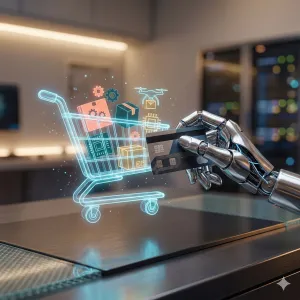
The New Customer That Never Opens a Browser
For thirty years, e-commerce optimization meant improving the experience for a human being looking at a screen: faster page loads, cleaner navigation, persuasive product photography, streamlined checkout. The metric hierarchy — traffic, sessions, conversion rate, average order value — assumed that the entity making the purchase decision was a person.
That assumption is being quietly dismantled. As of 2026, AI shopping agents — operating on behalf of consumers through platforms like ChatGPT shopping, Microsoft Copilot Checkout, Perplexity shopping, and Google’s Gemini purchasing flows — are making product discovery and checkout decisions without a human navigating a product page. These agents do not “look” at a website. They query APIs, parse structured data, evaluate attribute completeness, and select products based on machine-readable product descriptions rather than visual merchandising.
The emerging research makes the behavioral shift concrete. 73% of consumers already use AI in their shopping journey. 70% are comfortable with AI agents making purchases on their behalf. 90% of B2B buying is projected to be AI agent-intermediated by 2028, according to commercetools analysis. The implication is direct: a merchant’s relationship with its customer is increasingly mediated by an AI agent that the merchant cannot see, cannot control, and cannot influence through the traditional levers of digital marketing.
The merchants who understand this — and restructure accordingly — are already seeing results. Nexus Apparel (a case study documented by commerce infrastructure firm Presta) added 15 new attributes to their Universal Commerce Protocol discovery primitive: “Sustainability Score,” “Breathability Index,” and similar intent-driven fields. The result was a 40-60% conversion uplift compared to traditional mobile web checkout and a 35% lower customer acquisition cost than Google Ads-driven traffic. A 210% increase in “Proxy Sales” (agent-initiated transactions) within 60 days followed.
Why Standard SEO Doesn’t Work for AI Agents
Traditional search engine optimization was built for crawlers that index text and return ranked URLs to humans who then make the final decision. Agent Engine Optimization (AEO) — the emerging practice of optimizing for AI agent discovery — operates on fundamentally different mechanics.
When a consumer asks an AI agent to “find me a refurbished laptop under 60,000 DZD with at least 16GB RAM and a battery that lasts 8 hours,” the agent does not return a list of links. It selects a product directly, triggers a checkout flow, and completes the transaction. The selection algorithm weighs attribute completeness (does this product listing have a verified battery life field?), inventory accuracy (is it actually in stock?), API response latency (can the agent retrieve the data within 2 seconds?), and trust signals (is the seller credentialed in the UCP manifest?).
A merchant whose product catalog has rich SEO-optimized titles and descriptions but no structured attribute fields will be invisible to this selection process — not ranked lower, but categorically absent from the consideration set. The incompleteness does not produce a bad ranking; it produces a zero.
Advertisement
What Merchants Must Do to Be Agent-Ready
1. Rebuild Your Product Catalog Around Machine-Readable Attributes
The core technical investment is attribute enrichment: moving from human-readable product descriptions to structured, queryable attribute fields that AI agents can directly evaluate. The Universal Commerce Protocol framework recommends exposing a /.well-known/ucp manifest covering four primary API namespaces: Discovery (product queries), Cart (persistent state management), Checkout (transaction execution), and Order Management (fulfillment tracking). Beyond the manifest, individual product records need expanded attribute schemas. Generic fields like “color: blue” are insufficient — agent systems operating on behalf of consumers with specific preferences need granularity: colorway family, fade resistance rating, material composition percentage, size-run completeness, country of manufacture. The Nexus Apparel case study showed that adding 15 intent-driven attributes directly increased the frequency with which AI agents recommended the brand over competitors with equivalent products but thinner data. Catalog enrichment is not a one-time project — it is an ongoing editorial function, the same way SEO content management became an ongoing function in the 2010s.
2. Set API Response Latency Targets Before They Are Set For You
The UCP framework specifies that AI agents will “move on to a faster competitor” if API responses exceed 2 seconds, with enterprise targets of under 100 milliseconds for edge-based implementations. This is not a stretch goal — it is a binary threshold. An agent querying ten competing merchants for a product will select from the subset that responds within its latency tolerance. Merchants operating on shared hosting, unoptimized legacy API infrastructure, or platforms that were not designed for machine-to-machine query throughput will fail this threshold without intervention. The remediation path is technical but well-defined: edge deployment of the product catalog API (CDN-level caching for attribute queries), structured database optimization for attribute-filtered queries, and load testing under simulated agent concurrency rather than human session patterns. Merchants on modern commerce platforms (Shopify, commercetools, BigCommerce) typically have a shorter path to compliance than merchants on custom legacy stacks.
3. Implement Agent Payments Protocol 2 Before Autonomous Checkout Becomes Standard
Agent Payments Protocol 2 (AP2) is the authorization framework that allows AI agents to complete transactions on behalf of consumers without exposing the consumer’s full payment credentials to the agent. Transactions require “one-time execution tokens” and “scoped spending limits” — the agent is authorized to spend up to a defined amount on a defined category, not to make unlimited purchases with stored card data. For merchants, AP2 implementation means integrating with payment providers that support token-based agent authorization: Stripe, PayPal, and Shopify Payments have all published AP2 roadmaps. Merchants that complete AP2 integration before it is widely required will capture agent-originated transactions that currently fail or fall back to human-in-the-loop checkout — a significant revenue leak in any category where agentic shopping is already active. The “scoped spending limits” feature is also a consumer trust catalyst: consumers who might hesitate to authorize an AI agent with unrestricted purchase authority will authorize one with a defined budget cap and category restriction.
4. Restructure Post-Purchase Data Pipelines for Agent Feedback Loops
AI shopping agents learn which merchants to recommend based on post-purchase outcomes: did the item arrive as described? Was the return process frictionless? Did the delivery confirmation flow integrate with the agent’s task completion? Merchants whose order management APIs do not surface structured fulfillment events (shipped, out-for-delivery, delivered, return-initiated) to agent platforms will receive systematically lower confidence scores over time, regardless of their product catalog quality. The post-purchase data pipeline is the feedback mechanism through which agent recommendation algorithms update their merchant rankings. Building a structured webhooks layer for fulfillment events — not just for consumers but for agent platforms — is the operational equivalent of maintaining a strong Trustpilot rating in a human-driven search ecosystem.
What Comes Next for Merchant Strategy
The agentic commerce transition is not waiting for merchants to complete their readiness work. Microsoft Copilot Checkout, live since January 8, 2026, already reports that journeys including Copilot drive 53% more purchases within 30 minutes. Shopify’s Agentic Storefronts, live since late March 2026, have given “millions of merchants” single-surface presence in ChatGPT, Copilot, Gemini, Meta, and Perplexity — but single-surface presence with thin product data produces thin results.
The competitive dynamic among merchants is not yet resolved. The merchants who complete catalog enrichment, API infrastructure hardening, and AP2 integration in the next 12 months will have a structural advantage during the period when agent platforms are actively building their merchant trust models. Merchants who delay will find that the trust models are already formed — and retraining an agent platform’s confidence scores takes much longer than building them correctly the first time.
The recommendation for any merchant generating over $1 million in annual online revenue is direct: treat agent readiness as a Q3 2026 technical priority, not a Q4 planning item. The customers who will not browse your website are already shopping.
Frequently Asked Questions
What is Agent Engine Optimization (AEO) and how is it different from SEO?
AEO is the practice of optimizing product data, APIs, and checkout flows for AI agent discovery and selection — as opposed to SEO, which optimizes for human-readable search engine rankings. Where SEO rewards well-structured text, internal linking, and page authority, AEO rewards attribute completeness (granular structured fields), API response speed (sub-2-second latency), inventory accuracy (real-time stock data), and trust signals (verified UCP manifests). A product that ranks well in Google search results is not automatically discoverable by an AI shopping agent — the two optimization targets require different underlying data structures.
What is the Universal Commerce Protocol (UCP) and do I need to implement it?
The Universal Commerce Protocol is a standardized framework — co-developed by Google and Shopify and endorsed by Walmart, Target, Mastercard, Visa, Stripe, and others — that provides a machine-readable interface for AI agents to discover, query, and purchase from merchant catalogs. Merchants implement UCP by exposing a /.well-known/ucp manifest with four API namespaces (Discovery, Cart, Checkout, Order Management). Shopify merchants on Agentic Storefronts are enrolled automatically; merchants on other platforms implement via their commerce platform’s UCP connector or via direct API development. Merchants who do not implement UCP are not penalized on traditional search — they are simply absent from agent-originated commerce flows.
How significant is the revenue impact of agentic commerce today?
Microsoft Copilot Checkout, launched January 8, 2026, reports that journeys including Copilot drive 53% more purchases within 30 minutes. Adobe Analytics recorded 393% year-over-year growth in AI-driven traffic to US e-commerce sites in Q1 2026. Early-adopter merchants report 40-60% conversion uplift versus traditional mobile web checkout for agent-initiated sessions. Morgan Stanley projects AI shopping agents will account for roughly 25% of online spending by 2030. The revenue impact is already measurable for merchants on agent-compatible platforms; it is immeasurable for merchants not on them.
—