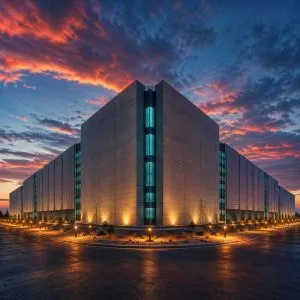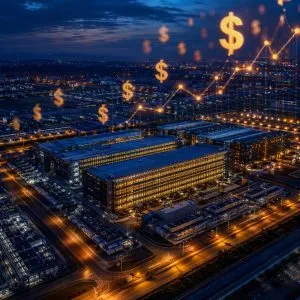
The server room you picture in your head is dead. Forget the neat rows of humming boxes behind glass walls, the cold aisles and blinking LEDs that defined two decades of cloud computing. The facilities being built right now to power artificial intelligence look nothing like that. They are louder, hotter, wetter, and vastly more expensive. They consume enough electricity to power small cities. And the companies building them are spending more money, faster, than at any point in the history of technology.
En bref : The AI revolution runs on a new kind of physical infrastructure. Hyperscalers are collectively spending upwards of $650 billion in 2026 on AI-optimized data centers featuring liquid cooling, custom rack designs delivering 120-230 kW per rack, and NVIDIA DGX SuperPOD architectures. This is not an upgrade to existing facilities — it is a wholesale reinvention of what a data center is.
The AI Factory Concept
Jensen Huang, NVIDIA’s CEO, has been correcting people for two years now. At Computex 2025, he declared that AI data centers are “improperly described” — they are, in fact, AI factories. The distinction matters: you apply energy to an AI factory, and it produces something valuable. Those outputs are called tokens.
The rebranding is not mere marketing. A traditional data center stores and serves data. It responds to requests. An AI factory, by contrast, runs computation continuously. It consumes raw inputs — electricity, cooling water, training data — and produces outputs: model weights, inference results, generated text and images. The analogy to industrial manufacturing is precise: these are production facilities with inputs, throughput, and yield metrics.
And the scale of production is staggering. At the World Economic Forum in Davos in January 2026, Huang laid out the supply chain: TSMC is building 20 new chip plants, and Foxconn, Wistron, and Quanta are building 30 new computer plants, which then feed into AI factories. These are not speculative announcements. Ground has broken. Concrete is being poured.
The Liquid Cooling Revolution
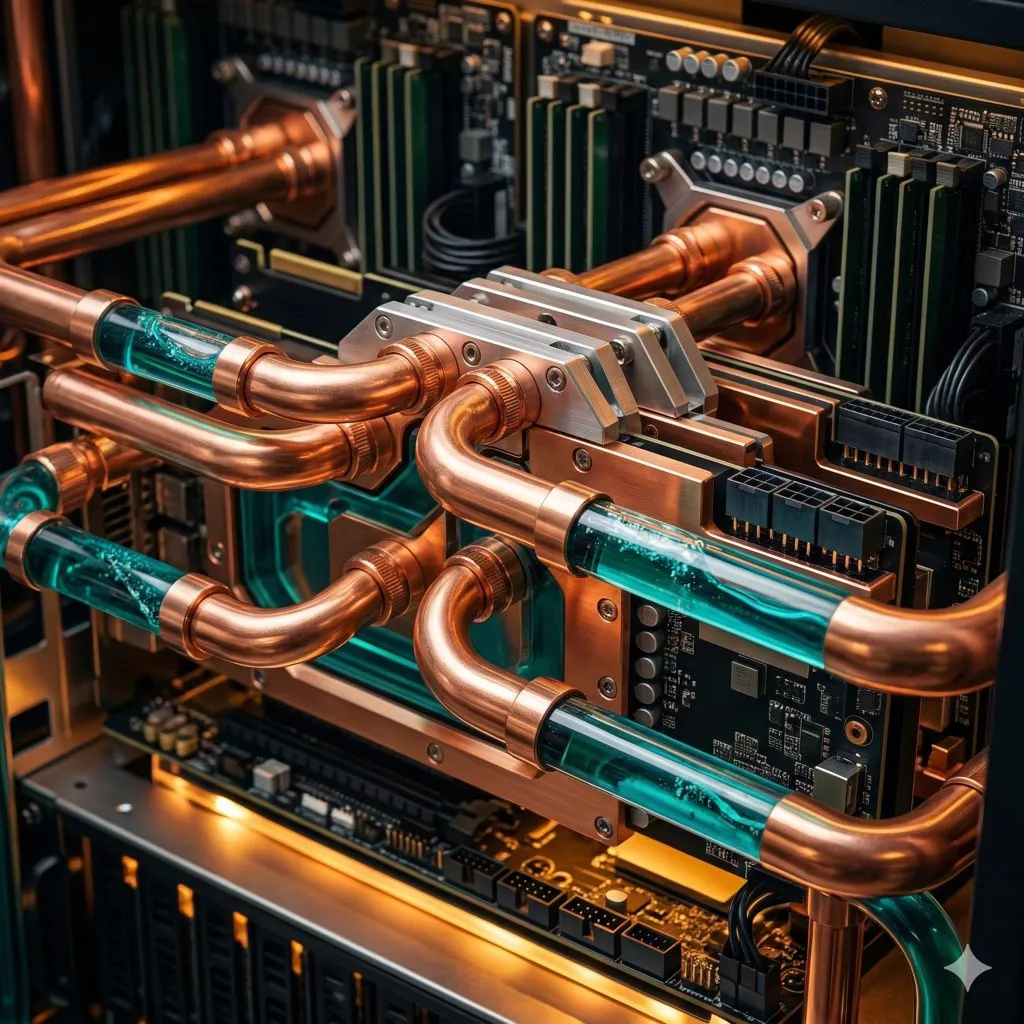
The single biggest architectural shift in AI data centers is thermal management. Traditional air cooling — pushing cold air through raised floors and hot aisles — cannot handle the heat densities that modern AI hardware produces. An NVIDIA GB200 NVL72 rack draws approximately 120 kilowatts of power, with 115 kW managed by liquid cooling and 17 kW by air cooling. The next generation, the Vera Rubin VR200 NVL72, is projected to reach up to 230 kW per rack in its Max P configuration. For context, a standard enterprise server rack draws 7-15 kW.
At these power densities, air cooling is not merely insufficient — it is physically impossible. The air cannot absorb and transport heat fast enough. The solution is liquid cooling, and the industry has moved from experimental pilots to standard architecture with remarkable speed.
NVIDIA’s DGX SuperPOD, the company’s reference architecture for large-scale AI deployment, employs a hybrid cooling solution. The most power-intensive components — GPUs and CPUs — are directly liquid-cooled, with coolant flowing through cold plates attached to the chips. Less intensive components still use air cooling. The result is a system that can handle extreme heat loads while maintaining the reliability that enterprise customers demand.
The market is responding accordingly. The liquid cooling market for data centers is projected to grow from roughly $6.6 billion in 2026 to between $25 and $38 billion by the early 2030s, with compound annual growth rates ranging from 20% to 29% depending on the forecast. Already, 22% of data centers globally have implemented some form of liquid cooling, and that figure is climbing with every new AI facility that comes online.
In December 2025, Siemens and nVent announced a joint reference architecture purpose-built for NVIDIA AI data centers, targeting 100-megawatt hyperscale sites built around large, liquid-cooled DGX SuperPOD clusters. The Tier III-capable design integrates Siemens’ industrial-grade electrical and automation systems with nVent liquid cooling technology. This is infrastructure designed from the ground up — not retrofit, not adapted, but engineered specifically for AI workloads.
Inside a DGX SuperPOD
The NVIDIA DGX SuperPOD is the building block of modern AI infrastructure. It is a rack-scale system designed for both training and inference, optimized to maximize performance per dollar and per watt.
A single GB200 NVL72 rack contains 72 Blackwell GPUs and 36 Grace CPUs connected via NVLink, arranged across 18 compute trays in a unified, liquid-cooled chassis. The NVLink Switch System provides 130 terabytes per second of low-latency GPU communications, making the 72-GPU domain act essentially as a single massive accelerator. Multiple racks connect via high-bandwidth networking to form a SuperPOD. Multiple SuperPODs scale into AI factories.
The architecture is not just about raw compute. NVIDIA’s reference design specifies every element of the facility: power delivery, cooling loops, networking fabric, storage tiers, and management software. Schneider Electric has developed matching infrastructure designs — the industry’s first integrated power management and liquid cooling controls reference design using a plug-and-play MQTT-based architecture that bridges operational technology and IT systems. This enables operators to harness data from every layer to optimize performance.
The first real-world deployment of the DGX B300 SuperPOD was completed by pharmaceutical giant Eli Lilly. Dubbed “LillyPod,” it comprises 1,016 Blackwell GPUs offering over 9,000 petaflops of AI performance. Assembled in four months, it was unveiled at NVIDIA’s GTC event in Washington, D.C. in late October 2025. Lilly is using the system for AI-powered drug discovery, training biomedical foundation models on 700 terabytes of genomics data — demonstrating that AI factories are not just for tech companies.
The Multi-Hundred-Billion-Dollar Buildout
The numbers are almost incomprehensible. According to CNBC reporting in February 2026, Alphabet, Microsoft, Amazon, and Meta are on track to spend between $635 billion and $665 billion in capital expenditure in their respective 2026 fiscal years. When Oracle’s $50 billion target is included, the combined figure approaches $690 billion. That represents roughly a 67-74% increase over 2025 spending levels.
Amazon leads with projected 2026 capex of $200 billion. Alphabet follows at $175-185 billion. Microsoft is tracking toward approximately $145 billion based on its current quarterly run rate. Meta has guided $115-135 billion. Approximately 75% of this spending is going directly to AI infrastructure — chips, servers, cooling systems, and the facilities to house them.
Satya Nadella, Microsoft’s CEO, framed the stakes at the World Economic Forum in Davos in January 2026. He proposed a new macroeconomic indicator — “Tokens per Dollar per Watt” — and argued that GDP growth in any place will be directly correlated to the cost of energy in using AI. He added a warning that resonates beyond Silicon Valley: “We will quickly lose even the social permission to actually take something like energy, which is a scarce resource, and use it to generate these tokens, if these tokens are not improving health outcomes, education outcomes, public sector efficiency.”
Half of Microsoft’s spending is outside the United States. The company announced its largest-ever investment in Asia — $17.5 billion over four years in India — to advance cloud and AI infrastructure, including a massive new hyperscale region in Hyderabad set to go live in mid-2026. This is not American infrastructure being exported. It is global infrastructure being built wherever energy is affordable and regulations are favorable.
Advertisement
Power: The New Constraint
Every conversation about AI data centers eventually arrives at the same bottleneck: electricity. An AI factory consuming 100 MW requires as much power as a city of 80,000 people. The largest facilities under construction will draw over a gigawatt — approaching the output of a nuclear power plant.
This is reshaping energy policy worldwide. Utilities that spent decades planning for gradual demand growth are suddenly fielding requests for hundreds of megawatts of firm power. Grid operators are re-evaluating interconnection queues. Nuclear energy, long sidelined, has become the darling of hyperscalers seeking carbon-free baseload power. In September 2024, Constellation Energy and Microsoft signed a 20-year power purchase agreement to restart Unit 1 at Three Mile Island, bringing 800 megawatts of nuclear capacity back online by 2028. Amazon and Google have invested in small modular reactors.
Microsoft alone sits on an $80 billion backlog of Azure orders that it cannot fulfill because it cannot find enough electricity to power its GPUs. The power challenge extends beyond generation to distribution. Traditional data centers could be sited almost anywhere with decent fiber connectivity. AI factories must be sited where massive, reliable power is available. This is driving a geographic shift in the data center industry — away from traditional hubs like Northern Virginia and toward regions with abundant hydroelectric, nuclear, or natural gas resources.
From General-Purpose to AI-Optimized
The architectural shift is not limited to cooling and power. Every layer of the data center stack is being redesigned for AI workloads.
Networking has moved from 25/100 Gbps Ethernet to 400 Gbps and beyond, with NVIDIA’s NVLink and InfiniBand providing the ultra-low-latency interconnects that distributed training requires. A single DGX SuperPOD can deliver 130 terabytes per second of bisection bandwidth across its NVLink domain.
Storage architectures have shifted from general-purpose SANs to purpose-built AI data pipelines. Training runs consume petabytes of data that must be streamed to GPUs without bottlenecks. Checkpoint storage — saving model state during training to recover from hardware failures — requires high-throughput, low-latency storage tiers that did not exist five years ago.
Physical design has changed fundamentally. AI racks are deeper, heavier, and require reinforced flooring. Liquid cooling plumbing runs throughout the facility. NVIDIA is leading a transition to 800-volt DC power distribution to support racks approaching and eventually exceeding 1 MW, reducing conversion losses at extreme power densities. The entire mechanical and electrical infrastructure is engineered around a single constraint: keep the GPUs fed with power and kept cool.
The Sustainability Question
The environmental implications of this buildout are impossible to ignore. A single large AI training run can consume as much electricity as 100 American homes use in a year. Multiply that across thousands of training runs and billions of inference queries, and the energy footprint is enormous.
The industry’s response has been a mix of genuine investment and public relations. All major hyperscalers have committed to 100% renewable energy, though definitions and timelines vary. Microsoft, Google, and Amazon have collectively signed more power purchase agreements for clean energy than any other sector. Data center operators are pioneering heat reuse — capturing waste heat from liquid cooling systems and using it for district heating.
But the fundamental tension remains. AI capabilities scale with compute. Compute scales with energy. And despite efficiency improvements in each generation of hardware, total energy consumption continues to grow because demand grows faster than efficiency.
What Comes Next
Jensen Huang believes the industry is at the beginning of roughly a decade of buildout. The current spending levels are, in his view at Davos, just a fraction of the total capacity the world needs, with trillions of dollars’ worth of infrastructure still to be built.
The next generation of hardware — the Vera Rubin platform expected to ship in the second half of 2026 — will push rack densities beyond 230 kW, requiring even more aggressive cooling solutions. Once racks approach 200 kW, current 54-volt power distribution begins to face material constraints, driving the transition to 800-volt DC architectures that can support 1 MW racks and beyond. Full immersion cooling, where entire servers are submerged in dielectric fluid, is moving from niche deployments to mainstream consideration. Edge AI facilities, smaller but more distributed, will extend the infrastructure to cities and industrial sites.
The architecture of AI data centers is not converging on a final form. It is evolving rapidly, driven by hardware capabilities that leap forward every generation and demand that grows even faster. What is clear is that the old model — the generic, air-cooled, general-purpose data center — is a relic of a computing era that is ending. The AI factory is the infrastructure of the next decade. And it is being built, right now, at a pace and scale that rivals the construction of the internet itself.
Frequently Asked Questions
What is ai data centers?
AI Data Centers: The Architecture Behind the AI Revolution covers the essential aspects of this topic, examining current trends, key players, and practical implications for professionals and organizations in 2026.
Why does ai data centers matter?
This topic matters because it directly impacts how organizations plan their technology strategy, allocate resources, and position themselves in a rapidly evolving landscape. The article provides actionable analysis to help decision-makers navigate these changes.
How does the liquid cooling revolution work?
The article examines this through the lens of the liquid cooling revolution, providing detailed analysis of the mechanisms, trade-offs, and practical implications for stakeholders.
Sources & Further Reading
- NVIDIA and Partners Define a Repeatable Blueprint for AI Factory Data Centers — Data Center Frontier
- Tech AI Spending Approaches $700 Billion in 2026 — CNBC
- NVIDIA CEO Envisions AI Infrastructure Industry Worth Trillions — NVIDIA Blog
- Energy Costs Will Decide Which Countries Win the AI Race — CNBC
- Lilly Launches LillyPod NVIDIA DGX SuperPOD for Drug Discovery AI — HPCwire
- Siemens and nVent Joint Reference Architecture for NVIDIA AI Data Centers — Siemens Press
- Schneider Electric Unveils New AI Data Centre Reference Designs with NVIDIA — BusinessWire