How a West African State Became the Test Case for US Digital Statecraft
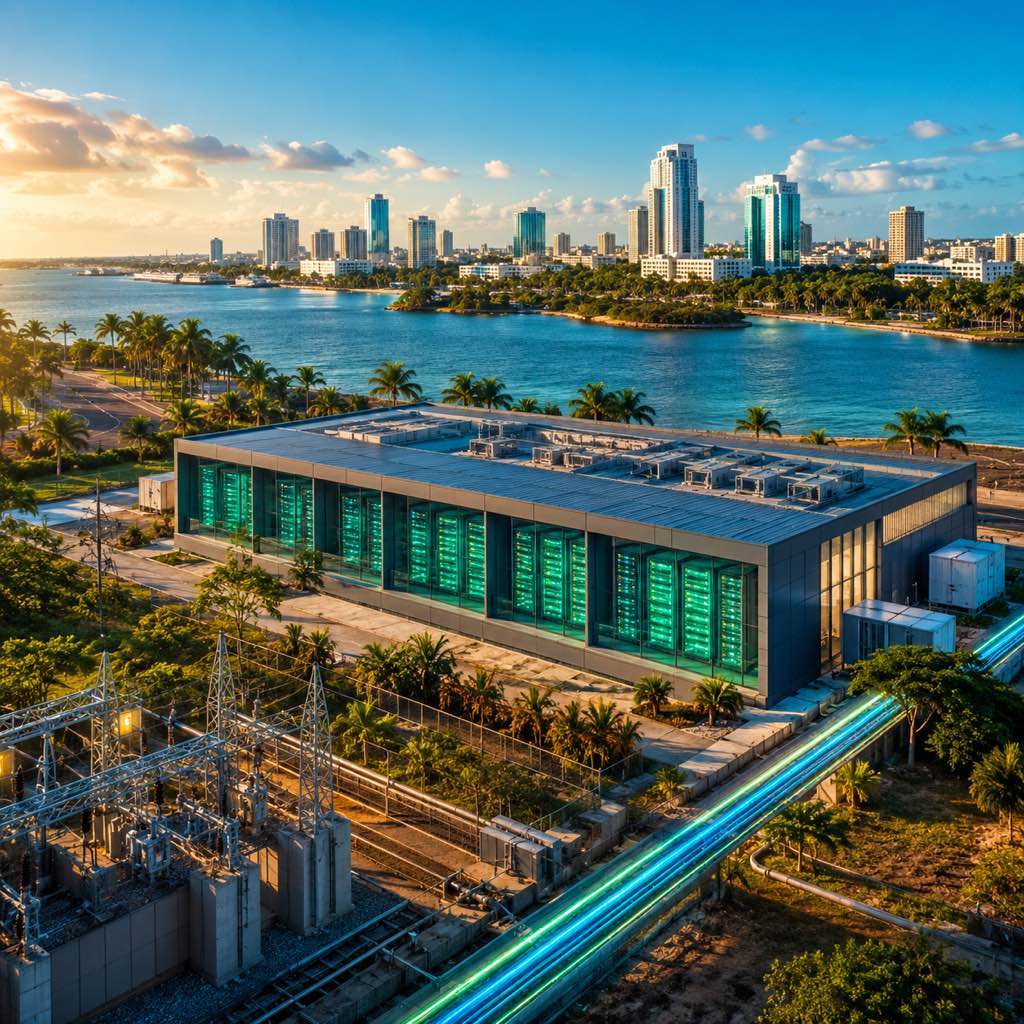
On July 16, 2026, standing at the US Embassy in Abidjan, US Assistant Secretary of State for African Affairs Frank R. Garcia announced that Washington-based Cybastion Institute of Technology had received formal Ivoirian authorization to proceed with a $170 million digital-infrastructure package, TechAfrica News reported. The announcement came during Garcia’s July 15–16 visit — his inaugural Africa trip in the role — and bundled three components that rarely travel together: a sovereign national data center, a platform to digitize government services, and a smart-border surveillance system to monitor cross-border activity.
What makes the deal significant is not its size alone but its financing architecture. The package is backed by the Export-Import Bank of the United States (EXIM), the federal export credit agency, rather than by a hyperscaler’s balance sheet or a Chinese vendor’s concessional loan. That is a deliberate departure from how most African data-center capacity has been built to date, and it reframes digital infrastructure as an instrument of US commercial and strategic policy on the continent.
The Financing, Decoded
The $170 million headline figure is the cumulative total of EXIM guarantees now attached to Cybastion’s Côte d’Ivoire program. Its foundation was laid earlier: at a New York press conference on September 22, 2025, EXIM approved what Pan African Visions described as its “first-ever $100 million financing guarantee dedicated to Africa’s digital transformation.” Of that guarantee, $66 million funds the national data center and $47 million accelerates the digitalization of the Ministry of Finance and Industry.
Cybastion — headquartered in Washington, D.C. and led by founder and CEO Dr. Thierry Wandji — is the exporter of record, working with the Ivoirian Ministry of Digital Transition and Digitization, which oversees national cyberspace. The build relies on a stack of US technology partners: Cisco, Hewlett Packard Enterprise, and Schneider Electric supply the equipment, per the EXIM award citation surfaced by DataCenterDynamics. On the ground, Ivorian firm Porteo Group is partnering with Cybastion on the physical data-center construction. EXIM recognized the program on May 4, 2026 with its “Industries of the Future Deal of the Year” award, EXIM confirmed, where EXIM President and Chairman John Jovanovic framed it as proof that “trusted, secure American solutions are part of the infrastructure being built around the world.”
The data center did not arrive in isolation. During the same July visit, the Ivoirian government granted final approval for Starlink LEO satellite operations to reach underserved areas, and US firms closed adjacent deals — including ABD Group’s $293 million healthcare-infrastructure initiative, part of a $570 million framework agreement signed in Washington in April 2026 spanning healthcare, education, and water.
Advertisement
Why the Timing Matters: Africa’s Capacity Deficit
The deal lands against a structural imbalance that has become impossible to ignore. Africa accounts for just 0.6% of global data-center capacity despite hosting roughly 20% of the world’s population, ITWeb reported, citing industry assessments. The continent’s active operational capacity sits near 360MW — against a global active base of roughly 55GW — with another 238MW under construction and 656MW in the pipeline.
That deficit has a direct sovereignty cost. When a country lacks domestic capacity, its citizens’ and government’s data is processed abroad, under foreign jurisdiction. As CNBC Africa reported, Boston Consulting Group’s Kesh Mudaly put the strategic logic bluntly: “You do not want to export your data and import that IP. You really want to leverage the richness of African data in Africa.” A sovereign national data center is precisely the instrument that keeps government e-services, cybersecurity, and — increasingly — AI workloads inside national borders.
Côte d’Ivoire is not alone in this push. Across the region, states are treating domestic compute as a policy lever rather than a private-sector afterthought, and the competition to supply it — American, Chinese, Gulf, and pan-African — is now overt.
What This Means for African Digital-Infrastructure Decision-Makers
For ministries, regulators, and enterprise buyers weighing similar moves, the Cybastion deal offers a replicable template — and several traps.
1. Read the financing model, not just the ribbon-cutting
The story here is the export-credit guarantee, not the concrete. EXIM’s guarantee de-risks a US exporter’s participation, which is why the vendor stack is entirely American. Decision-makers should ask what strings attach to the capital: procurement is effectively tied to the guaranteeing country’s suppliers. That can be an acceptable trade for speed and financing certainty — but it is a sovereignty choice dressed as a technical one, and it should be evaluated as such before signing.
2. Bundle sovereignty with government-services digitization from day one
The most instructive design choice is that $47 million of the package targets Ministry of Finance and Industry digitization, not just the data center shell. A hall full of racks delivers no sovereignty if government workloads never migrate onto it. Pair every capacity build with a funded, deadline-bound migration plan for the flagship public services that will actually run on the new iron.
3. Treat the smart-border component as a governance question, not a feature
The package includes a smart-border surveillance system. Cross-border monitoring infrastructure carries data-protection, procurement-transparency, and civil-liberties implications that outlast any minister. Buyers should insist on clear governance — retention rules, oversight, and audit rights — written into the contract, because surveillance capabilities are far harder to unwind than to install.
4. Diversify vendors deliberately — don’t swap one dependency for another
Choosing a US-financed, US-vendor stack reduces reliance on one set of foreign providers by increasing reliance on another. The strategic win is optionality: a country that can credibly source from American, Chinese, Gulf, and African suppliers negotiates from strength. Lock-in to any single ecosystem — including a friendly one — erodes exactly the sovereignty the project claims to build.
The Bigger Picture: Compute Is the New Terrain of Influence
The Cybastion deal is a small line item against Africa’s true capacity gap, but it is an outsized signal. Washington has decided that export-credit financing — long used for aircraft and turbines — is now a tool for placing American cloud, networking, and security stacks inside African governments. That directly answers concessional-loan-financed builds from other powers, and it turns the continent’s data-center deficit into contested ground.
For the region, the lesson is that digital sovereignty is being financed into existence by outside actors as much as built from within — and the terms of that financing will shape who governs African data for a generation. The states that come out ahead will be the ones that treat these offers as a competitive market to be played, insist on real government-workload migration rather than empty capacity, and refuse to mistake a change of foreign vendor for genuine independence. Sovereignty, in the end, is measured not by whose flag is on the financing but by how much leverage the host country keeps after the ribbon is cut.
Frequently Asked Questions
What exactly did Côte d’Ivoire sign, and who is financing it?
Côte d’Ivoire cleared a $170 million digital-infrastructure package delivered by Washington-based Cybastion Institute of Technology, announced on July 16, 2026 at the US Embassy in Abidjan. It bundles a sovereign national data center, a platform to digitize government services, and a smart-border surveillance system. The financing is backed by the US Export-Import Bank (EXIM), whose first-ever $100 million guarantee dedicated to Africa’s digital transformation — approved in September 2025 — anchors the program, with $66 million for the data center and $47 million for Ministry of Finance and Industry digitization.
Why does the deal matter for Africa’s digital sovereignty?
Africa holds just 0.6% of global data-center capacity while home to roughly 20% of the world’s population, so most of the continent’s data is processed abroad under foreign jurisdiction. A sovereign national data center keeps government e-services, cybersecurity and AI workloads inside national borders. The deal is also a signal: Washington is using export-credit financing — not a hyperscaler’s balance sheet or a concessional loan — to place American cloud, networking and security stacks inside African governments.
What is the lesson for Algeria?
Algeria is pursuing the same sovereignty goal by an almost opposite path: on July 5, 2026 it inaugurated a Huawei-built, state-funded National Center for Digital Services with twin data centers in Algiers and Blida, and legislated a one-month migration deadline. The read-throughs: the migration mandate is the real lever, vendor concentration is the exposure to watch, and financing terms are strategy — EXIM conserves treasury cash but ties procurement to US suppliers, while Algeria’s state-funded model avoids those strings but ties up scarce public capital.
Sources & Further Reading
- US Expands Côte d’Ivoire Tech Footprint with Starlink Approval and $170m Data Centre Project — TechAfrica News
- Cybastion Highlights $170M Côte d’Ivoire Digital Infrastructure Projects — TechAfrica News
- A New Chapter for Africa’s Digital Sovereignty: Côte d’Ivoire’s $100 Million EXIM-Backed Leap — Pan African Visions
- EXIM Awards Industries of the Future Deal of the Year to Cybastion Institute of Technology for Côte d’Ivoire National Data Center — EXIM.gov
- US’s Export-Import Bank Approves More Than $100m in Financing Guarantees for Digitalization in Côte d’Ivoire — DataCenterDynamics
- Africa’s Data Centre Capacity on Back Foot, Despite Investment Push — ITWeb
- Africa Has Less Than 1% of Global Data Center Capacity. Can It Catch Up? — CNBC Africa
- Algeria Launches National Digital Services Center to Strengthen Digital Sovereignty — TechAfrica News
🔗 Related Intelligence

Africa Digital Public Infrastructure: How DPI Stacks Enable AfCFTA Digital Trade in 2026

Africa’s Digital Governance Shift: From Connectivity to Control in 2026

The Broadband Dividend: Inside the World Bank’s $137M West Africa Digital Push

Africa’s $4.1B Tech Year: Inside the Strongest Funding Cycle Since 2022