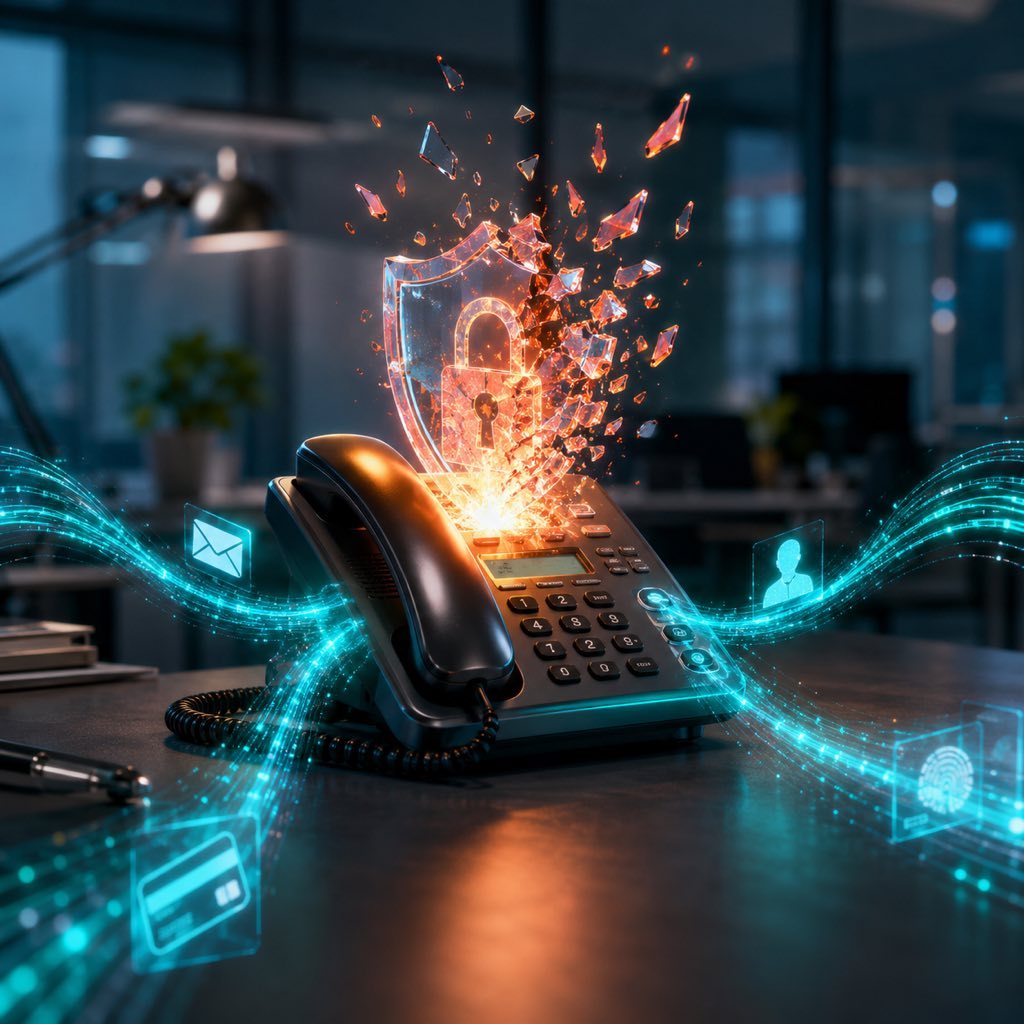
One Phone Call, 1.6 Million Exposed Accounts
The RingCentral breach is a case study in how the most damaging intrusions of 2026 increasingly bypass technology entirely. BleepingComputer’s reporting on the incident confirms that the extortion group ShinyHunters compromised the cloud-communications provider and stole personal information tied to roughly 1.6 million accounts. RingCentral disclosed the intrusion on July 28, 2026, describing it as the result of a “sophisticated social engineering campaign” affecting a limited portion of its customers.
The exposed data was not exotic, but it was plenty for downstream abuse: names, email addresses, phone numbers, and physical addresses. The Register’s account of the attack reports that ShinyHunters exfiltrated more than 623GB of data before the theft was contained. The breach became broadly visible when the breach-notification service Have I Been Pwned ingested the leaked dataset in mid-August 2026, confirming roughly 1.6 million unique email addresses — the point at which affected users could finally check whether they were caught up in it.
For a provider whose entire business is trusted communications infrastructure for other companies, a breach of this scale is more than an embarrassment. It’s a direct hit to the thing RingCentral sells.
The Attack Was a Conversation, Not an Exploit
What makes this breach instructive is how ordinary the entry point was. According to The Register, a ShinyHunters spokesperson said the group “broke into RingCentral by voice-phishing an employee and tricking them into giving the crooks their password.” No unpatched vulnerability, no malware, no zero-day — a single employee was talked out of their credentials over the phone.
That tradecraft is the ShinyHunters signature throughout 2025 and 2026. SecurityWeek’s coverage of the breach situates it within the group’s broader campaign of help-desk impersonation and voice-phishing attacks that repeatedly sidestep multi-factor authentication by targeting the humans who hold or can reset credentials, rather than the systems those credentials protect. When an attacker convinces an employee to hand over a working password, MFA that relies on that same session or that the employee can be walked through becomes far weaker than its glossy vendor sheet implies.
Refusing to Pay, and Living With the Consequence
RingCentral did not pay the ransom, and the group followed through. The Register reports ShinyHunters set a July 30 deadline, and when no agreement was reached, publicly dumped the stolen dataset, with a spokesperson complaining that “the company failed to reach an agreement with us despite our incredible patience.” RingCentral, for its part, said it “promptly responded to the intrusion upon detecting it, took steps to stop the unauthorized activity,” and had “not seen any new unauthorized activity since taking these remediation efforts.”
The non-payment decision is defensible and, per most law-enforcement guidance, correct — paying funds the next attack and offers no guarantee the data is destroyed. But it also illustrates the brutal asymmetry of extortion: the victim can do everything right after detection and still watch 1.6 million records land on a leak site, because the leverage was created the moment the credentials were handed over. Containment limits the bleeding; it cannot un-steal what was already taken.
That asymmetry reshapes what “good security” has to mean for a company like RingCentral. The measurable failure did not happen in the detection-and-response phase, where the company appears to have acted quickly; it happened in the seconds before, in a conversation that no firewall could see. For the affected accounts, the consequences are durable in a way a temporary outage is not: the names, phone numbers, and addresses in the dump feed targeted phishing, SIM-swap attempts, and follow-on impersonation for months or years, and they cannot be rotated the way a leaked password can. That is the specific danger of contact-data breaches — the exposed fields are permanent facts about people, not resettable secrets, which is why the prevention side of this equation carries so much more weight than the cleanup side.
Advertisement
What This Means for Organizations Defending Against Social Engineering
1. Harden the help desk and credential-reset flow before hardening anything else
ShinyHunters’ repeated success comes from targeting help desks and employees who can hand over or reset credentials. Security teams should treat identity-verification procedures for password resets, MFA re-enrollment, and privileged access requests as a top-tier control — requiring callbacks to known numbers, manager approval, or in-person verification for sensitive changes — because this is the exact door the group keeps walking through.
2. Assume MFA can be socially bypassed and add phishing-resistant factors
Multi-factor authentication that an employee can be talked through by phone is not the barrier it appears to be. Organizations should move privileged and high-risk accounts to phishing-resistant authentication such as hardware security keys or device-bound passkeys, which cannot be relayed to an attacker over a phone call, and reserve push-approval MFA for lower-risk contexts.
3. Run realistic voice-phishing drills, not just email phishing tests
Most security-awareness programs test employees against phishing emails while leaving the phone channel — ShinyHunters’ preferred vector — untested. Security leaders should add regular voice-phishing (vishing) simulations that specifically target help-desk and IT-support staff, measure how often credentials or resets are granted, and use the results to tighten verification procedures where they fail.
The Bigger Lesson: The Human Perimeter Is the Real Perimeter
RingCentral’s breach adds to a mounting 2026 body of evidence that the most effective attacks against well-defended organizations no longer target software — they target people. ShinyHunters did not need to defeat RingCentral’s firewalls, patch cadence, or detection stack; it needed one employee to answer a phone and trust a plausible voice. As enterprises pour budget into endpoint detection, zero-trust architectures, and AI-driven security tooling, the cheapest and most reliable path in remains a convincing conversation with a helpful human. The organizations that fare best against this class of attack in 2026 and beyond will be the ones that treat identity verification, help-desk procedures, and phishing-resistant authentication as core infrastructure — not awareness-training footnotes — and that accept a hard truth the RingCentral case makes plain: you can respond flawlessly to an intrusion and still lose the data, because by the time the phone call ends, the breach has already happened.
Frequently Asked Questions
How did ShinyHunters breach RingCentral?
ShinyHunters breached RingCentral through voice phishing (vishing) — a spokesperson said the group tricked an employee into handing over their password over the phone. There was no exploited software vulnerability or zero-day; the intrusion relied entirely on social engineering of a single employee.
How many people were affected and what data was exposed?
Roughly 1.6 million accounts were exposed, with the leaked data including names, email addresses, phone numbers, and physical addresses. ShinyHunters exfiltrated more than 623GB of data and dumped the dataset publicly after RingCentral declined to pay the ransom; Have I Been Pwned confirmed about 1.6 million unique email addresses.
Did RingCentral pay the ransom, and what did it do in response?
RingCentral did not pay the ransom. It said it promptly responded upon detecting the intrusion, took steps to stop the unauthorized activity, and had not seen new unauthorized activity since its remediation. ShinyHunters set a July 30, 2026 deadline and leaked the data when no agreement was reached.
Sources & Further Reading
🔗 Related Intelligence

The Phishing-as-a-Service Economy: How $50 Buys a Cyberattack in 2026

The Odido Mega-Breach: When a Telecom Giant Refuses to Pay and Millions of Records Hit
Prompt Injection Attacks: The Security Hole That Comes With Every AI Application

AI-Powered Scam Call Centers Now Run Fully Automated Fraud Operations at Scale