A Barcelona Lab, an Algiers Clinic, and a Shared Maternal-Health Model
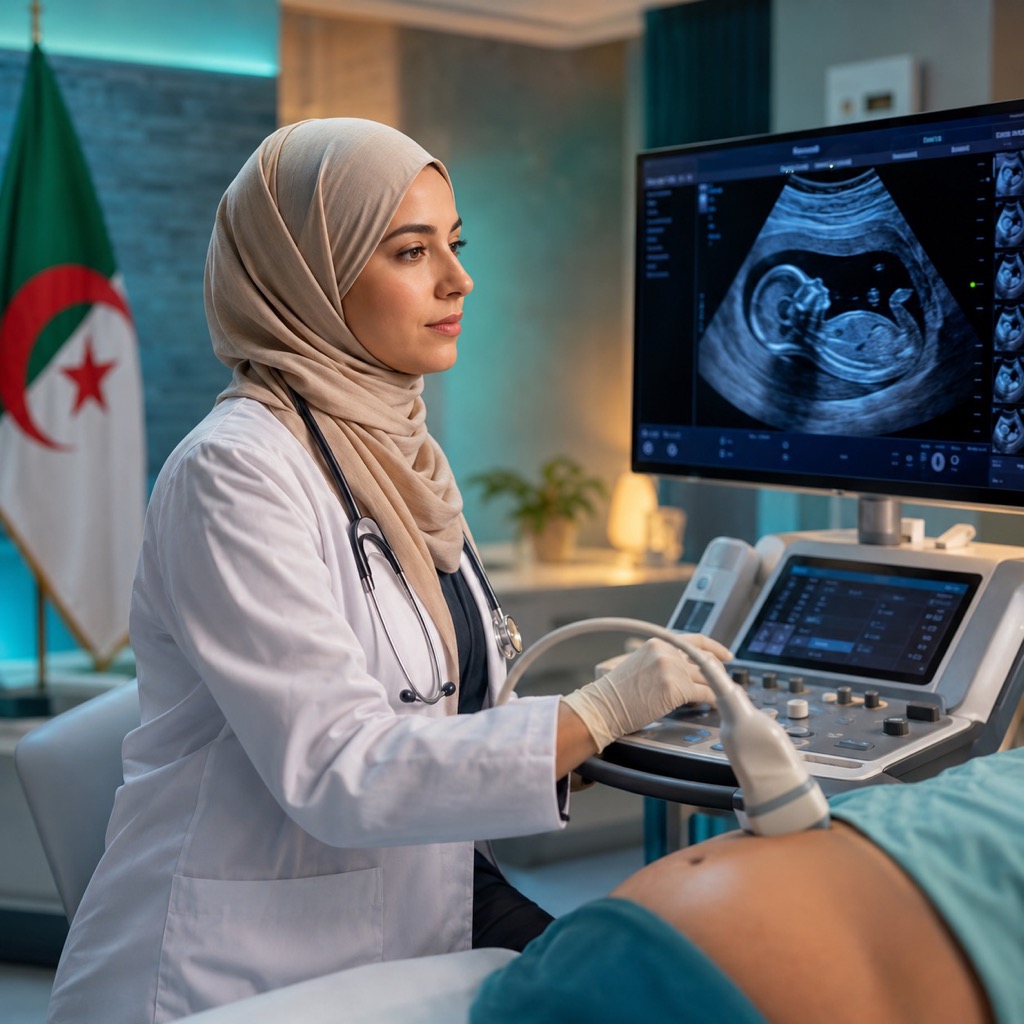
When researchers at the University of Barcelona set out to test whether fetal ultrasound AI could work outside well-funded European hospitals, two Algerian sites helped answer the question: EPH Kouba and Clinique Des Lilas in Algiers. According to the study published in Scientific Reports in February 2023, Algeria was one of five African countries — alongside Egypt, Uganda, Ghana, and Malawi — that contributed locally sourced ultrasound images to train and validate a model that classifies the standard fetal scan planes a clinician uses to screen for abnormalities.
This is a quietly important milestone. Most medical AI is built on data from high-income settings, then exported. Here, the data flowed the other way: Algerian patient scans became part of the evidence base that proved these models can generalise to clinics with mid-range ultrasound machines and smaller datasets. For Algerian clinicians and AI engineers, it is a concrete entry point into a field — maternal-health diagnostics — where the country already has hospitals, sonographers, and a growing pool of machine-learning graduates.
The maternal-health stakes are real. The same study notes that neonatal mortality in Sub-Saharan Africa stood at 27 deaths per 1,000 births in 2019, against an average of 3.4 per 1,000 in the European Union — a gap driven largely by limited access to antenatal screening. Tools that help a less-specialised operator capture a correct diagnostic plane are exactly the kind of leverage that closes that distance.
How the Model Actually Works — and Why Local Data Mattered
The model classifies four standard fetal planes — femur, thorax, head (brain), and abdomen — plus an “other” category. These are the views a sonographer needs to assess growth and screen for structural anomalies. The base model was trained on European data: 1,792 patients and 9,463 images from two Barcelona hospitals, Hospital Clínic and Hospital Sant Joan de Déu, plus a Danish cohort of 1,008 patients.
The key finding was about adaptation. Each African country contributed a modest sample — 25 patients and roughly 75 to 100 images apiece, 120 patients in total. Applied raw, a European-trained model degraded on this lower-resource data. But with a transfer-learning step that fine-tuned the model on a small slice of local images, performance recovered to an average recall of 0.92 and an AUC above 98%. The lesson for Algeria is precise: you do not need a million-image national dataset to get a clinically useful model — you need a well-curated local set and the engineering skill to adapt a strong base model to it.
That is a buildable target. The study was led by Carla Sendra-Balcells, Víctor M. Campello, and Karim Lekadir at the University of Barcelona, working with hospitals across five countries — a collaboration model Algerian university hospitals and AI labs can replicate and extend.
Advertisement
Why Algeria Is Well Positioned to Lead This
The talent base is already forming. Per the New Lines Institute’s analysis of Algeria’s AI trajectory, the country has 57,702 students enrolled across 74 AI master’s programs in 52 universities, and ranks among Africa’s top five for scientific publications. Its AI market is projected to grow from $498.9 million in 2025 to $1.69 billion by 2030, a 27.67% compound annual growth rate, with healthcare named as one of six priority pillars in the national strategy.
The clinical infrastructure is moving in parallel. Algeria is establishing the National Agency for Health Digitalization (ANNS), rolling out Electronic Medical Records across neighbourhood clinics, hospitals, and university hospital centres, and expanding telemedicine. In December 2025, the Health Ministry launched a national digital platform to coordinate inter-hospital patient transfers, with a 48-hour maximum response on urgent cases. Each of these systems generates structured clinical data — the raw material homegrown diagnostic models need.
Put the two together — a deepening talent pool and a digitising health system — and the path from “we contributed data to someone else’s study” to “we build and own the model” becomes a question of organisation, not capability.
What Algerian Clinicians and AI Engineers Should Do
1. Form clinician-engineer pairs around a single, well-defined plane-detection task
The fastest route into medical AI is not a grand national platform — it is one narrow, validated task. Pair a sonographer at a maternity ward with a machine-learning graduate and target a single deliverable: a model that flags when a captured fetal plane is diagnostic-quality. The Barcelona study proved this works with as few as 25 well-curated patients per site. Resist the temptation to start with rare-anomaly detection; nail the standard-plane classifier first, because it is the foundation every downstream tool depends on. The “don’t” here is starting too broad — a 50-task roadmap with no working baseline.
2. Build a curated, consented local ultrasound dataset before touching model architecture
The scarce asset is not GPUs — it is clean, labelled, ethically consented Algerian scan data. Establish a labelling protocol with two sonographers cross-checking each plane assignment, and align consent and storage with the data-governance work ANNS is standing up. Aim for a few hundred annotated studies from two or three maternity centres rather than thousands of unlabelled images. A 200-study set that is correctly labelled beats a 5,000-image dump that no one trusts. This dataset, not any single model, is the durable national asset — and the thing that lets you fine-tune any future base model.
3. Use transfer learning from a strong open base model, not training from scratch
The study’s central result is that a European-trained model, fine-tuned on a thin slice of local data, recovered to an AUC above 98%. Replicate that pattern: start from a published, openly licensed medical-imaging base model, then adapt it on your curated Algerian set. Training a fetal-imaging model from zero would demand data and compute Algeria does not need to spend. The discipline is to measure generalisation honestly — report performance on a held-out Algerian test set, not on the European data the base was built on, because a model that looks excellent on foreign data can quietly fail on local scans.
4. Partner with a university hospital and publish, to convert a pilot into recognised evidence
A working prototype is not the same as a clinically credible tool. Anchor the project in a university hospital (CHU) with an ethics committee and an obstetrics department willing to co-author. Follow the Barcelona collaboration model — clinicians and engineers as joint authors — and publish the validation, even as a short report. Publication does three things a demo cannot: it earns clinician trust, it creates a citable track record that attracts the next grant, and it puts Algerian-built maternal-health AI on the regional map. The mistake to avoid is treating the model as a product before it is evidence.
Where This Fits in Algeria’s 2026 Health-Tech Ecosystem
The fetal-ultrasound work sits at the intersection of two trends already underway in Algeria: a maturing AI talent base and a health system that is finally digitising its records and workflows. Neither alone produces homegrown diagnostics — but together they create the conditions for it. The 2023 study did the hard, unglamorous proof-of-concept work: it showed that local data, even in small amounts, can adapt strong models to Algerian clinical reality. What remains is execution — pairing the people, curating the data, and publishing the results.
The opportunity is to move up the value chain. Contributing 25 patients’ scans to a foreign-led study is a starting point; leading the next study, owning the dataset, and deploying the tool in an Algerian maternity ward is the destination. With healthcare written into the national AI strategy and a digital health backbone taking shape through ANNS and EMR rollout, the building blocks are in place. The clinicians and engineers who pair up now — around narrow, well-validated tasks — will be the ones who define what Algerian medical AI looks like by 2030.
Frequently Asked Questions
What did Algeria contribute to the fetal ultrasound AI study?
Two Algerian sites — EPH Kouba and Clinique Des Lilas in Algiers — provided locally sourced fetal ultrasound images. Algeria was one of five African countries (with Egypt, Uganda, Ghana, and Malawi), each contributing about 25 patients and 75–100 images, that helped validate whether deep-learning models trained in Europe could generalise to lower-resource clinical settings.
How accurate is the fetal ultrasound AI model?
After a transfer-learning step that fine-tuned the European-trained model on a small slice of local images, the model reached an average recall of 0.92 and an AUC above 98% for classifying standard fetal planes (femur, thorax, head, and abdomen). The key finding is that strong performance is achievable with relatively little local data, not millions of images.
Why does maternal-health AI matter for Algeria specifically?
Tools that help less-specialised operators capture correct diagnostic ultrasound planes can widen access to antenatal screening — a major driver of the gap between neonatal mortality in Sub-Saharan Africa (27 per 1,000 in 2019) and the EU (3.4 per 1,000). With healthcare named in Algeria’s national AI strategy and a digital health backbone forming through ANNS and EMR rollout, the country has both the need and the infrastructure to build its own tools.
Sources & Further Reading
- Generalisability of fetal ultrasound deep learning models to low-resource imaging settings in five African countries — Scientific Reports / PMC
- Generalisability of fetal ultrasound deep learning models to low-resource imaging settings in five African countries — Nature Scientific Reports
- Why Algeria Is Positioned to Become North Africa’s AI Leader — New Lines Institute
- Algeria Launches Digital System to Overhaul Hospital Transfer Process — We Are Tech Africa
- Algeria’s Bold Blueprint to Rebuild Modern Healthcare — Horizons
🔗 Related Intelligence

AI Radiology in Algeria: How CHUs Are Building the Diagnostic Imaging Backbone
AI Reads X-Rays in Algeria’s Rural Clinics: Closing the Diagnostic Gap

Algeria’s 12-Week AI Programme: Training 500,000 ICT Specialists by 2030

Algeria HealthTech 2026: AI Diagnostics and Telemedicine Startups Targeting the Public Hospital Gap