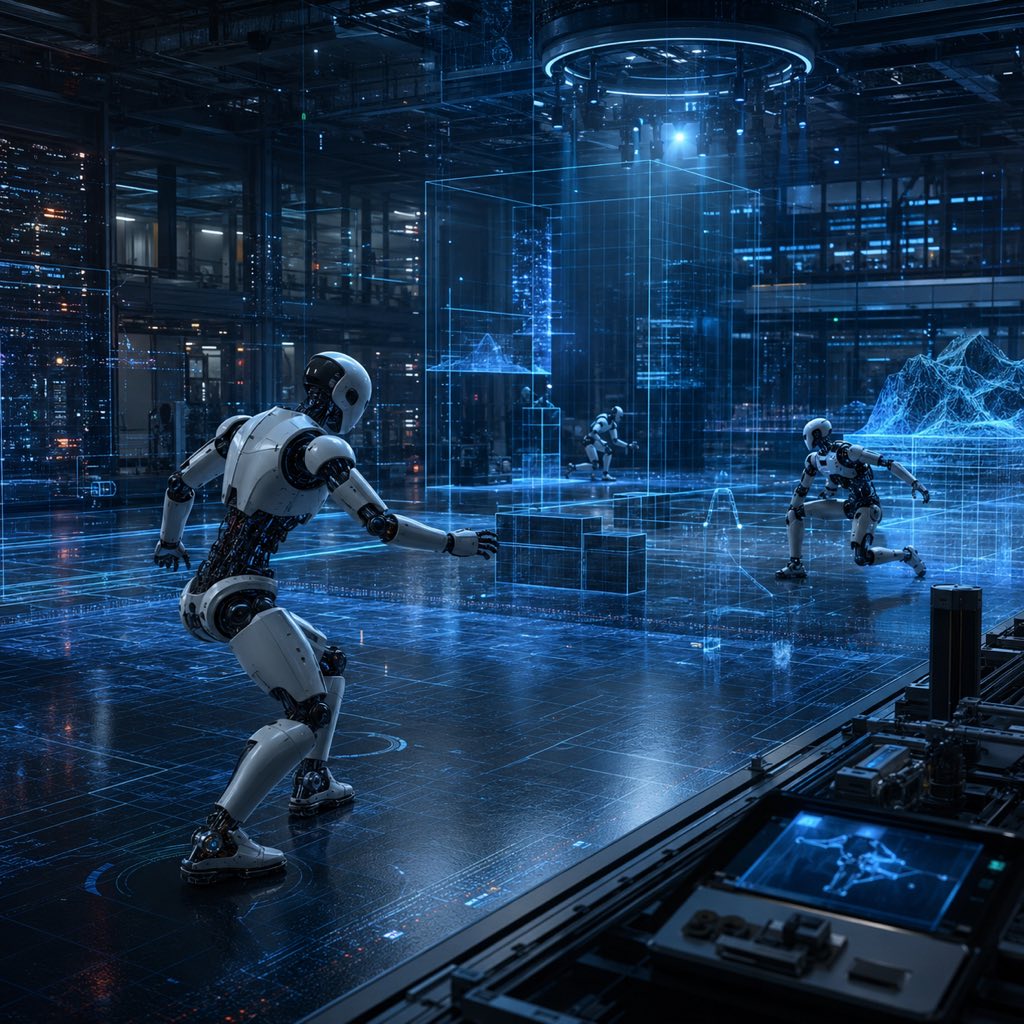
On June 1, 2026, at COMPUTEX in Taipei, NVIDIA CEO Jensen Huang introduced Cosmos 3 — a fully open omnimodel that the company calls the “open frontier foundation model for physical AI.” The announcement matters not because NVIDIA is building yet another large model, but because Cosmos 3 does something architecturally new: it collapses vision reasoning, world generation, and action prediction into a single system trained on 20 trillion tokens of multimodal data, including nearly a billion images and 400 million real and synthetic videos. Physical AI researchers working on robotics and autonomous vehicles have spent years assembling pipelines from separate perception, simulation, and planning components. Cosmos 3 compresses that pipeline into one model.
The practical payoff is stark. According to NVIDIA, Cosmos 3 reduces physical AI training and evaluation cycles from months to days. For teams building autonomous robots or self-driving systems, that is not an incremental improvement — it is a fundamental change in the economics and speed of development. The model achieves this by generating physically plausible synthetic data at scale: joint angles, gripper positions, trajectory points, and full video sequences that robots and vehicles can use for post-training, without the cost and danger of equivalent real-world data collection.
Cosmos 3 ships under the OpenMDW 1.1 license from the Linux Foundation and is immediately available through build.nvidia.com, Hugging Face, and GitHub, deployable as NVIDIA NIM microservices. NVIDIA simultaneously launched the Cosmos Coalition — a consortium including Agile Robots, Black Forest Labs, Generalist, LTX, Runway, and Skild AI — to build an ecosystem of open world models on top of this foundation.
What Cosmos 3 Actually Does
Cosmos 3 is best understood as three capabilities packaged into one mixture-of-transformers architecture. The architecture pairs a reasoning block with a generation block: the reasoning block interprets scenes and understands multimodal context, while the generation block produces physically grounded outputs.
Vision reasoning is the model’s ability to understand video, images, text, and ambient sound simultaneously. Cosmos 3 can analyze live camera streams, generate dense captions describing scene geometry, infer intent from action sequences, and answer questions about physical environments. In benchmark evaluations, it ranks first among open models on VANTAGE-Bench (smart infrastructure scene understanding) and leads the TAR challenge for traffic anomaly reasoning. Linker Vision, a partner in the Cosmos Coalition, is already using this capability to monitor thousands of city camera feeds simultaneously for infrastructure analysis.
World generation is the ability to create photorealistic, physically plausible video sequences — not as creative content, but as training data. Cosmos 3 can synthesize edge cases, collision scenarios, and rare environmental conditions that would be expensive or impossible to capture in the real world. It ranks first on Physics-IQ, R-Bench, and PAI-Bench — the principal benchmarks for physical realism in synthetic video. For autonomous vehicle teams, this means generating the “long-tail” situations — the unusual intersection geometries, the unexpected pedestrian behavior, the edge-case weather — that traditional simulation tools struggle to make realistic.
Action prediction is the newest and perhaps most significant capability. Cosmos 3 generates native numerical action data: not just video or descriptions of what a robot should do, but the actual joint angles, gripper positions, and trajectory waypoints a robot arm or mobile platform needs to execute a task. Agile Robots, a Cosmos Coalition partner, uses this capability with its humanoid robots Thor 3 and FR3 to create diverse industrial automation task trajectories at scale — effectively bootstrapping dexterous manipulation without exhaustive human demonstration.
Cosmos 3 in the Competitive Landscape
Physical AI has attracted serious investment across the industry, but most approaches have kept simulation, vision, and policy learning as separate systems. What makes Cosmos 3 architecturally significant is the combination of openness and omnimodality at this scale.
Training on 20 trillion tokens of multimodal data — including ambient audio alongside video and action data — gives Cosmos 3 a grounding that text-only or image-only foundation models cannot match for physical environments. Sound is a genuine physical signal: the scrape of a misaligned joint, the ambient frequency shift of a changing environment, the audio cues that tell an autonomous system something has changed off-camera. Incorporating audio into the training distribution is a quiet but meaningful design choice.
The three-variant release strategy also reflects real deployment realities. Cosmos 3 Super is optimized for highest physics accuracy in post-training robotics and AV workflows — the version a team would use when generating synthetic training datasets. Cosmos 3 Nano is tuned for high-quality video and action reasoning in fractions of a second — the version that can run inference fast enough to help during live robot operation. Cosmos 3 Edge, announced as coming soon, targets real-time inference at the edge on embedded hardware.
The Cosmos Coalition is NVIDIA’s answer to the ecosystem challenge. Foundation models are only as useful as the fine-tuning, deployment, and integration tools built around them. By launching with six partners — including video generation specialists (Black Forest Labs, LTX, Runway), robotics training specialists (Agile Robots, Skild AI, Generalist) — NVIDIA is establishing the open-model equivalent of an app store before competitors can.
The OpenMDW 1.1 license matters commercially. Most frontier foundation models are either closed API products or fully open weights with permissive but legally ambiguous licenses. OpenMDW 1.1, stewarded by the Linux Foundation, provides a middle path: open weights with clear commercial terms. For enterprise teams building physical AI products, this licensing clarity reduces the legal risk of building on Cosmos 3 relative to models under less defined terms.
Advertisement
What AI Engineers and Product Teams Should Do
1. Evaluate Cosmos 3 Nano for Vision-Language Tasks in Your Existing Stack
The lowest-friction entry point is Cosmos 3 Nano via NVIDIA NIM microservices on build.nvidia.com. Teams already running vision tasks — quality inspection, video analytics, scene understanding — should benchmark Cosmos 3 Nano against their current models this quarter. The first-place rankings on VANTAGE-Bench and TAR suggest it will outperform most current open VLMs on physical environment understanding. This is a practical swap worth measuring, not a theoretical future investment.
2. Pilot Synthetic Data Generation for Your Hardest Edge Cases
If your team is training perception or policy models and you have a backlog of “we just don’t have enough data for X scenario,” Cosmos 3 Super’s world generation capability is worth a structured pilot. Identify three to five specific underrepresented scenarios in your training distribution, generate synthetic video with Cosmos 3 Super, and measure the downstream impact on model performance. This process — identify gap, generate synthetic data, measure transfer — is exactly the workflow NVIDIA designed Cosmos 3 for, and running it as a controlled experiment will tell you quickly whether the physics accuracy is sufficient for your domain.
3. Track the Cosmos Coalition Roadmap Before Committing to Competing Simulation Platforms
If your organization is evaluating or renewing contracts for simulation platforms (robotics simulators, AV test environments), delay final decisions until Q3 2026 when Cosmos 3 Edge ships and the Coalition partners release their initial integrations. The combination of open weights, NIM deployment, and committed ecosystem partners suggests the total cost of synthetic data generation via Cosmos 3 will undercut traditional simulation licensing in most categories. Waiting 60 to 90 days to see the early Coalition integrations is lower-risk than locking into a competing stack now.
Where Physical AI Fits in 2026
Cosmos 3 arrives at a specific moment in the physical AI arc. The software models for language and image generation are largely mature — the remaining performance gains are incremental. The next decade of AI value creation will come from systems that operate in physical environments: manufacturing floors, road networks, warehouses, hospitals, construction sites. These environments require training data that is expensive to collect in the real world, and they require models that understand not just what things look like but how they move, interact, and change over time.
NVIDIA is positioning Cosmos 3 as the infrastructure layer for this transition — the equivalent role that transformer pre-training played for NLP in 2018. Whether that comparison holds depends on whether the physics accuracy in Cosmos 3’s world generation transfers reliably to real-world robot and vehicle performance. Early partner results from Agile Robots suggest it does, at least for structured industrial manipulation tasks. The broader validation across diverse physical environments will take time.
What is already clear is that the combination of open weights, multimodal training at 20 trillion tokens, and a purpose-built benchmark suite (PAI-Bench, RoboArena, RoboLab) gives the research community the tools to measure and improve physical AI rigorously for the first time. That infrastructure — the model plus the evaluation frameworks — may prove as important as the model itself.
Frequently Asked Questions
What exactly is an omnimodel, and why does it matter for physical AI?
An omnimodel is a single neural network that natively processes and generates multiple data types — in Cosmos 3’s case, text, images, video, ambient sound, and action data — rather than routing inputs through separate specialized models. For physical AI, this matters because real environments are inherently multimodal: a robot navigating a factory hears machinery, sees conveyor belts, reads labels, and must translate all of that into coordinated physical action. A single model trained on all these modalities together learns cross-modal correlations that pipeline systems miss, and it eliminates the latency and error accumulation of handoffs between separate models.
How is Cosmos 3 different from general-purpose video generation models like Sora or Runway?
General-purpose video models optimize for visual realism and creative plausibility. Cosmos 3 optimizes for physical accuracy: the generated outputs must be accurate enough to train robots and autonomous vehicles that will operate in the real world. This means Cosmos 3 is benchmarked on Physics-IQ (physical plausibility of generated sequences) and PAI-Bench (physical AI performance) rather than aesthetic quality metrics. It also generates native action data — joint angles and trajectory points — which creative video models do not produce. The Cosmos Coalition partners (Agile Robots, Skild AI) validate that the physics accuracy transfers to real robot performance, which is the key test that aesthetic video models would fail.
Is Cosmos 3 accessible to teams without NVIDIA GPU infrastructure?
Yes, at the inference level. Cosmos 3 is available through NVIDIA NIM microservices on build.nvidia.com, which means teams can access the model via API without owning GPU hardware. Hugging Face and GitHub host the open weights for teams that want to run their own inference. Cosmos 3 Nano is specifically designed for fast inference, running in fractions of a second, making it practical for cloud-based integration. Cosmos 3 Super, which runs full world-generation workloads for training data synthesis, requires more substantial compute, but can be accessed through cloud GPU providers. Cosmos 3 Edge, coming soon, will target embedded inference on local devices.
Sources & Further Reading
- NVIDIA Launches Cosmos 3, the Open Frontier Foundation Model for Physical AI — NVIDIA Newsroom
- How Cosmos 3 Helps Physical AI Think Before It Acts — NVIDIA Blog
- NVIDIA Cosmos: World Foundation Models Powering Physical AI — NVIDIA
- Cosmos 3: Omnimodal World Models for Physical AI — NVIDIA Research Technical Report
- NVIDIA Launches Cosmos 3 Open Frontier Foundation Model — GlobeNewswire
🔗 Related Intelligence

NVIDIA and the GPU Economy: How One Company Controls the AI Hardware Pipeline

Cadence and NVIDIA Tackle Sim-to-Real: The Partnership That Could Unlock Physical AI

NVIDIA’s Groq Deal: How the Vera Rubin Platform Reshapes AI Inference
Open Source AI Business Models: How Mistral, Together AI, and Others Make Money