A New Last-Mile Channel Opens for Algeria’s Online Merchants
In early February 2026, EMS Champion — the express-courier subsidiary of Algerie Poste — switched on the first units of Smartbox-Champion, a network of secure, automated parcel lockers that operate around the clock without any counter or staff. According to EMS Champion’s launch announcement, the system lets customers both receive and send parcels 24/7, marking the first national smart-locker network of its kind in the country.
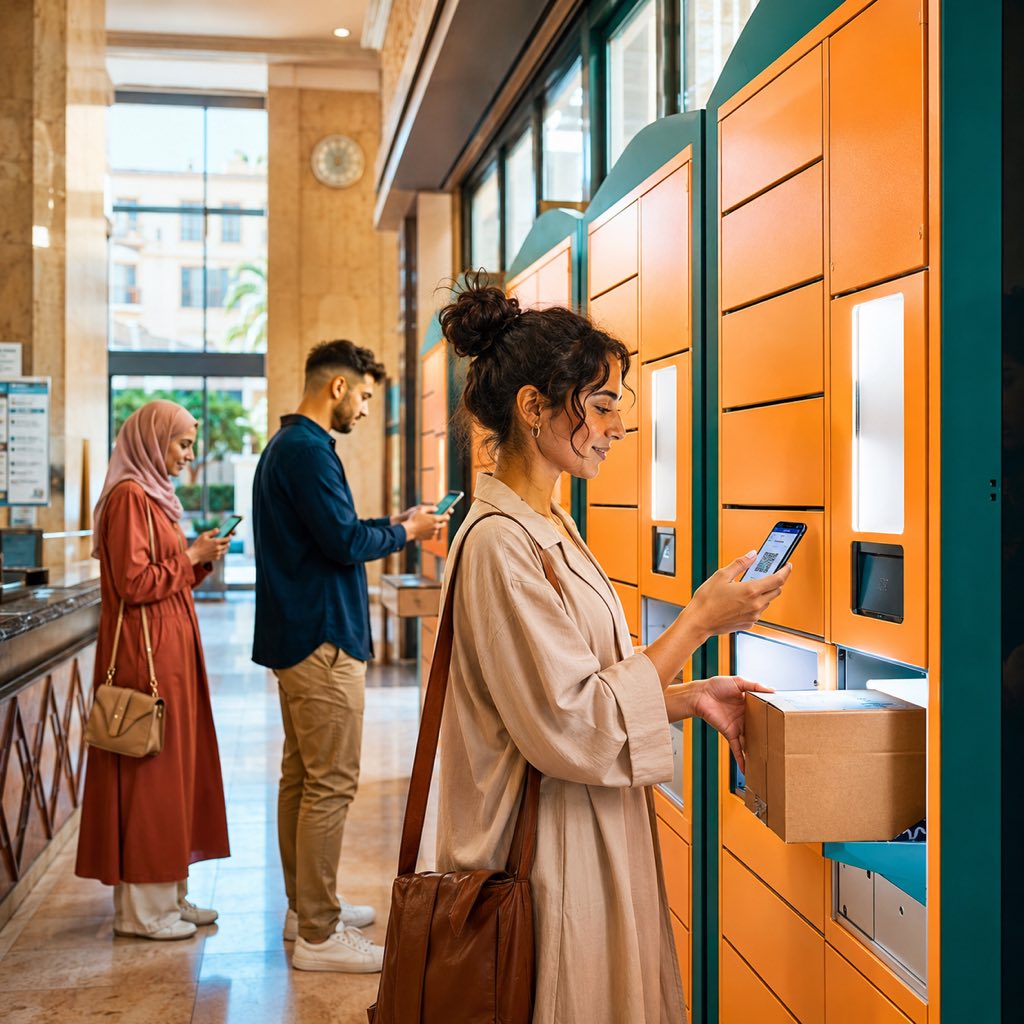
The rollout began as a pilot across four wilayas — Alger, Oran, Sétif, and Ghardaïa — with the first installation placed in the new city of Sidi Abdallah, on the western edge of Algiers. As Algérie Éco reported, the lockers are open seven days a week with no operating-hour limits, designed so a buyer can pick up an order at 7 a.m. before work or 11 p.m. after a shift, using a code rather than waiting for a courier.
For Algeria’s e-commerce sector, the timing is meaningful. The country counted 37.8 million internet users at the end of 2025, an online penetration of 79.5%, according to DataReportal — a large addressable base for online retail. Yet last-mile delivery has long leaned on a handful of private couriers and on cash on delivery, which still accounts for roughly 95% of online transactions. A 24/7 self-service pickup point adds a delivery mode that the market simply did not have before.
How Smartbox-Champion Fits the Existing Delivery Map
Today, most Algerian online orders move through private courier networks — Yalidine and Maystro being the two most visible — plus Algerie Poste’s own EMS footprint. EMS Champion itself operates 102 agencies and EMS points nationwide, positioning it as one of the established players in parcel logistics rather than a newcomer. Smartbox-Champion extends that physical presence into a self-service layer that does not depend on a courier ringing a doorbell or a recipient being home.
The lockers were built through a collaboration between EMS Algérie and a local Algerian startup, using what the company describes as 100% Algerian labor and materials — a detail that ties the project to the broader push to localize digital-economy infrastructure. According to Algérie 360’s coverage of the launch, CEO Nabil Ben Si Saïd framed the initiative as a way to “bring our services closer to citizens while keeping pace with technological progress.”
The expansion plan is ambitious: EMS Champion intends to deploy more than 3,000 Smartbox units across all 69 wilayas during 2026 and 2027. The company has named the kinds of high-traffic sites it is targeting — shopping centers, AADL residential developments, university campuses, transport stations, airports, and Algerie Poste service spaces — which together describe a network meant to put a pickup point within a short walk of where people already live, study, and commute.
For merchants, a locker network changes the unit economics of delivery in subtle ways. A successful first-attempt delivery rate is one of the biggest hidden costs in last-mile logistics; failed home deliveries trigger re-attempts, return trips, and customer-service overhead. A locker that holds a parcel until the buyer collects it removes the “nobody home” failure entirely, which is exactly the kind of friction that erodes margins on low-ticket COD orders.
Advertisement
What This Means for Algeria’s E-Commerce Players
The pilot is small, but the direction is clear. Merchants, couriers, and consumers each have a concrete way to act on this opening rather than wait for the full 3,000-unit rollout.
1. Online merchants should offer locker pickup as a checkout option in pilot-wilaya zones now
If you sell into Alger, Oran, Sétif, or Ghardaïa, add Smartbox pickup as a delivery choice alongside home delivery at checkout. Even a modest share of buyers choosing a locker reduces failed-delivery re-attempts and the courier surcharges that come with them. Track which postal codes convert best on locker pickup; that data tells you where the next wave of units will matter most to your order volume, and lets you prioritize inventory and promotions accordingly.
2. Logistics operators should plan integration and code-handoff workflows before scale arrives
For couriers and fulfillment partners, the operational question is how a parcel and its pickup code move cleanly from your dispatch system into a locker bay. Map that handoff now — barcode or code generation, locker assignment, and the customer notification that carries the pickup code. Operators who solve the integration during the four-wilaya pilot will be ready to plug into a 3,000-unit network without rebuilding workflows under pressure once the rollout reaches dozens of wilayas.
3. Consumers and small social-commerce sellers should treat lockers as a trust and convenience upgrade
A large share of Algerian online selling happens informally on Facebook and Instagram, where the buyer’s biggest worry is whether a parcel will actually arrive and whether they have to be home to receive it. A neutral, 24/7 pickup point backed by Algerie Poste gives small sellers a more credible delivery story and gives buyers flexibility on timing. Social-commerce sellers in pilot cities should test locker delivery on a few orders and use it as a selling point — “collect anytime, from a secure Smartbox” — in their listings.
4. Retail and property managers should position lockers as a tenant and footfall amenity
Because EMS Champion is targeting shopping centers, AADL developments, and transport hubs, owners and managers of those sites have a reason to engage early. A Smartbox installed at a residential complex or mall entrance is a convenience that draws repeat visits and gives residents a reason to pass through. Property and retail managers in the pilot wilayas should reach out to EMS Champion about hosting a unit, turning their location into a default pickup node for the surrounding neighborhood.
The Bigger Picture for Algeria’s Digital Economy
Smart parcel lockers are not a flashy technology, but they sit at a pressure point in Algeria’s e-commerce growth. The market’s heavy reliance on cash on delivery and on home delivery has kept logistics costs high and first-attempt success rates uneven. A self-service layer that lets a buyer collect on their own schedule chips away at both problems at once — and it does so with infrastructure built locally, which keeps the value chain inside the country.
The four-wilaya pilot is a test of demand and operations, not yet a finished network. Whether Smartbox-Champion reaches its 3,000-unit target on schedule will depend on installation logistics, merchant adoption, and how quickly buyers grow comfortable with code-based pickup. But the strategic logic is sound: meeting online shoppers where they already are, on their own time, is one of the most reliable ways to lower the cost and raise the reliability of last-mile delivery. For a digital economy still building its logistics backbone, that is a foundation worth laying now.
Frequently Asked Questions
What is Smartbox-Champion and who launched it?
Smartbox-Champion is Algeria’s first national network of 24/7 self-service smart parcel lockers, launched in early February 2026 by EMS Champion, the express-courier subsidiary of Algerie Poste. The secure automated lockers let customers send and receive parcels around the clock using a pickup code, with no staff or fixed counter hours.
Which wilayas have Smartbox-Champion lockers, and how many are planned?
The pilot launched in four wilayas — Alger, Oran, Sétif, and Ghardaïa — with the first installation in the new city of Sidi Abdallah near Algiers. EMS Champion plans to deploy more than 3,000 Smartbox units across all 69 wilayas during 2026 and 2027, targeting shopping centers, AADL developments, university campuses, transport hubs, and airports.
How can online merchants in Algeria benefit from parcel lockers?
A 24/7 locker eliminates the “nobody home” failed-delivery problem that drives up costs on cash-on-delivery orders. Merchants in the pilot wilayas can offer Smartbox pickup as a checkout option, which reduces re-attempt surcharges and gives buyers flexibility to collect parcels on their own schedule — a meaningful advantage in a market where about 95% of orders are paid on delivery.