A Global Data Firm and a Local Startup Sign for the Same Hospital Floor
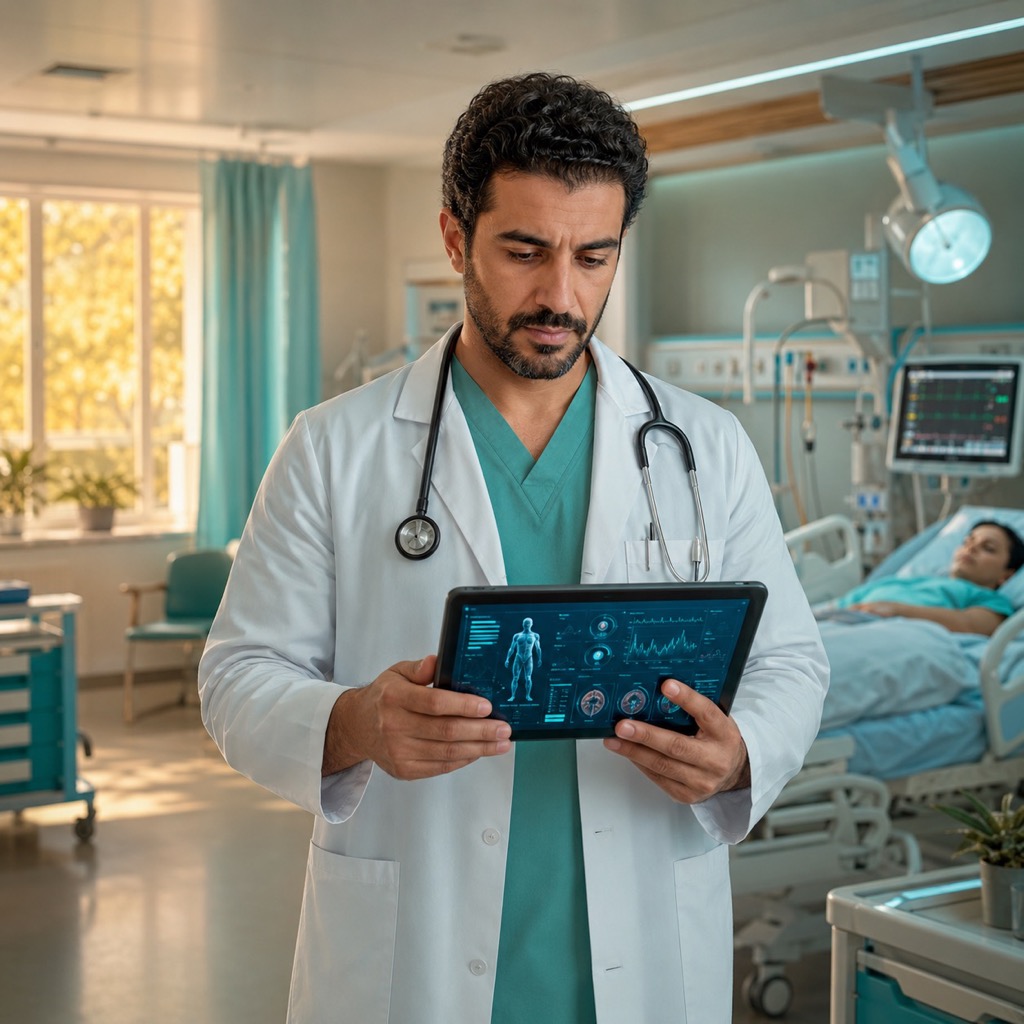
The handshake happened on the second day of DeepX, inside the auditorium of the Great Mosque of Algiers. On April 25, 2026, IQVIA Algeria — the local arm of the multinational that builds health data, advanced analytics, and consulting products — and Think Touch Solution, an Algiers-based startup, signed a memorandum of understanding to co-develop digital-health tools tailored to the Algerian market.
The MoU is not a generic innovation pledge. The two parties named specific build areas: real-world evidence (clinical data captured in everyday care rather than controlled trials), AI-driven decision-support tools for clinicians, and technology products designed for Algerian conditions but built to scale across the wider region. The stated logic is co-construction — IQVIA contributing international experience in clinical research and real-world data, Think Touch Solution contributing agility and local market knowledge.
What makes this worth a closer look is the pairing itself. IQVIA is one of the largest health-data and clinical-research companies in the world. Think Touch Solution is a young Algerian firm founded in 2022, specialized in pharmaceutical and healthcare services — pharmacovigilance, regulatory affairs, market research, and digital health — and backed at the pre-seed stage by the Algerian Startup Fund. When a company of IQVIA’s size signs a co-development MoU with a startup that age, the interesting question is not the press photo; it is whether the deliverables reach an actual hospital.
Why DeepX Is the Right Stage for This
The signing venue matters. DeepX is the inaugural deep-tech venture-building summit organized by the Algerian venture studio DeepMinds, held in Algiers on April 25–26, 2026. Its design goal is to convert scientific research into commercial ventures, and it organized itself around five priority sectors — food security, healthcare, cybersecurity, logistics and smart cities, and fintech.
Healthcare is one of those five for a reason. DeepMinds lined up real-world deployment partners so that startups have somewhere to test, including pharmaceutical group SAIDAL and national insurer CAAT. The summit also drew participants from the United States, Europe, Asia, and Africa, and a second edition is already scheduled for December 2026 in Djanet, in the south. That cadence is the part worth tracking: a one-off conference produces signatures; an annual platform with deployment partners produces follow-through.
For the IQVIA–Think Touch pact, this context lowers one of the biggest risks in any health-tech partnership — the gap between a signed MoU and a deployed product. A summit built specifically to push research into commercial pilots is a more promising launch pad than a standalone announcement.
Advertisement
The Infrastructure the Tools Will Land On
Algeria’s health system is in active modernization, and that backdrop shapes how fast these tools can be useful. In April 2026, Health Minister Mohamed Seghir Aït Messaoudene outlined a digital-transformation roadmap that places electronic health records, telemedicine, and data exchange at the center of the national strategy, aligned with the 2030 Sustainable Development Goals.
The capacity picture gives those tools their value. Algeria runs at roughly 1.57 hospital beds and 1.37 nurses per 1,000 inhabitants in 2025, and national health expenditure sat around 6.24% of GDP in the most recent World Health Organization figures. In a system where clinical staff time is the scarcest resource, decision-support software that helps a doctor triage faster or flag a drug-safety signal earlier is not a luxury feature — it is a force multiplier on the people already in the building.
That is precisely the niche real-world evidence and AI decision-support are built for. Real-world evidence turns the data already generated in everyday Algerian care into something analyzable; AI decision-support turns that analysis into a prompt at the point of care. The two reinforce each other, which is why naming both in the same MoU is a meaningful signal rather than a buzzword stack.
What Algerian Health and Tech Decision-Makers Should Do
1. Treat the MoU as a pilot opportunity, not a finished product
A memorandum of understanding is an intent to build, not a deployed system. Hospital administrators and health-directorate officials who want a seat in the first pilots should reach out now, while the scope is still being defined, rather than waiting for a launched tool. The early adopters of a co-construction project help shape what gets built — and the deliverables are explicitly meant to fit Algerian context specifications, so local clinical input is an asset the partners actually need.
2. Map your existing data before adopting decision-support
Real-world evidence and AI decision-support are only as good as the data feeding them. Before signing onto any pilot, an institution should inventory what clinical data it already captures, in what format, and how cleanly it can be exported. The hospitals with structured, retrievable records will extract value from these tools fastest; the ones still on paper or fragmented systems should prioritize digitizing one high-volume department first rather than attempting an enterprise rollout.
3. Build the governance layer alongside the technology
AI decision-support in a clinical setting touches sensitive patient data and influences medical judgment, so governance cannot be an afterthought. Health institutions should designate a clinical owner for any deployed tool, define where the AI advises versus where a human decides, and align data handling with Algeria’s evolving health-data and personal-data rules. Getting this layer right early is what lets a successful pilot scale to a second department instead of stalling under review.
Where This Fits in Algeria’s 2026 Health-Tech Push
The IQVIA–Think Touch Solution MoU is a small agreement carrying an outsized signal. It shows a global healthcare-data company choosing to build with a local founder team rather than simply selling a product into the market — the co-construction model that tends to produce tools people actually use. It lands during an active ministerial digital-health push, on a summit platform engineered to move research into deployment, in a sector where every hour of clinician time is precious.
None of that guarantees a hospital floor will see software this year; MoUs fail to convert more often than they succeed. But the pieces are unusually well aligned: a credible global partner, a funded local startup with regulatory and pharmacovigilance depth, a national strategy actively pulling in the same direction, and a venture platform with deployment partners standing by. For Algeria, the deal is less important as a single event than as a template — proof that the country’s health system can be a place where serious health-tech gets co-built, not just imported. The next twelve months, and the December DeepX edition in Djanet, will show whether the template holds.
Frequently Asked Questions
What exactly did IQVIA Algeria and Think Touch Solution agree to do?
They signed a memorandum of understanding on April 25, 2026, at the DeepX summit to co-develop digital-health tools for the Algerian market. The named focus areas are real-world evidence, AI decision-support tools for clinicians, and technology solutions adapted to Algerian conditions but designed to scale regionally. It is a build-intent agreement, not yet a deployed product.
Why does it matter that this was signed at DeepX rather than as a standalone deal?
DeepX is a deep-tech venture-building summit organized by DeepMinds, designed to push research into commercial pilots, with healthcare as one of five priority sectors and real-world deployment partners like SAIDAL and CAAT on board. Signing there lowers the usual risk that an MoU never becomes a working tool, because the platform exists specifically to drive follow-through, with a second edition set for December 2026 in Djanet.
How can an Algerian hospital actually benefit from AI decision-support tools?
Decision-support software helps clinicians triage faster, flag drug-safety signals earlier, and analyze the real-world data already generated in everyday care. In a system running at roughly 1.57 hospital beds per 1,000 people, where staff time is the scarcest resource, such tools act as a force multiplier. Hospitals with structured, exportable clinical records will benefit fastest, so digitizing one high-volume department is a sensible first step.
Sources & Further Reading
- Further Reading
- Santé digitale : IQVIA Algérie et Think Touch Solution scellent un partenariat stratégique — TDM Santé Inov
- DeepX: DeepMinds Launches Algeria’s DeepTech Summit — Arab Founders
- Think Touch Solution — Crunchbase Company Profile
- Algeria’s Bold Blueprint to Rebuild Modern Healthcare — Horizons
- Health Indicators — Algeria — Statista Market Forecast
🔗 Related Intelligence

AI Agents in Algerian Healthcare: From Clinic Digitalization to Autonomous Triage
Algeria’s Medical AI Moment: Fetal Ultrasound Models Trained on Local Datasets

Algeria HealthTech 2026: AI Diagnostics and Telemedicine Startups Targeting the Public Hospital Gap
Algeria’s 2025-2030 AI Strategy: Implementation Checkpoint at 16 Months