A Clean Sweep Across the Three Core Technical Tracks
On June 9, 2026, the closing and awards ceremony of the 10th Huawei ICT Competition Global Final took place in Shenzhen, China. According to Huawei’s official announcement, the edition was the largest in the competition’s decade-long history, drawing more than 220,000 university students and faculty members from over 2,000 tertiary institutions across more than 100 countries and regions. Only 177 teams from 49 countries and regions survived the national and regional rounds to reach the global final.
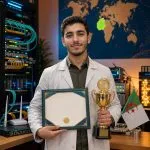
Algeria did not simply qualify. Algerian teams won Grand Prizes — the highest honour the competition awards — in all three of the core Practice Competition tracks. Per the PR Newswire results release, an Algerian team shared the Network Track Grand Prize alongside Brazil, Nigeria, and Shenzhen Polytechnic University; the Cloud Track Grand Prize alongside Egypt, Kenya, and Central South University of Forestry and Technology; and the Computing Track Grand Prize alongside Egypt, the Dominican Republic, and Henan Institute of Economics and Trade.
Across all the headline tracks — Practice, Innovation, and Programming — the Grand Prize went to teams from just eight countries: China, Nigeria, Singapore, Algeria, Brazil, Egypt, Kenya, and the Dominican Republic. To appear three times on that short list, in the three most technically demanding practice categories, is the strongest result Algeria has recorded at this event.
The Students Behind the Result
The win was not abstract. It was earned by named students from Algeria’s specialist computer-science schools. As AL24 News reported, the Cloud Track team — Imad Eddine Megrane and Amira Bellali — came from the Higher School of Computer Science (ESI) in Algiers, supervised by faculty mentors Sofiane Kara and Ishak El Arabi. The Computing Track was carried by Abdelrahman Talbi, Mohamed Mahloul, and Abdelrahman Della from the Higher School of Computer Science in Sidi Bel Abbès (ESI-SBA), with Anis Massoudi as their supervisor. The Network Track team brought together Elias Merzouga, Aya Sarah Beldi, and Ibrahim Snoussi from multiple institutions, mentored by Mokhtar Merah.
These are details that matter for the wider ecosystem. The grand prizes were spread across more than one school and more than one city — Algiers and Sidi Bel Abbès — which signals that competitive ICT talent in Algeria is not concentrated in a single campus. The supervising faculty named in each track also point to something durable: a coaching layer inside Algerian universities that knows how to prepare students for enterprise-grade cloud, network, and computing challenges set by a global vendor.
Advertisement
What the Tracks Actually Test
The reason this result carries weight is the nature of what the competition measures. The Huawei ICT Competition 2025-2026 Global Final site frames the contest as a hands-on talent platform rather than a written exam. The Network Track tests routing, switching, enterprise network design, and security fundamentals. The Cloud Track covers cloud architecture, storage, virtualisation, and AI-enabled services. The Computing Track addresses data-center hardware, high-performance and heterogeneous computing infrastructure — the layer underneath every AI workload.
Winning across all three is a statement that Algerian students can hold their own against peers from established tech ecosystems on practical, deployable skills — not theory. Huawei’s Ritchie Peng described the competition as reflecting the company’s “long-standing commitment to using technology for good,” and the event drew diplomatic representatives from 11 countries to present awards to students from their home nations. For Algerian engineering graduates, that level of recognition translates into a verifiable line on a CV that hiring managers across the Gulf, Europe, and Africa understand instantly.
What Algerian Tech Students Should Do
A single global result is a signal, not a finish line. Here is how students and recent graduates can convert this momentum into their own career capital.
1. Register for the next national round early and build a three-person team that mixes strengths
The competition runs national, regional, and global phases, and Algeria’s editions have historically opened in the autumn with registration closing before year-end. Do not wait for a faculty email. Form a team of three that deliberately combines a networking-minded student, a cloud/virtualisation student, and a systems/computing student, then pick the track that matches your strongest member. The winning Algerian teams competed in distinct tracks for a reason — depth in one domain beats shallow coverage of all three.
2. Stack Huawei certifications (HCIA → HCIP) alongside the competition, not after it
The competition feeds directly into Huawei’s certification hierarchy — HCIA (Associate), HCIP (Professional), and HCIE (Expert). Treat the contest preparation as exam preparation: the routing, cloud-architecture, and data-center material overlaps heavily. Walking away with both a competition placement and an HCIA or HCIP credential makes you legible to employers who may not follow the competition but absolutely recognise the certifications. Aim to clear at least HCIA in your chosen track before the global rounds.
3. Document everything publicly so the win becomes searchable career capital
A grand prize that lives only on a stage in Shenzhen is half-used. Write a short technical post-mortem of the challenges you solved — the lab topology, the failure you debugged under time pressure, the architecture decision you defended. Publish it on LinkedIn and a personal site, tag the institution and supervisors, and link the official Huawei results. Recruiters search for exactly these signals. The students who turn a competition into a public portfolio entry compound the value of one week in China into years of inbound opportunity.
4. Use the faculty coaching layer — and then become it
Every winning Algerian team had a named supervisor. That coaching capacity is one of the most transferable assets in the system. Junior students should seek out the faculty who have taken teams to the global final and ask to join a practice cohort early. Graduating winners should consider mentoring the next cohort: it deepens your own expertise, builds your professional network, and helps the pipeline that produced you keep producing.
What This Signals for Algeria’s Tech Ecosystem
The headline is a celebration: Algerian students competed against more than 220,000 peers and came home with three of the most prestigious technical prizes on offer. But the deeper signal is about infrastructure of talent, not a single trophy.
Three grand prizes, spread across two cities and multiple institutions, with named supervising faculty behind each, describe a system that can reliably produce world-class ICT talent — not a one-off lucky run. That is exactly the kind of evidence that matters as Algeria builds out its digital economy, expands its cloud and data-center capacity, and seeks to retain and grow high-skill engineering jobs at home. Global employers and partners read competition results as proxy evidence of a country’s engineering depth, and a result like this strengthens the case that ambitious technical work can be sourced from Algerian campuses.
For students, the message is direct: the ceiling is global, the pathway is documented, and the people who just proved it studied in the same lecture halls you can walk into next semester. The opportunity now is to widen the pipeline — more teams, more tracks, more public portfolios — so that the next Shenzhen ceremony features not three Algerian grand prizes but a contingent too large to overlook.
Frequently Asked Questions
What did Algerian students win at the Huawei ICT Competition 2026?
Algerian university teams won Grand Prizes — the highest award in the competition — in three of the core Practice Competition tracks: Network, Cloud, and Computing. The results were announced at the 10th Huawei ICT Competition Global Final closing ceremony in Shenzhen, China, on June 9, 2026. Only eight countries took home Grand Prizes across all tracks, and Algeria was one of them, appearing in all three technical practice categories.
How big was the 2025-2026 Huawei ICT Competition?
It was the largest edition in the competition’s ten-year history. More than 220,000 university students and faculty members from over 2,000 institutions across more than 100 countries and regions took part. After the national and regional rounds, only 177 teams from 49 countries and regions advanced to the global final in Shenzhen, making the Algerian grand prizes a result drawn from a very narrow elite.
How can an Algerian student take part in the next edition?
The competition runs in national, regional, and global phases and typically opens registration in the autumn through partner universities and Huawei’s local programme. Interested students should form a three-person team, pick a track that matches their strongest skills (Network, Cloud, or Computing), and start preparing with the associated Huawei certification material (HCIA and HCIP). Reaching out early to faculty who have coached previous teams is the most reliable way in.
Sources & Further Reading
- Further Reading
- 10th Huawei ICT Competition Concludes with Student Winners from 49 Countries — Huawei
- 10th Huawei ICT Competition Concludes with a Record 220,000 Participants — PR Newswire
- Algerian Students Shine in Huawei ICT Competition — AL24 News
- Huawei ICT Competition 2025-2026 Global Final — Official Site
🔗 Related Intelligence

Algeria at the Top: How Huawei’s Global ICT Competition Is Proving Algerian Students Can Win on the World Stage

Huawei and Algeria’s Vocational Diploma: A New On-Ramp for Non-University AI Talent

Huawei ICT Academy Meets Algerian Vocational Training: Can Joint Diplomas Create a Viable Alternative to University Degrees?
Huawei Vocational Partnership: Cloud and Cybersecurity Diplomas Begin Sept 2026