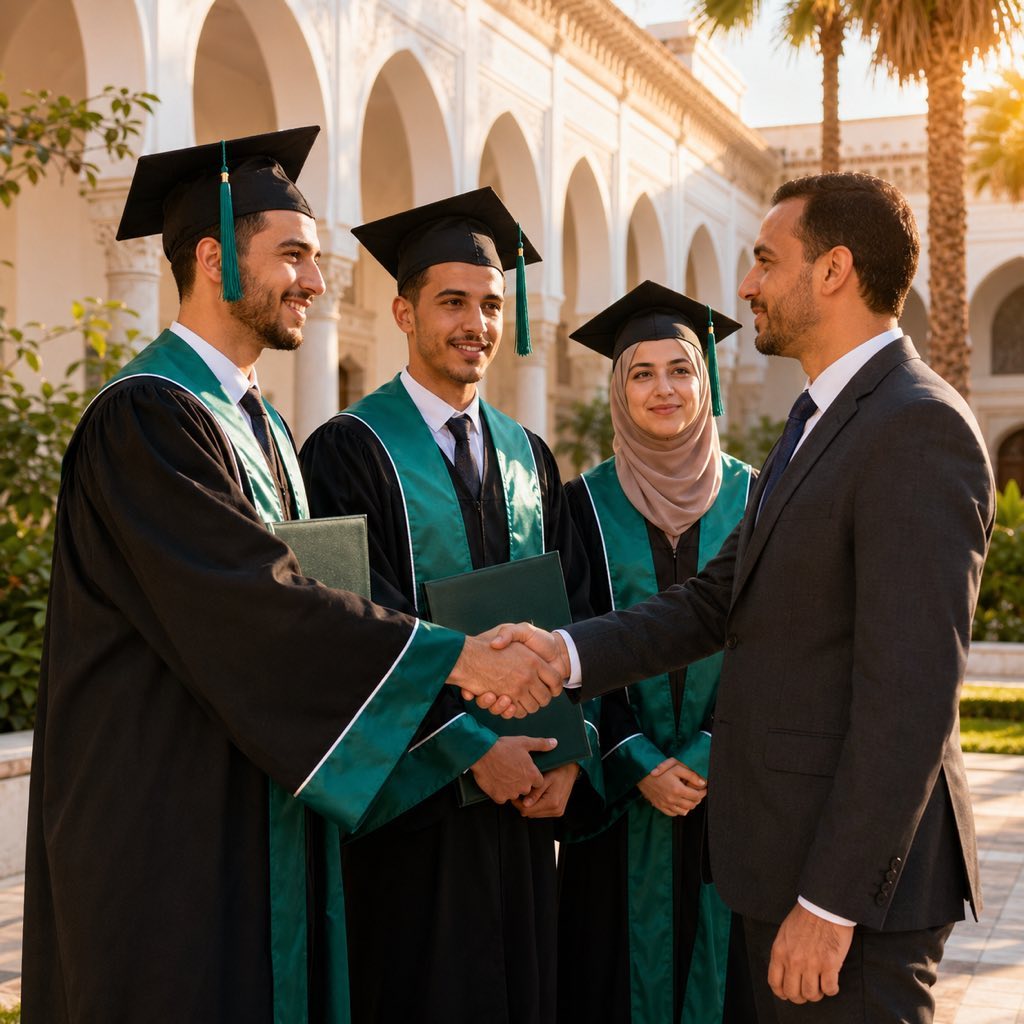
A Diploma That Comes With a Signed Contract
For most engineering graduates anywhere in the world, the diploma is the start of a job hunt, not the end of it. For the 2026 class of Algeria’s two flagship technical schools, the order is reversed: the offer arrives before the cap and gown.
On Saturday, November 15, 2025, at the first edition of the Salon de l’employabilité held at the Chahid Abdelhafid-Ihaddaden Scientific and Technological Pole in Sidi Abdellah, west of Algiers, two ministers stood together to confirm it. According to Radio Algérienne’s coverage of the event, all 157 graduates of the 2026 cohort — 107 from the École nationale supérieure d’intelligence artificielle (ENSIA) and 50 from the École nationale supérieure de mathématiques (ENSM) — will benefit from direct hiring contracts the moment they graduate in June 2026.
Kamel Baddari, Minister of Higher Education and Scientific Research, framed the move as a deliberate strategy rather than a one-off gesture. As Ouest Tribune reported, the approach is designed to give this elite cohort stability and to channel their work into building a knowledge economy — diversifying and modernising national activity while creating an environment that rewards innovation. He was joined by Sid Ali Zerrouki, Minister of Posts and Telecommunications, whose sector is opening some of the most technical positions in the scheme.
This is a story about more than 157 jobs. It is about what happens when a country treats its newest, scarcest skill — applied artificial intelligence — as a national asset to be retained and deployed, not a credential left to find its own way in the market.
Two Young Schools, One Strategic Bet
To understand why guaranteed contracts make sense here, it helps to know how new these institutions are. ENSIA opened its doors in the 2021–22 academic year in the Sidi Abdellah technology pole, teaching in both English and French across mathematics, computer science, software engineering, computer security, and applied AI. As its Times Higher Education profile notes, it was created specifically to train engineers in the theory and practice of artificial intelligence and data science, with graduates expected to deploy solutions across health, energy, agriculture, and transport.
The 2026 cohort is therefore close to the school’s first full output of fully-fledged AI engineers — a tiny, high-value pool. ENSIA has also been building the hardware to match the ambition: the school recently inaugurated a high-performance computing centre stocked with NVIDIA H100, L40S, and A40 processors to support model development. The ENSM, its sister school for applied mathematics, supplies the quantitative backbone — the optimisation, statistics, and modelling skills that turn raw AI capability into working systems.
When you have spent four years and serious public investment producing 157 people who can build and deploy machine-learning systems, letting them disperse without a plan is a waste. The guaranteed-contract scheme is the logical conclusion: secure the talent at the point of graduation, before competing demand pulls it in a dozen directions.
Advertisement
Where the 157 Will Land
The placement is not abstract. More than 125 national companies took part in the employability salon, and students reportedly received multiple offers on the day. The contracts span national economic enterprises and service companies across sectors where AI and mathematics now have a foothold.
The most technically demanding slots come from the telecom and postal sector. Minister Zerrouki was explicit that his ministry is offering “qualified positions” rather than entry-level roles — placing graduates inside technology departments as research-and-development actors tasked with solving real company problems, according to Reflexion’s report on the scheme. That distinction matters: it signals the recruits are wanted for their ability to build, not to fill a headcount line.
There is a forward path baked in too. Beyond immediate employment, graduates are set to gain privileged access to doctoral programmes in the months ahead, as Horizons reported from the salon — keeping a research pipeline open alongside the industry track.
What Algerian Stakeholders Should Do About It
The guaranteed-contract model creates clear, concrete moves for the people around it — graduates, enterprises, and the schools themselves.
1. Prospective ENSIA and ENSM applicants: treat the contract as a multiplier, not a finish line
A signed job at graduation removes the single biggest risk most engineering students carry — the post-diploma gap. Use that certainty to specialise deeper while you study: pick a vertical (energy optimisation, telecom network intelligence, fraud detection) and build a portfolio of real projects on ENSIA’s HPC cluster rather than generic coursework. The contracts go to the 2026 cohort because the schools are still small and the output is scarce; that scarcity is your leverage. Don’t treat the guarantee as a reason to coast — treat it as a reason to arrive on day one already useful, so your first R&D placement compounds into a senior role rather than stalling.
2. National enterprises and telecom operators: build the absorption capacity before the talent arrives
A direct-hire contract only pays off if the receiving organisation can actually use an AI engineer. The telecom and postal sector got this right by defining “qualified positions” inside R&D and technology units rather than dropping graduates into generic IT support. Other recruiting enterprises should copy that discipline: designate a technical lead, scope a real problem (predictive maintenance, demand forecasting, document automation), and give each recruit a concrete first project within 90 days. The failure mode to avoid is hiring scarce AI talent and parking it on tasks any generalist could do — that is how guaranteed placements quietly become guaranteed attrition.
3. ENSIA, ENSM, and employers: turn the employability salon into a permanent loop, not an annual event
The first Salon de l’employabilité worked because it put 125-plus companies in the same room as the entire graduating class. The next step is making the feedback flow both ways year-round: employers tell the schools which problems they actually need solved, and the schools fold those into capstone projects and thesis topics. That keeps the curriculum tied to live industrial demand instead of drifting into pure theory. Pair it with the doctoral track so the strongest graduates can split between industry deployment and research — the combination is what lets a small school punch far above its headcount.
Where This Fits in Algeria’s 2026 Knowledge-Economy Push
The ENSIA–ENSM scheme is best read as one move in a wider 2026 pattern: Algeria building the institutions, infrastructure, and talent pipelines for a digital, knowledge-driven economy rather than importing finished capability. The HPC centre at ENSIA, the new specialised schools spanning AI, robotics, nanotechnology, and cybersecurity that Zerrouki referenced, and the direct-hire contracts all point the same way — capability built at home and put to work at home.
What makes the contract guarantee distinctive is that it closes the loop most education systems leave open. Producing skilled graduates is necessary but not sufficient; the value is realised only when those graduates land in roles that use their skills. By pre-committing employers — especially a technically serious one like the telecom and postal sector — Algeria is treating the transition from classroom to workplace as part of the strategy itself. For a cohort of 157, the scheme is generous. As a template that scales with each new graduating class, it could become one of the more important pieces of how Algeria converts elite technical education into economic output over the rest of the decade.
Frequently Asked Questions
How many ENSIA and ENSM graduates will receive guaranteed jobs in 2026?
All 157 graduates of the 2026 cohort: 107 from the National School of Artificial Intelligence (ENSIA) and 50 from the National School of Mathematics (ENSM). Each will receive a direct hiring contract upon graduation in June 2026, across national economic enterprises and the telecom and postal sector.
Who announced the guaranteed-employment scheme and where?
It was announced on November 15, 2025 by Kamel Baddari, Minister of Higher Education and Scientific Research, alongside Sid Ali Zerrouki, Minister of Posts and Telecommunications, at the first Salon de l’employabilité held at the Chahid Abdelhafid-Ihaddaden Scientific and Technological Pole in Sidi Abdellah, Algiers. More than 125 national companies took part.
What kinds of roles are the graduates being hired into?
Roles span national economic and service enterprises, but the most technical come from the telecom and postal sector, which is offering “qualified positions” inside research-and-development and technology units rather than entry-level jobs. Graduates are also set to gain privileged access to doctoral programmes, keeping a research track open alongside industry employment.
Sources & Further Reading
- Further Reading
- Les diplômés de la promotion 2026 de l’ENSIA et l’ENSM bénéficieront de contrats d’embauche directe — Radio Algérienne
- Kamel Baddari : les diplômés de la promotion 2026 de l’ENSIA et l’ENSM bénéficieront de contrats d’embauche directe — Ouest Tribune
- 157 diplômés de l’IA et des mathématiques intégrés dans le marché du travail — Horizons
- Promotion 2026 de l’ENSIA et de l’ENSM : des contrats d’embauche garantis pour les diplômés — Reflexion
- Les diplômés de la promotion 2026 de l’ENSIA et l’ENSM bénéficieront de contrats d’embauche directe — APS
- National School of Artificial Intelligence (ENSIA) — Times Higher Education