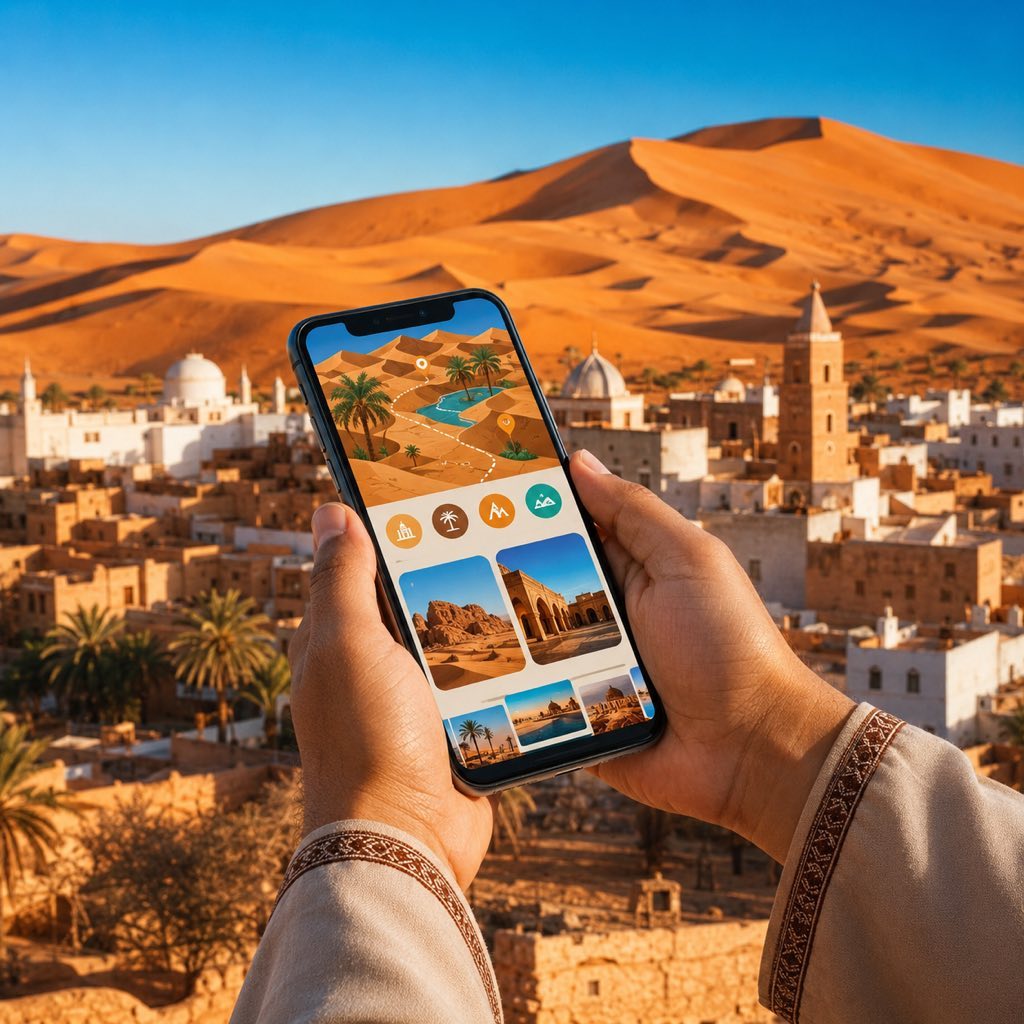
A Tourism Fair That Became a Startup Showcase
For 24 editions, Algeria’s Salon International du Tourisme et des Voyages (SITEV) was a place where travel agencies, hotels and airlines staffed booths and handed out brochures. The 25th edition, held May 18-21, 2026 at the Palais des Expositions des Pins Maritimes in Algiers, looked different. Alongside Air Algérie, ONAT and dozens of foreign tourism offices, roughly 50 Algerian startups specialising in the digital promotion of tourism products took floor space — and a large share of the attention. According to Tourisme et Voyages DZ, which reported 450 exhibitors from 41 countries, the salon explicitly framed digitalization through booking platforms, electronic payment and traveler-facing tools as an acceleration of the sector.
That framing matters. The SITEV 2026 organizers — the Ministry of Tourism and Handicrafts — listed “Tourisme digital” as one of six headline exhibition sectors, covering platforms, innovation, booking, digital marketing and professional tools. When a state-run national fair carves out a dedicated digital lane and fills it with founders rather than legacy operators, it is signalling where it wants the next decade of growth to come from. For Algerian builders, SITEV 2026 was less a trade show than a public confirmation that traveltech is now a recognised, supported category.
What Sacoddo Actually Built — And Why It Matters
The startup that drew the most coverage was Sacoddo, a platform described by DNAlgérie as “entirely dedicated to travel within the country”. It is 100% Algerian-built, launched on May 1, 2025 by a team of Algerian entrepreneurs, and reaches a wider audience precisely because of what global platforms leave out: family guesthouses (maisons d’hôtes familiales), rural homestays, destination and circuit discovery, plus listings for restaurants, artisans and local guides.
The strategic insight is the long tail. Booking.com and Tripadvisor index standardised, internationally bankable inventory — chain hotels, riads with credit-card terminals, properties that fit a global template. Vast swathes of Algerian supply never appear there: the guesthouse in a Saharan oasis town, the family running rooms near a mountain trail, the licensed guide who runs 4×4 desert circuits. Sacoddo’s localized approach surfaces exactly this inventory. Maghreb Émergent reported that several startups at SITEV presented apps designed to facilitate travel for Algerians inside and outside the country, but Sacoddo’s discovery-plus-booking model is the clearest template for what a defensible Algerian traveltech moat looks like: inventory no incumbent can easily replicate, payment rails tuned to local cards, and content in the traveller’s own context.
Advertisement
The Market Behind the Moment
This is not a one-off marketing event. Algeria’s tourism strategy gives the vertical a long runway. The country is targeting 12 million foreign arrivals by 2030 and 14 million by 2035, backed by streamlined visa procedures and a strong push on Saharan tourism — desert tourism alone drew more than 16,000 foreign visitors last year. A national digital platform to centralise licensing, reservations and secure payments, integrated with international payment systems, is part of the plan. The investment is already visible: Algeria implemented 582 tourism projects adding roughly 70,000 new beds by end-2025.
New beds and new arrivals need a booking, discovery and payment layer — and that layer is where founders win. The structural gap is also documented: academic work on Algerian tourism startups notes that many face complex administrative procedures and low digital-marketing adoption, leaving large parts of supply offline. That gap is the opportunity. Each unlisted guesthouse and undigitised circuit is an addressable customer for a platform that can onboard it, take payment locally and put it in front of travellers.
What Algerian Traveltech Founders Should Do
The SITEV signal is clear, but a fair appearance is not a business. The founders who turn this opening into durable companies will make a few specific moves in the next 6-12 months.
1. Win the long-tail inventory before competing on polish
Sacoddo’s edge is not a slicker interface than Booking — it is access to supply Booking does not carry. Build your onboarding flow around the guesthouse owner with a smartphone and no credit-card terminal, not the four-star hotel that already has global distribution. Sign exclusive or first-mover listings in Saharan towns, mountain trails and rural circuits where no platform has presence yet. The defensible asset is a catalogue of verified local supply, not the app shell — anyone can clone a search box, but re-signing 2,000 guesthouses takes years. Map the unlisted inventory district by district and treat each onboarded host as a moat brick, not a vanity metric.
2. Make local payment the product, not a bolt-on
International OTAs assume a foreign-currency card most Algerian travellers don’t hold. Treat Edahabia, CIB and BaridiMob acceptance — plus cash-on-delivery and confirm-on-arrival flows — as core product, designed in from day one rather than patched on later. The payment friction that blocks global platforms is precisely the friction your platform removes; that is the wedge. Build the booking experience around how Algerians actually pay, and you convert travellers that Booking and Tripadvisor structurally cannot.
3. Use SITEV and ministry channels as a distribution and trust layer
A state-run fair flagging digital tourism is an invitation, not just an audience. Use the institutional backdrop to sign onboarding partnerships with ONAT agencies, licensed travel operators and regional tourism directorates that already hold relationships with guesthouse owners. These channels solve the cold-start problem — the hardest part of a two-sided marketplace is the first thousand suppliers. Position your platform as the digital rail that helps the ministry’s 12-million-arrivals target become bookable, and you convert official momentum into supply onboarding rather than just press coverage.
4. Build for both inbound foreign travellers and domestic tourists
Sacoddo focuses on travel within Algeria, and domestic tourism is the volume base — but the highest-value bookings come from foreign visitors chasing Saharan experiences. Design dual-language, dual-currency flows so the same circuit can be booked by an Algiers family and a French or Gulf traveller. The 16,000 foreign Saharan visitors are a small but high-margin segment growing toward the 2030 arrivals target; capturing them early builds the reviews, content and supply density that then pull in domestic demand. Don’t pick one audience and ignore the other — the inventory serves both.
Where This Fits in Algeria’s 2026 Ecosystem
SITEV 2026 sits inside a broader pattern. Algeria’s startup scene spent 2025 and early 2026 proving that vertical, locally-built platforms can win where global incumbents are absent — from e-commerce after Jumia’s exit to dinar-denominated flight booking. Tourism is the next vertical to open, and it opened in public, on a ministry stage, with roughly 50 founders in the room. The structural ingredients are aligned: a state target of 12 million arrivals, billions in new hotel capacity, a documented digital gap in supply, and a flagship app in Sacoddo demonstrating that the long-tail model works.
The lesson for founders is not that tourism is suddenly easy — administrative complexity and thin financing remain real. It is that the category now has institutional cover, visible demand and a reference product. The traveltech founders who move in the next year — claiming long-tail inventory, owning local payment, and partnering with the channels that already hold supplier trust — will define what Algerian travel looks like when the 2030 arrivals wave actually lands.
Frequently Asked Questions
What is Sacoddo and how is it different from Booking or Tripadvisor?
Sacoddo is a 100% Algerian travel platform launched on May 1, 2025, dedicated to travel within Algeria. Unlike Booking and Tripadvisor, which index standardised international inventory, Sacoddo surfaces family guesthouses, rural homestays, Saharan circuits, local guides and artisans that global platforms typically ignore — supply that is hard for incumbents to replicate.
Why does SITEV 2026 matter for Algerian startups?
The 25th SITEV, held May 18-21, 2026 in Algiers with 450 exhibitors from 41 countries, gave roughly 50 digital-tourism startups dedicated floor space and listed “Tourisme digital” as a headline sector. That signals official, state-backed recognition that traveltech is a supported growth category — institutional cover founders can build on.
How big is the opportunity for traveltech founders in Algeria?
Algeria targets 12 million foreign arrivals by 2030 and 14 million by 2035, with 582 tourism projects adding around 70,000 beds by end-2025 and Saharan tourism drawing 16,000+ foreign visitors last year. New beds and arrivals need a booking, discovery and payment layer — and much local supply is still offline, leaving a large addressable market for founders who can digitise and monetise it.
Sources & Further Reading
- Further Reading
- 450 exhibitors and 41 countries at SITEV 2026 — Tourisme et Voyages DZ
- Sacoddo challenges Booking and Tripadvisor — DNAlgérie
- At SITEV 2026, startups bet on apps and digital services — Maghreb Émergent
- SITEV — International Tourism and Travel Show (official site)
- Algeria’s tourism investment boom: 582 projects, 70,000 new beds by end-2025 — DIVAN Centre