Africa’s Attack Surge: What the Numbers Say for Algerian Business Owners
The cybersecurity threat statistics for Africa in 2026 are not background noise — they represent an operational risk that directly affects Algerian small and medium enterprises conducting digital transactions, maintaining customer records, or using cloud-hosted software.
According to April 2026 industry threat intelligence, African organizations averaged approximately 2,940 cyberattacks per organization per week — making Africa the most attacked region in the world on a per-organization basis. The January 2026 data from Intelligent CIO Africa placed the continent’s average at 2,864 attacks per week, with government and financial services most targeted — but consumer goods and services (which includes retail, food, distribution, and professional services where Algerian SMEs are concentrated) ranking among the top three targeted sectors continent-wide.
The ransomware picture is particularly concerning for SMEs. Ransomware groups recorded 707 attacks globally in April 2026 — a 12% year-over-year increase — and the tactical shift among attackers makes SMEs uniquely vulnerable: threat actors are increasingly abandoning encryption-based attacks (which require technical sophistication to recover from) in favor of data exfiltration and extortion (which requires only the ability to steal files and send a threatening email). An SME that maintains customer records, supplier contracts, or employee data is a target for extortion regardless of whether it has any notable digital infrastructure.
The generative AI acceleration compounds this. Algeria itself is not immune: a 2025 incident documented by The Hacker News involved an amateur in Algeria who used AI-assisted tools to build ransomware that hit 85 targets in its first month of deployment. This illustrates both the lowering entry barrier for attackers and the fact that regional threat actors can operate domestically.
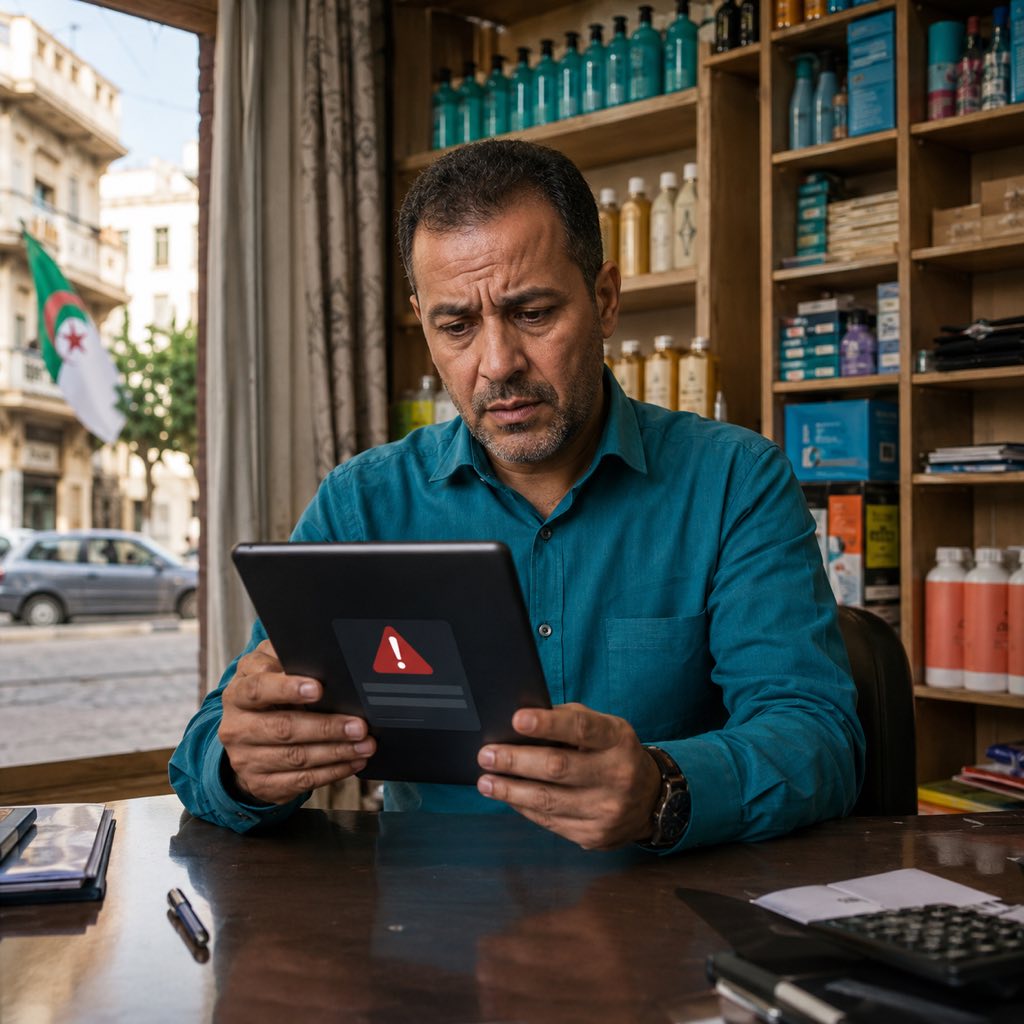
For Algerian SME owners, the starting question is not “are we a target?” — the statistics make clear that all networked organizations are — but “what affordable steps can we take immediately with our existing budget?”
The SME Security Gap: Why Standard Advice Fails Smaller Businesses
Most cybersecurity guidance is written for enterprise IT teams with dedicated security budgets, full-time staff, and access to commercial tools. Algerian SMEs — many of which operate with 10-50 employees, a single part-time IT person or none, and reliance on consumer-grade equipment — need a different framework.
The barriers are real: enterprise security tools cost hundreds of thousands of dinars annually; qualified cybersecurity professionals are scarce and expensive in Algeria’s current labor market; and most SME owners cannot evaluate competing security vendors. Algeria’s vocational training expansion in cybersecurity is producing more graduates, but the enterprise sector absorbs most of them.
The practical reality is that cyber hygiene — the set of basic, consistent security practices that eliminate the most common attack vectors — is achievable for SMEs without enterprise budgets. Studies consistently show that basic hygiene eliminates 80-90% of attack surface. The failures that lead to SME breaches are almost never sophisticated zero-day exploits — they are phishing emails that employees click, reused passwords that attackers guess, and unpatched systems that attackers exploit with tools available on the public internet.
Advertisement
What Algerian SMEs Can Do Right Now: A Four-Step Action Guide
1. Activate Multi-Factor Authentication on Every Business Account
Multi-factor authentication (المصادقة متعددة العوامل) is the single highest-impact security control an SME can implement at near-zero cost. Enable MFA on: the business email account (Google Workspace, Microsoft 365, or any local provider), all banking and payment platform accounts, any cloud storage used for business documents (Google Drive, OneDrive), and any social media accounts used for customer-facing communications. Most of these platforms include MFA at no extra charge.
The threat MFA addresses is credential compromise — attackers who obtain a password through phishing or a data breach (of which there were 678 publicly recorded ransomware incidents in January 2026 alone) are stopped by MFA because they cannot complete the second factor. Voice phishing (vishing) has surged to the second most common initial access vector globally in 2025, accounting for 11% of initial access methods according to Mandiant M-Trends 2026. Employee awareness of suspicious calls requesting account credentials is the behavioral complement to technical MFA controls.
2. Establish a Monthly Patching Routine and Stick to It
The exploitation timeline has collapsed dramatically. Mandiant M-Trends 2026 data shows that the mean time-to-exploit is now negative — attackers are using vulnerabilities before patches exist, or within days of patch release. For SMEs, the practical implication is that Windows updates, antivirus definition updates, and updates to any internet-facing software (especially routers, VPN clients, and remote access tools) should be applied as soon as they are available, not deferred.
Designate one person — even if it’s the business owner — as responsible for checking that operating systems and key software are updated on the first Monday of each month. Document which devices are in scope (every device that accesses business email or business systems). The cost is time, not money. The risk of not doing this is documented: 45% of vulnerabilities in larger organizations are never remediated according to Mandiant M-Trends 2026, creating the persistent attack surface that ransomware operators exploit.
3. Create and Test a Backup Process — Offline, Not Just Cloud-Synced
Ransomware and extortion attacks that exfiltrate data before deleting or encrypting it are effective primarily because the victim has no clean copy of their data. SMEs that maintain a current, tested backup can recover from ransomware without paying a ransom. The operational requirement is: weekly backups of all business-critical data (customer database, financial records, contracts), stored in a location that is physically or logically separate from the primary systems (an external drive disconnected after backup, or a cloud backup service that is not directly synced to the primary file system), and tested quarterly by actually restoring a file.
The common mistake is relying on cloud sync (Google Drive, OneDrive) as a backup — these platforms sync deletions and ransomware encryption events in real time, meaning they protect against hardware failure but not against attacks. A true backup is isolated from the primary system.
4. Report Incidents to DZ-CERT — The Reporting Chain Matters
DZ-CERT (دي زي سيرت), Algeria’s National Computer Emergency Response Team operated by CERIST, is the primary official body for cybersecurity incident reporting. SMEs that experience a phishing attack, ransomware, data theft, or unauthorized system access should report to DZ-CERT. The reporting serves two purposes: it allows DZ-CERT to issue threat intelligence that may prevent the same attack from hitting other Algerian organizations, and it creates an official record that may be relevant for Law 18-07 / Law 25-11 breach notification obligations if customer personal data was involved.
Reporting to DZ-CERT does not require a large organization or a formal legal team — it is available to any Algerian business or individual affected by cybercrime. For incidents involving personal data of customers or employees, recall that Law 25-11 (July 2025) requires notification to the ANPDP within 5 days of awareness. Missing this window carries criminal penalties.
The Bigger Picture: Collective Resilience for Algerian SMEs
Individual SME cyber hygiene matters, but Algeria’s SME cyber resilience is ultimately a collective challenge. Attackers targeting supply chains and distribution networks hit upstream suppliers to reach downstream targets — an SME that delivers goods or services to a larger enterprise is a potential entry point into that enterprise’s network if its systems share credentials or network access.
Algeria’s cybersecurity expansion in vocational training and the broader 2025–2029 national strategy are beginning to create a pipeline of affordable security consulting talent. SMEs that cannot build internal capability should look at the emerging cohort of young Algerian cybersecurity graduates offering affordable assessments — a service model that is already common in other markets and is beginning to appear in Algeria. The four-step guide above is the immediate floor; engaging a local security practitioner for a half-day assessment is the next step beyond it.
The cost of basic cyber hygiene — MFA activation, monthly patching, offline backups, incident reporting — is measured in hours, not dinars. The cost of a ransomware attack that exfiltrates customer records and triggers a Law 25-11 notification obligation is measured in reputational damage, business disruption, and potential criminal penalty. The asymmetry makes the choice straightforward.
Frequently Asked Questions
How do I know if my Algerian SME has been targeted by a cyberattack?
Common indicators include: unexpected account login notifications from unfamiliar locations, employees receiving phishing emails impersonating the business owner or a supplier, unusual activity in banking or payment accounts, files becoming inaccessible or renamed, and unexpected data usage spikes on network connections. Many attacks go undetected for weeks — Mandiant M-Trends 2026 found a median dwell time of 14 days between initial intrusion and detection. Monthly log reviews of key systems (email admin, banking platform, cloud storage access records) can surface anomalies before they become crises.
Does Law 18-07 apply to small Algerian businesses?
Yes. Law 18-07 and its July 2025 amendment (Law 25-11) apply to any person or entity — including small businesses — that processes personal data in Algeria. If your business stores customer names, contact details, purchase history, or employee records, you are a data controller subject to Law 18-07. The 5-day breach notification obligation to the ANPDP applies regardless of company size. The ANPDP has not published an SME-specific exemption. Criminal penalties for violations (up to 5 years imprisonment) apply to individuals, not just corporations.
What does DZ-CERT actually do, and how do I contact them?
DZ-CERT (Centre de Recherche sur l’Information Scientifique et Technique) is Algeria’s national Computer Emergency Response Team, responsible for monitoring cyber threats, coordinating incident response, and publishing security advisories for Algerian networks. It handles technical incident assistance for organizations experiencing active attacks, threat intelligence sharing, and vulnerability disclosure coordination. SMEs can contact DZ-CERT through the CERIST website (www.cerist.dz) to report incidents or access advisories. DZ-CERT also coordinates with international CERT networks, enabling Algerian organizations to benefit from threat intelligence gathered globally.
Sources & Further Reading
- Ransomware and Cyber Threats Surge in 2026 — Help Net Security
- Global Cyber Attacks Rise in January 2026 — Intelligent CIO Africa
- 2026: The Year of AI-Assisted Attacks — The Hacker News
- Algeria Expands Vocational Training for Cybersecurity — TechAfrica News
- Mandiant M-Trends 2026: Access Handoff Shrinks to 22 Seconds — Help Net Security
🔗 Related Intelligence
Algeria Under Siege: 70 Million Cyber Attacks and the New National Defense Framework

CYSEC Africa 2026: What Algeria Gains from Continental Cyber Defense Cooperation
Algeria’s Cyber Resilience: Turning 2024’s Attack Volume Into 2026 Detection Strength

Algeria and ANCA: A Strategic Playbook for Joining Africa’s Continental Cyber Defense Network