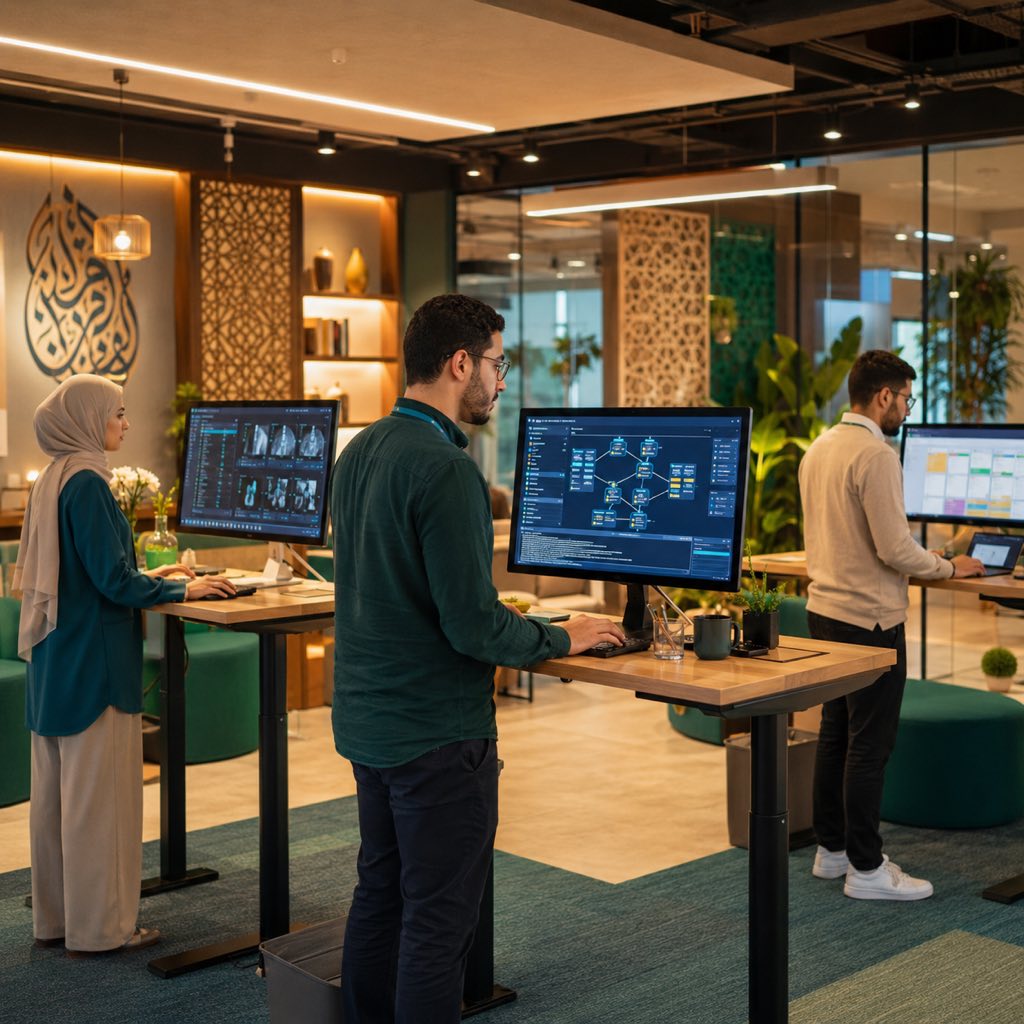
The Hiring Pressure Building Inside Algeria’s Banks and Telecoms
For most of the past decade, AI in Algeria’s financial and telecommunications sectors meant a chatbot answering customer queries or a fraud-detection rule engine running on vendor software. That era is ending. The sector-wide push toward digital transformation — accelerated by Algeria’s 2030 Digital Transformation Strategy, unveiled in May 2025 — is forcing Algerian banks and telecoms to build proprietary data infrastructure, which in turn demands a new layer of internal technical talent that these institutions have never had to hire before.
The immediate catalyst on the talent side is Algeria’s national AI training programme, launched in April 2026 by the Ministry of Formation and Vocational Education. The 12-week initiative — eight weeks of intensive instruction followed by four weeks of real-world project work — is explicitly designed to produce “highly specialised and operational human capital capable of integrating directly into high-value economic sectors.” Banking and telecom are at the top of that list.
The scale of ambition is significant. The programme’s stated goal, reported by Ecofin Agency, is to train up to 500,000 ICT specialists, with AI contributing nearly 7% of Algeria’s GDP by 2027. Even if actual numbers fall short of that target, the supply-side infrastructure is being built: centres of excellence, startup incubators inside vocational institutes, and dedicated funding streams are all live.
The demand side is also concrete. According to Himalayas.app’s May 2026 snapshot of Algeria’s remote job market, 795 remote tech roles are currently listed for Algerian candidates, with machine learning (43 open listings), data science (25 listings), AI tools (51 listings), and large language model (LLM) work (52 listings) all appearing explicitly. These are not speculative projections — they represent live job postings that cannot be filled at current local supply levels.
What the New Roles Actually Look Like
Understanding which specific AI-adjacent positions are emerging inside Algerian banks and telecoms is essential for any candidate planning an upskilling trajectory. Three role families are the most active hiring targets.
Data Engineers sit at the foundation. Banks including Banque Nationale d’Algérie (BNA) and Banque Extérieure d’Algérie (BEA) are building centralised data lakes and pipelines that feed risk models, customer segmentation engines, and regulatory reporting systems. The skill set required is Python (263 remote listings on Himalayas for Algerian candidates), SQL (201 listings), cloud platforms — primarily AWS (154 listings) — and ETL orchestration tools. A data engineer in a Algerian bank today is, functionally, the person who makes all AI workflows possible; without clean, well-governed pipelines, the models cannot run.
Model Validators and AI Quality Assurance Specialists are the role that surprises most candidates. Before any model goes into production at a regulated financial institution, it must be tested for bias, accuracy under distribution shift, and compliance with internal risk policy. In the EU, this function is codified in the AI Act; in Algeria, internal bank policies and the Bank of Algeria’s emerging digital oversight frameworks are creating equivalent internal requirements. The skill set overlaps with data science but tilts toward statistical testing, documentation, and audit trail management. This is one of the most underhired roles in the market precisely because it sits between data science and compliance — few people have trained for it deliberately.
AI Product Owners bridge the technical team and business stakeholders. They write requirements for AI-powered features, manage the feedback loop between model outputs and business decisions, and own the roadmap for internal AI tools. Telecom operators — including Djezzy, Ooredoo Algeria, and Mobilis — are deploying AI-driven churn prediction, network optimisation, and personalised offer engines, and all three functions require a product layer. The profile: two to four years of technical experience, strong communication skills in Arabic and French, and familiarity with agile delivery frameworks.
Advertisement
What This Means for Algerian Candidates in Banking and Telecom
1. Target the 12-Week National Programme as Your Fastest Entry Point
The Ministry of Formation and Vocational Education’s programme is not a generic coding bootcamp — it is specifically structured around “simulated professional scenarios” evaluated under a “strict performance framework based on merit, innovation, effectiveness, and measurable outcomes.” This language maps almost exactly to what data-engineering hiring managers want to see from entry-level candidates: evidence of working on real problems under constraints, not just completing tutorial courses. If you are currently employed in a support, compliance, or operations role inside a bank or telecom and have not yet enrolled, treat this programme as a formal career lever, not optional enrichment. The programme also runs the first business incubator embedded inside a National Institute for Professional Training — completing it puts you inside an innovation network, not just a classroom credential.
2. Stack Python, SQL, and One Cloud Platform Before Any Other Skill
The skills signal from Algeria’s live job market is unambiguous. Python dominates with 263 listings; SQL is second with 201; AWS leads cloud platforms at 154. These three skills together form the minimum viable profile for a data engineering role in an Algerian bank. Candidates who attempt to specialise in deep learning or LLM fine-tuning before mastering these fundamentals routinely fail technical screenings because data infrastructure work — not model building — is where the actual unfilled positions sit. A practical six-month plan: complete Python Data Engineering foundations (via DataCamp or Coursera), pass the AWS Cloud Practitioner certification, and build one end-to-end pipeline project that reads data, transforms it, and loads it into a target system. That project portfolio is more valuable than any certification on its own.
3. Position Yourself for Model Validation — the Overlooked High-Demand Niche
Globally, the AI talent supply-demand ratio sits at 3.2 qualified candidates for every 10 open positions, with model validation and AI ethics governance scoring the highest shortage — demand at 78 out of 100, supply at 19 out of 100 on standardised indexes. Inside Algerian banks, regulatory pressure from the Bank of Algeria’s ongoing digitalisation oversight is pushing compliance teams to hire people who understand both statistics and audit documentation. A candidate who combines data science basics with documentation skills and an awareness of bias testing frameworks is positioning for a role with almost no local competition. The entry path: study the EU AI Act’s model risk categories (freely available), learn to write a model card, and apply those skills to one internal data project.
4. Apply Algeria’s French-Arabic Bilingual Advantage Strategically
One structural advantage Algerian candidates hold over imported talent: native bilingualism in Arabic and French, the two operating languages of Algeria’s financial sector. AI Product Owner roles require writing requirements documents, facilitating workshops, and explaining model outputs to non-technical executives — all of which happen in Arabic and French simultaneously. Candidates who position their language skills as a professional asset (including in their CV and portfolio descriptions) are differentiating themselves against candidates with identical technical skills but single-language profiles. For telecom in particular, where customer-facing AI features require Arabic-language model tuning, native Arabic speakers with any NLP background are in acute demand.
The Structural Gap This Moment Reveals
The mismatch between the pace of AI adoption in Algeria’s banks and telecoms and the current local skills supply is not a crisis — it is a window. When 90% of enterprises globally face critical AI skills shortages, as data from Iternal AI’s 2026 skills gap report indicates, the scarcity is not unique to Algeria. What is unique is that Algeria’s government is funding a supply-side response at scale — the 500,000 specialist target, the embedded incubators, the train-the-trainers programme launched January 15, 2026 — at exactly the moment when the demand signals are becoming visible in live job postings.
Candidates who enter the pipeline now — through the national programme, through self-directed skills stacking, or through internal upskilling agreements with their current employers — will be competing for positions that do not yet have an established local talent pool. That is a hiring advantage of unusual size and temporary duration. Banks and telecoms will eventually build recruitment pipelines; the question is whether Algerian professionals are inside those pipelines before or after that infrastructure matures.
Frequently Asked Questions
What AI roles are Algerian banks and telecoms actually hiring for?
The three most active hiring targets are data engineers (who build and maintain the data pipelines that feed AI models), model validators (who test models for bias, accuracy, and regulatory compliance before production deployment), and AI product owners (who translate business requirements into AI feature roadmaps). Data engineering is the largest volume need because it underpins all other AI workflows.
Do I need a computer science degree to get these jobs?
Not necessarily. The national 12-week AI training programme specifically targets professionals without prior CS degrees, using a competency-based assessment framework rather than credential screening. Banks and telecoms are increasingly hiring for demonstrated skills — portfolio projects, completed certifications (AWS Cloud Practitioner, Python data engineering courses), and evidence of real-world problem-solving — alongside or instead of traditional degrees.
How much do AI roles in Algerian banks pay compared to standard IT positions?
Globally, workers with advanced AI skills earn a 56% wage premium over peers without those skills, according to Gloat’s 2026 AI workforce report. While Algerian salary benchmarks for AI roles are not publicly indexed, the premium dynamic is emerging locally: AI-adjacent roles in Algerian financial institutions command the top of the domestic IT salary band, and positions requiring model validation or data pipeline management are beginning to attract international remote compensation in addition to local offers.
Sources & Further Reading
- Algeria Launches 12-Week AI Training Programme — TechAfrica News
- Algeria Launches National AI Training Program to Build Digital Skills — Ecofin Agency
- Algeria Remote Tech Job Market Statistics — Himalayas.app
- Global AI Talent Shortage Statistics 2026 — Second Talent
- AI Skills Gap Report 2026 — Iternal AI
- AI Workforce Trends 2026 — Gloat
🔗 Related Intelligence

Algeria Private Sector AI Upskilling: How Companies Build Internal AI Talent in 2026

AI Literacy for Algeria’s Non-Tech Professionals: The Career Advantage That Compounds in 2026

Algeria’s Tech Talent Demand: AI Skills, Hiring Surges, and Career Paths for Developers in 2026

AI Operations Manager: The Career Path Algeria’s Private Sector Is Building in 2026