The Voice Gap That Global AI Cannot Fill
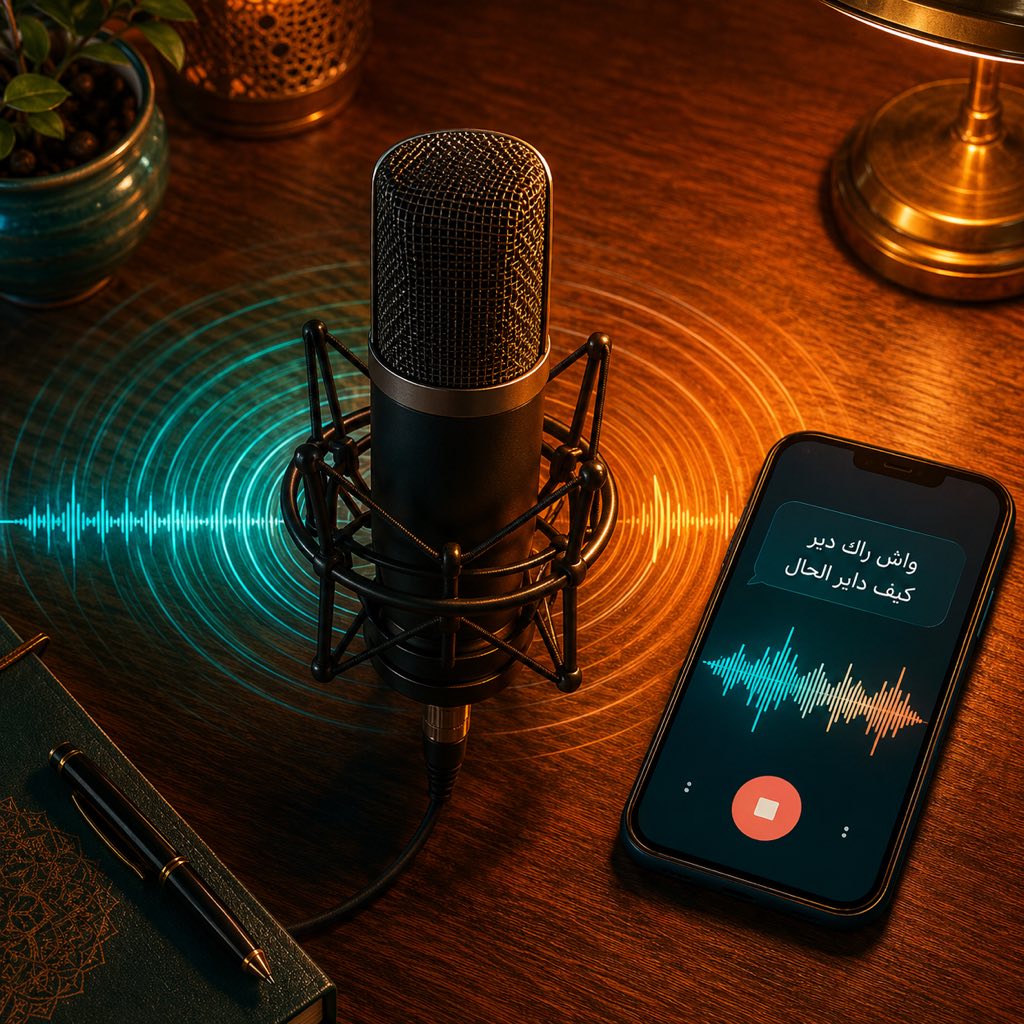
Ask Siri or Google Assistant a question in Darija. The response will range from confused to comic — a mismatch that captures something important about the global AI industry’s blind spots. Despite the enormous commercial investment in voice AI, automatic speech recognition, and conversational agents, the world’s most widely spoken Arabic dialect families remain dramatically underserved.
Arabic accounts for less than 1% of training data in major global large language models, with North African dialects — Darija, Maghrebi Arabic — virtually absent from the datasets that power the tools Algerian users encounter every day. The practical consequences compound. A citizen trying to interact with a government chatbot in Darija gets no response. A call center agent relying on AI transcription misses context because the model cannot handle code-switching between Darija, French, and Modern Standard Arabic in the same sentence. A student using voice dictation on a mobile device produces output that requires more correction than the typing it was meant to replace.
This gap is not merely inconvenient — it is a structural market failure that shapes who participates in the digital economy. For 45 million Darija speakers in Algeria alone, and more than 100 million across the Maghreb, global voice AI is effectively a foreign language service.
The Building Blocks That Already Exist
The encouraging dimension of Algeria’s Darija AI story is that the research foundation is more substantial than its commercial visibility suggests.
DziriBERT — developed by researchers from USTHB and ESI, and documented in CERIST’s ASJP research repository — is the first Transformer-based language model specifically pre-trained on Algerian Arabic. Built on the BERT architecture and trained on a corpus of Algerian dialect text drawn from social media and web sources, DziriBERT demonstrated statistically significant improvements over standard Arabic models on Algerian dialect tasks including sentiment analysis and topic classification. It is the proof-of-concept that Algerian Arabic can be modeled computationally with meaningful accuracy.
Nojoom.ai describes itself as “the first 100% Algerian generative AI platform,” with three named products: Thuraya (Arabic-language search), Suhail (document analysis), and Nitaq (an enterprise assistant). The company has secured backing from private investors and is building a client base in the public sector — a validation signal that Algerian Arabic AI has reached commercial readiness, not just academic prototype status.
Fentech’s Hadretna is the most ambitious published effort. Pre-trained on two billion tokens of Darija and Tamazight text, Hadretna represents the first model specifically targeting the full linguistic landscape of Algerian Arabic — including the dialect-French-MSA code-switching that makes standard models fail. Fentech launched a public crowdsourcing campaign for native speaker data, recognizing that the fundamental bottleneck in Algerian Arabic AI is not compute or architecture — it is labeled data.
The academic infrastructure is similarly substantial. Algeria hosts 74 AI master’s programs across 52 universities, with 57,700 students currently enrolled in AI-related fields. Dr. Taha Zerrouki at the University of Bouira leads one of the country’s most respected NLP research programs, producing open-source Arabic language tools including the Mishkal text vocalizer (automatic diacritization) and the Tashaphyne morphological analyzer. The intellectual capital exists; the commercialization pipeline is the missing link.
Advertisement
What Algerian AI Founders and Investors Should Do
1. Target the Public Sector Procurement Market First — It Pays in Dinars, Not Dollars
The largest near-term market for Darija voice AI in Algeria is not consumer apps — it is public sector digitization. The Bawabatak portal already digitizes over 342 government services across 25 ministerial departments, creating a natural integration surface for voice interfaces. A citizen who can say “renew my identity card” or “check my CNAS contribution status” in Darija and receive an accurate, action-capable response is a citizen who uses the e-government system instead of queueing at a wilaya office. For founders building Darija NLP, this is the pitch: reduce queue pressure at CNEP, Algérie Télécom, and CNRPS counters with voice-first AI interfaces that work in the language people actually speak. Public sector contracts pay in local currency, scale through institutional procurement, and provide the high-volume transactional data that makes models improve continuously.
2. Solve the Code-Switching Problem — It Is the Moat
The technical challenge that most distinguishes Darija AI from standard Arabic AI is code-switching. Algerian conversations do not stay in one language: a single sentence might begin in Darija, include a French noun, incorporate an MSA verb, and end with a borrowed technical term. Symloop’s 2026 analysis of Algeria’s AI market identifies code-switching as the primary failure mode for imported voice AI tools in the Algerian market. Building a robust code-switching recognition layer is not a marginal improvement — it is the capability that separates a tool that Algerians will actually use from one they will abandon after two failed interactions. Founders who solve this problem own the primary technical barrier to entry. Investors who back this capability own the moat.
3. Build Annotated Datasets Commercially, Not Just Academically
The bottleneck for Darija AI is not researchers — it is labeled data. Fentech’s crowdsourcing approach is the right instinct, but commercially scaled data collection requires economic incentives beyond academic volunteerism. Algerian AI startups should build structured data annotation businesses alongside their model businesses: pay native speakers to transcribe, correct, and label voice recordings, dialogue pairs, and sentiment examples in Darija. This is a two-sided asset. The annotated corpus improves the model; the data business generates revenue that funds the model development. Lahajati, which offers text-to-speech and speech-to-text in 192+ Arabic dialects, demonstrates that there is a paying market for Arabic voice services — the question for Algerian startups is whether they capture value from this market or cede it to services that treat Algerian Arabic as a generic “Arabic” variant.
4. Position for the Maghreb, Not Just Algeria
The commercial logic of Darija AI does not stop at Algeria’s borders. Moroccan Darija and Tunisian Arabic share substantial structural features with Algerian Darija — enough that a model trained primarily on Algerian data will perform meaningfully better on Moroccan inputs than any standard Arabic model. The Maghreb digital market spans more than 100 million people who share broadly similar dialect structures, digital infrastructure gaps, and public sector digitization trajectories. Statista’s Algeria AI outlook situates Algeria within a MENA AI adoption curve that runs through 2030 — founders who build Darija AI for Algeria today are building the foundation for a regional product that no international competitor is positioned to match.
The Structural Lesson
The opportunity in Algerian Arabic speech AI is not obvious from outside Algeria, which is exactly why it remains open. The major voice AI vendors — Google, Apple, Amazon, Microsoft — optimize for language markets measured in hundreds of millions of speakers and documented training datasets. Darija, oral and inconsistently written, falls below their investment threshold.
But the market is not small. The 45 million Algerians who speak Darija are increasingly connected — Algeria’s internet penetration stands at 71%, and mobile-first digital adoption is accelerating across the 40% of the population under 24. Every government service digitization, every e-commerce expansion, every enterprise chatbot deployment has a Darija voice layer problem that needs solving.
The startups that build the data assets, the trained models, and the integration APIs for Darija speech today will not face significant competition from global players for at least five years. That is an unusual window for a technology market in 2026, and it belongs to founders who understand that the underserved user is not a niche — in Algeria, the underserved user is everyone.
Frequently Asked Questions
What makes Darija different from Modern Standard Arabic for AI systems?
Darija is a spoken dialect that diverges significantly from Modern Standard Arabic (MSA) in vocabulary, grammar, and phonology. It also incorporates substantial French loanwords and code-switches fluidly between Darija, French, and MSA within single sentences. AI systems trained exclusively on MSA — which is the dominant form of Arabic in training datasets — fail on Darija inputs because the vocabulary, syntax, and phonological patterns are different enough that the model treats them as noise or translates them incorrectly. DziriBERT, the first Transformer model specifically pre-trained on Algerian dialect text, demonstrated measurable improvement over MSA-trained models on Algerian language tasks.
How large is the commercial market for Darija AI services?
Algeria’s 48 million Darija speakers represent the core market, but the addressable market spans the Maghreb — Morocco, Tunisia, and Libya share broadly similar dialect structures, creating a regional base of over 100 million speakers. In Algeria specifically, the most immediate commercial opportunity is the government services digitization market: 342 services on the Bawabatak portal, plus CNEP, CNRPS, and Algérie Télécom customer interactions that currently require physical presence or standard Arabic interfaces that a significant share of the population finds uncomfortable to use.
Is the GPU infrastructure available in Algeria to train and run Darija AI models?
This is the primary infrastructure constraint. Algeria currently has no significant GPU-as-a-service offering, and import restrictions and currency controls complicate procurement of training hardware. Algerian AI startups currently use cloud compute from international providers (typically AWS or Google Cloud via diaspora billing mechanisms) or collaborate with academic institutions that have limited dedicated GPU resources. Ooredoo Group partnered with NVIDIA in 2024 to deploy GPUs across the MENA region, though Algeria’s rollout date remains undefined. Until a local GPU cloud offering is available, Algerian Darija AI development will remain partially dependent on international cloud providers — a constraint that shapes both cost structures and data sovereignty for commercial deployments.
Sources & Further Reading
- The Algerian Arabic AI Gold Rush: Why Darija and Tamazight Are the Next Frontier — AlgeriaTech
- Intelligence Artificielle Algérie 2026 — Symloop
- Arabic NLP Research and Algerian Dialect Processing — ASJP/CERIST
- Algeria AI Statista Market Outlook — Statista
- Why Algeria Is Positioned to Become North Africa’s AI Leader — New Lines Institute
- Lahajati — Arabic Dialect TTS and STT Platform
- DeepDive: AI in Algeria — TechaHub
🔗 Related Intelligence

Building Arabic-First AI Models: Algeria’s Push for Language AI

Algeria AI Content Creation: Darija, French, and Arabic at Scale for Media and SMEs
Qwen3.5-Omni’s 201-Language Edge: What Algerian Enterprises Gain

Content Moderation in Algerian Digital Spaces: Why AI Struggles with Darija