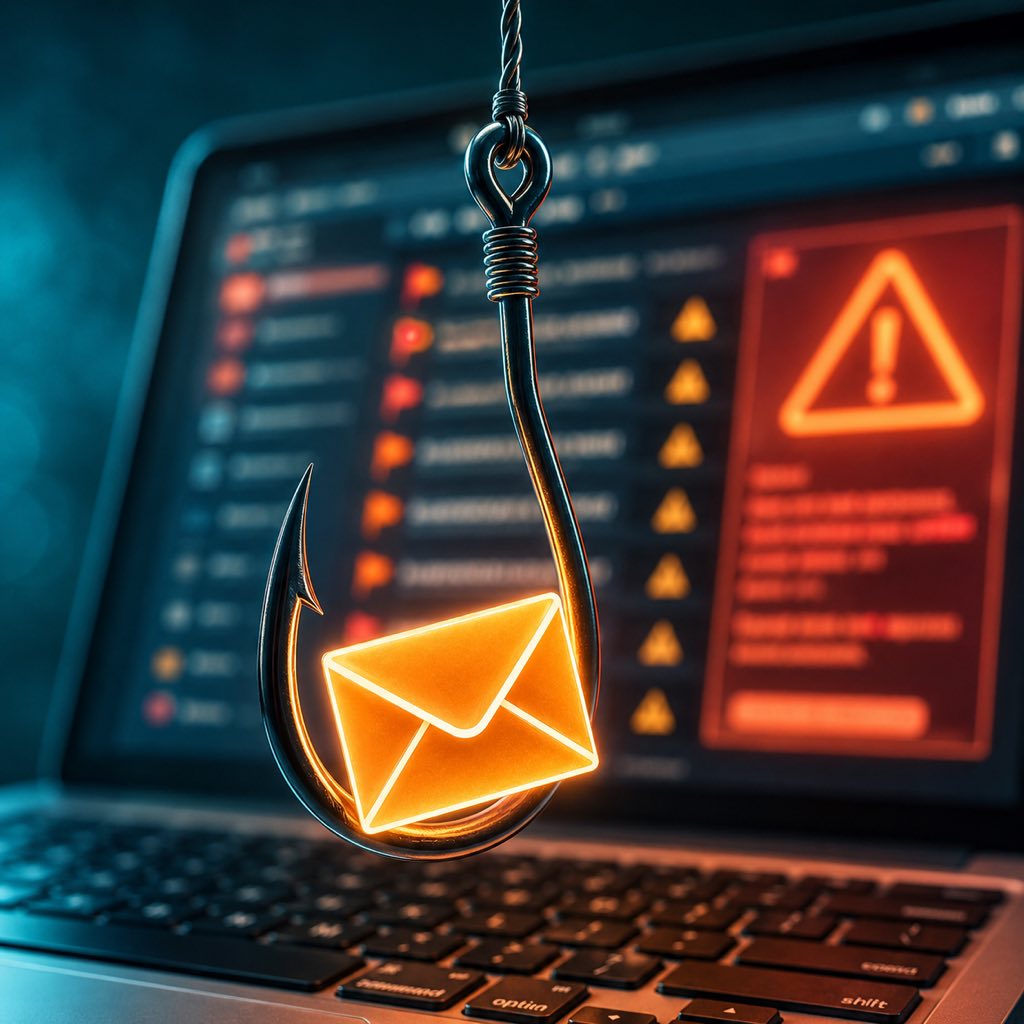
The Economics of AI-Powered Attacks Have Changed Everything
For twenty years, enterprise email security was built on a single detection heuristic: attackers make grammar mistakes, use implausible contexts, and write in culturally awkward ways. Employees were trained to look for these signals. Security platforms flagged them. This heuristic worked reasonably well because human attackers making thousands of phishing emails could not invest sixteen hours of skilled labor per message — they had to scale by cutting quality.
Generative AI destroyed this heuristic. According to AutoSPF’s 2026 analysis of FBI IC3 data, LLM-generated phishing emails are “grammatically sound, contextually relevant, and linguistically natural” — with Purdue/RIT research demonstrating that Gmail, SpamAssassin, and Proofpoint all show significantly reduced detection rates against LLM-rephrased content. The attack that cost 16 hours in 2023 takes five minutes in 2026. The detection capability that trained employees to spot now misses 82.6% of AI-assisted phishing.
The numbers behind this shift are not theoretical. IBM’s 2025 Security Report noted by AutoSPF found 16% of data breaches involve AI-powered attacks, with 37% of breached organizations identifying AI-generated phishing as the initial access vector and 35% attributing initial access to deepfake impersonation. ENISA’s 2025 threat landscape assessment reported that over 80% of social engineering attacks now incorporate AI in some form — up from negligible levels three years earlier.
The attack surface has also expanded well beyond email. Research cited by Brightside AI found that vishing incidents rose 442% between 2023 and 2024. Deepfake video call fraud — where attackers use AI-generated video conferencing appearances to impersonate executives — is documented at operational scale, with a 2025 case resulting in a $25 million fraudulent wire transfer after a deepfake video call convinced a finance employee they were receiving authorization from the CFO and multiple colleagues.
What AI-Generated Attacks Look Like in Practice
The AI Spear-Phishing Kill Chain
The mass personalization capability of AI has transformed spear-phishing from a labor-intensive elite technique to an industrial process. A 2026 AI-assisted attacker targeting a company’s finance department can:
- Scrape the company’s LinkedIn profiles, press releases, and financial filings to identify personnel names, reporting relationships, recent projects, and active vendor relationships
- Generate a phishing email referencing the target’s actual manager, a real recent project, and a plausible business context — in under five minutes per message
- Scale this across hundreds of employees simultaneously, adapting the social context for each target (the CFO framing differs from the accounts payable framing)
- A/B test email variants against different deliverability metrics to optimize click-through before the bulk campaign runs
According to Huntress’s 2026 AI phishing analysis, the result is AI-generated campaigns achieving click-through rates of up to 54%, versus approximately 12% for traditional phishing — a 4.5x performance differential that makes the incremental cost of AI-powered targeting trivially positive for any attacker with a laptop.
The Multi-Channel Attack: Beyond Email
The most dangerous evolution is not better email phishing — it is the fusion of AI capabilities across multiple simultaneous attack channels. A sophisticated attacker in 2026 does not rely on email alone:
- AI voice cloning: uses recorded speech (often from public YouTube videos, podcast appearances, or earnings calls) to clone an executive’s voice and conduct vishing attacks where the caller sounds indistinguishable from the real person
- Deepfake video: generates real-time video of an executive’s face for video conference calls — particularly effective for “urgent” scenarios requiring immediate financial authorization
- SMS/messaging platform attacks: generates hyper-personalized text messages that reference real organizational context to bypass SMS-aware employee training
Brightside AI’s CISO guide notes that human detection accuracy for deepfake video is only 24.5% — meaning employees presented with a deepfake video call will fail to identify it as fake 3 out of 4 times. Organizations running email-only phishing simulations are training employees for a 2019 threat model while 2026 attackers route around email.
Advertisement
The Enterprise Defense Playbook
1. Move DMARC to Enforcement and Authenticate All Sending Infrastructure
AutoSPF’s analysis makes a critical technical point: SPF, DKIM, and DMARC do not analyze content — they verify sending infrastructure. Since AI cannot forge legitimate infrastructure authorization, email authentication represents the “last reliable machine-verifiable signal” that defends against sophisticated AI-generated phishing regardless of prose quality. An AI-generated email that passes grammar detection will still fail DMARC if the sending domain is not authorized.
The implementation steps:
- Move all domains to
DMARC p=reject(most organizations are still atp=none— monitoring only) - Implement DKIM signing on all email sending sources, including third-party marketing platforms, ticketing systems, and CRM tools that send email on your domain’s behalf
- Authenticate parked domains (domains you own but don’t use for sending are frequently weaponized by attackers to construct convincing typosquat addresses)
- Publish a strict SPF record and eliminate soft-fail (
~all) permissiveness
This single infrastructure change eliminates a large category of AI-generated phishing attacks — those impersonating your domain or closely related domains. It does not eliminate attacks from unrelated domains crafted to appear plausible.
2. Replace Email-Only Training with Multi-Channel Simulation Programs
Employee training programs that simulate phishing via email only are defending against the 2019 threat model. In 2026, training programs must include voice, video, and messaging channel simulations:
- Voice simulation exercises: send employees simulated vishing calls from “IT support” or “vendor partners” requesting credential confirmation or password resets — and measure and report the bypass rate
- Video deepfake awareness: show employees documented examples of deepfake video conference calls (current AI capabilities require only a small video sample of the target to generate convincing real-time fakes), train them to use out-of-band verification for any video call requesting financial authorization or credential access
- Pre-authorization verification workflows: any financial transaction over a defined threshold (suggested starting point: $10,000 or equivalent) must be verified via a separate communication channel before execution, regardless of how convincing the authorization appears in the original channel
The organizational change here is not technological — it is procedural. Companies that require out-of-band verification for large wire transfers and sensitive credential requests are substantially more resistant to multi-channel AI social engineering than companies that rely on employee recognition ability.
3. Deploy Phishing-Resistant MFA Across High-Value Account Targets
Standard TOTP (Time-based One-Time Password) MFA — the six-digit authenticator app code — is vulnerable to real-time phishing proxies: attackers who set up a man-in-the-middle site capture the MFA code during a phishing session and replay it immediately. Huntress’s defense playbook advocates deploying hardware security keys (FIDO2/WebAuthn) for all high-value account targets: finance, executive assistants, IT privileged accounts, and cloud infrastructure access.
The FIDO2 standard binds authentication to a specific origin (the registered domain) — a phishing proxy that redirects to a fake site will fail FIDO2 authentication because the cryptographic challenge is bound to the legitimate domain, not the phishing domain. This makes FIDO2-protected accounts resistant to real-time phishing proxy attacks even when the employee falls for the phishing lure and enters their username and password. Combined with email authentication enforcement, FIDO2 for critical accounts represents the highest-ROI short-term defense investment for enterprise security teams facing AI-powered phishing campaigns.
The Structural Lesson for Enterprise Security Teams
The fundamental shift is this: AI has transformed phishing from a craft skill requiring investment per message to an industrial capability requiring investment per campaign. The unit economics of personalized social engineering have collapsed, meaning the volume of high-quality, personalized attacks is now limited only by target identification — not by attacker labor constraints.
Traditional enterprise security architectures — perimeter filtering, content scanning, employee awareness training — were designed for the old economics. They are not obsolete, but they are insufficient as the primary defense. The three defenses above — email authentication enforcement, multi-channel simulation, and phishing-resistant MFA — address the structural shift directly. They do not try to detect AI-generated content (which is increasingly indistinguishable from legitimate content) but instead rely on infrastructure verification, procedural verification, and cryptographic domain binding — mechanisms that AI capabilities cannot trivially circumvent.
For security leaders building 2026-2027 defense programs, the FBI IC3’s documented progression from $70 million to $215.8 million in phishing losses in a single year is the best evidence that the current enterprise posture is not keeping pace with the threat.
Frequently Asked Questions
Why does email authentication (DMARC/DKIM/SPF) defend against AI phishing specifically?
AI can generate grammatically perfect, contextually convincing phishing content — but it cannot forge the cryptographic infrastructure authorization that DMARC, DKIM, and SPF verify. When an AI-generated phishing email claims to come from your CEO, DMARC enforcement checks whether the sending mail server is authorized to send email for the CEO’s domain. An unauthorized server — regardless of how convincing the email content is — fails DMARC and is rejected before the employee ever sees it. This is why email authentication enforcement is described as the “last reliable machine-verifiable signal” against AI phishing: it is immune to content quality improvements.
How do deepfake video attacks work and why are employees so vulnerable?
Deepfake video attacks use AI to generate a real-time video feed of a target person’s face — their expressions, lip movements, and mannerisms — mapped onto a live video conference feed. In 2026, this capability requires only a few minutes of publicly available video of the target (from LinkedIn, YouTube, company presentations, or earnings calls). Human detection accuracy for deepfake video is approximately 24.5% in controlled studies, meaning employees in a realistic workplace scenario (under time pressure, expecting to hear from the person, on a standard video conferencing tool) will fail to identify the deepfake 3 in 4 times. The defense is not better detection ability — it is organizational policy that requires out-of-band verification for any video call requesting financial authorization.
What is FIDO2/WebAuthn and why does it defeat real-time phishing proxies?
FIDO2 is an authentication standard where the security key (hardware or platform-based) signs a cryptographic challenge that includes the origin domain of the site requesting authentication. A real-time phishing proxy — a man-in-the-middle site that captures credentials entered on a fake login page and replays them to the real site — fails FIDO2 authentication because the domain in the cryptographic challenge does not match the registered legitimate domain. Even if an employee enters their username and password on a phishing site, the FIDO2 key will refuse to authenticate because the origin is wrong. This makes FIDO2-protected accounts resistant to the most common AI-enhanced phishing technique of combining a convincing phishing email with a credential-harvesting proxy.
Sources & Further Reading
- AI-Powered Phishing in 2026: Email Authentication as the Last Reliable Defense Signal — AutoSPF
- What is AI Phishing? Evolving Phishing Attacks in 2026 — Huntress
- AI Spear Phishing in 2026: Statistics, Trends & CISO Action Guide — Brightside AI
- AI-Enabled Social Engineering in 2026: The Attack Your Enterprise Security Program Is Not Ready For — Mark Lynd
- Social Engineering in 2026: Beyond Phishing Emails — Helixstorm
- Spear Phishing in 2026: Detection, Training & Prevention Guide — Adaptive Security
🔗 Related Intelligence
AI-Assisted Attacks in 2026: How Generative AI Rewrites the Threat Actor Playbook
AI-Powered Threat Evolution: How Attackers Weaponize Artificial Intelligence in 2026
Agentic AI Attack Surface: Memory Poisoning, Privilege Escalation, and Enterprise Guardrails

AI Zero-Day Factories: How APT Groups Now Automate Exploit Development at Scale