
The Problem DARPA Is Trying to Solve
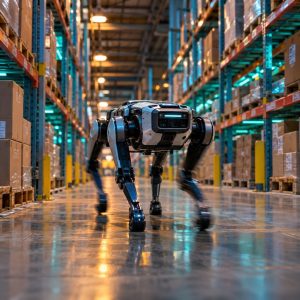
Today’s most capable robots — whether Boston Dynamics bipeds, surgical arms, or autonomous vehicles — share an architectural constraint that has defined robotics since the 1970s. Sensors collect data. Data travels to a central processor. The processor decides. Commands travel back to actuators. The robot acts. Each of those information transfers introduces latency, power consumption, and a potential point of failure — particularly in environments where external communication is limited, adversarial, or absent entirely.
DARPA’s Program Manager Julian McMorrow stated the problem directly in the RFI announcement: “Today’s robots are often limited by the need to sense, process, and act as separate steps. We are interested in collapsing that loop by embedding intelligence directly into the hardware so systems can respond in real time without relying on constant data movement.”
The Request for Information DARPA-SN-26-76, published April 27, 2026 by the Microsystems Technology Office, is not a research grant or a program announcement. It is a structured question directed at the research community: do the materials science, computational neuroscience, and embedded systems communities have the foundational capability to build what DARPA envisions? The May 27, 2026 response deadline is followed by an invite-only, in-person workshop in summer 2026 — the standard DARPA mechanism for converting community responses into a funded program.
What DARPA is describing is not an incremental improvement to existing robotics architectures. It is a paradigm shift: from robots that carry computational hardware to robots whose structural materials are themselves computational. According to EverGlade’s technical summary of the RFI, the program targets materials optimized for mission performance over human-like form factors — a deliberate departure from the anthropomorphic design assumptions that have dominated robotics funding for the past decade.
What “Physical Intelligence” Actually Means
The RFI defines two technical focus areas that together describe the concept of physical intelligence.
The first is actuation and sensing convergence. Current robots use separate components for sensing (cameras, LiDAR, force sensors), actuation (motors, hydraulics, pneumatics), and control (silicon processors). DARPA wants materials that integrate all three into a single physical substrate — stimuli-responsive polymers, for example, that deform in response to environmental pressure (sensing), generate force as a result of that deformation (actuation), and encode a simple decision rule in the material’s physical properties (control). A material that bends toward a heat source, stiffens when compressed beyond a threshold, or changes conductance when it detects a specific chemical — without any processor in the loop — exemplifies what DARPA is seeking.
The second focus area is dynamic adaptive closed-loop compute. This is more ambitious: materials capable of performing computation within their sensing and actuating elements, enabling real-time decision-making with minimal latency. The reference architecture is biological muscle — which integrates sensing, actuation, and rudimentary control in a single tissue without requiring a separate processor for every movement. DARPA is asking whether materials science has advanced enough to approximate this in synthetic systems.
The practical applications DARPA names align with extreme environments: autonomous systems operating in adversarial, unpredictable conditions with limited connectivity — the kind of conditions where a robot that depends on cloud compute for decision-making fails, and a robot whose intelligence is embedded in its materials continues to function.
Advertisement
What Enterprise Automation and Manufacturing Teams Should Do About It
DARPA RFIs define the research frontier — they rarely translate into commercial products within five years. But the technical direction they establish consistently shapes the enterprise technology roadmap a decade out. Enterprise leaders in manufacturing, logistics, and industrial automation should begin tracking the physical intelligence research program now.
1. Identify Where the Sense-Process-Act Latency Bottleneck Currently Costs You
The most direct near-term application of physical intelligence research is in environments where the latency of centralized processing creates safety or productivity failures. High-speed manufacturing lines where defect detection needs sub-millisecond response. Surgical instruments that need to detect tissue resistance before a surgeon’s grip does. Autonomous warehouse vehicles that need to avoid collisions faster than a remote server can authorize an action.
Map your current automation stack and identify the three processes where control latency is the binding constraint on performance. These are the use cases where physically intelligent materials — when they arrive commercially, likely in the 2030-2035 timeframe — will create the largest competitive advantage. Invest in understanding the process parameters now: what response time is needed, what environmental inputs need to be sensed, what actuation force is required. These specifications will be the inputs to your physical intelligence procurement requirements.
2. Track the Summer 2026 DARPA Workshop Outcomes and the Resulting Program Announcement
DARPA workshop attendees are drawn from the responses to the RFI — universities, national labs, defense contractors, and commercial materials companies that submitted responses by May 27, 2026. The workshop proceedings, while often not fully public, generate industry publications from participants within 3-6 months. Following those publications tracks which institutions are working on which technical sub-problems.
The practical action: assign a technology watch function to monitor DARPA-funded research outputs in stimuli-responsive polymers, neuromorphic hardware, and embedded compute materials. Academic preprint servers (arXiv, bioRxiv) and IEEE conference proceedings are the right monitoring channels. When DARPA transitions from RFI to a funded research program — likely announced in late 2026 or early 2027 — the participating institutions will be the source of first-generation commercially licensable prototypes.
3. Evaluate Whether Your Robotics Vendor Partners Have Physical Intelligence R&D Programs
Major robotics vendors — ABB, Fanuc, Kuka, Boston Dynamics — will be watching the DARPA program carefully. Some already have internal programs on smart materials and embedded sensing. Before your next major robotics capital expenditure, ask vendors directly: what is their R&D roadmap for physically intelligent components? When do they expect to have commercial products based on materials that integrate sensing and actuation at the substrate level?
Vendors who can answer this question with specifics — timelines, prototype results, partnership institutions — are tracking the technology frontier credibly. Vendors who respond with vague references to “AI integration” are not. The procurement question will sharpen your understanding of which vendors are genuinely positioned for the physical intelligence transition.
The Bigger Picture: Software AI Meets Hardware AI
The dominant narrative of the 2024-2026 AI cycle has been software AI: large language models, vision-language models, agentic systems that run on cloud GPUs and communicate via APIs. DARPA’s physical intelligence RFI represents the first major institutional signal that the next wave will move AI into hardware — not as chips (which has been happening since 2018), but as materials.
The distinction is important. AI chips (NVIDIA H100, Google TPU, Apple Neural Engine) are processors designed to run AI algorithms faster. Physically intelligent materials are substrates where the AI is the physics of the material — there is no separate algorithm, no separate chip, no separate power supply for computation. The material’s response to environmental inputs is itself the intelligence.
This is a fundamentally different engineering challenge. It sits at the intersection of materials science, computational neuroscience, embedded systems, and manufacturing — not computer science and statistics. The talent, the tooling, and the supply chains required to build physically intelligent robots are entirely distinct from those that built the software AI stack.
For enterprise leaders: the physical intelligence transition will be slower than the software AI transition and will require different vendor relationships, different capital equipment, and different engineering skills. The DARPA RFI is the earliest signal that those transitions need to begin entering the planning horizon.
Frequently Asked Questions
How is DARPA’s physical intelligence concept different from existing neuromorphic computing chips like Intel’s Loihi?
Neuromorphic chips (Intel Loihi, IBM True North) are silicon processors designed to mimic the architecture of biological neural networks — they are still separate computational hardware installed inside a robot. DARPA’s physical intelligence concept goes further: it seeks to eliminate the distinction between structural material and computational material, so that the robot’s body components themselves perform sensing, actuation, and control without any chip in the loop. Neuromorphic chips are an evolutionary step in processor design; physical intelligence is a step-change in the definition of what a robot’s “body” is.
Will physically intelligent materials have safety certification challenges for industrial deployment?
Yes — significantly. Current industrial safety frameworks (ISO 10218 for industrial robots, IEC 61508 for functional safety) assume that a robot’s decision-making is traceable to a software process running on identifiable hardware. A physically intelligent material’s “decision” is encoded in the material’s physical properties, which may be difficult to audit, verify, or predict under all environmental conditions. New safety frameworks will need to be developed alongside the technology. This regulatory development lag is one reason commercial deployment timelines are measured in decades rather than years.
What industries outside defense are most likely to benefit first from this technology?
Surgical robotics, prosthetics, and soft robotics for agricultural harvesting are the three most likely early commercial application areas. These environments reward compliance (the ability to interact safely with fragile objects or biological tissue), fast local response (reacting to touch or resistance faster than centralized processing allows), and low power consumption (embedded materials can potentially operate on harvested environmental energy). Defense applications fund the early-stage research; medical and agricultural robotics typically drive the first commercial product cycles, as has been the pattern in every prior DARPA-seeded robotics program from UAVs to exoskeletons over the past 3 decades.
Sources & Further Reading
- Rethinking Robotics with Physical Intelligence — DARPA
- DARPA RFI: Materials for Physical Compute in Untethered Robotics — DARPA Official Opportunity
- DARPA Issues RFI on Embedding Intelligence into Robotic Materials — HPCwire/AIwire
- Rethinking Robotics with Intelligent Materials — Mobility Engineering Technology
- Materials for Physical Compute in Untethered Robotics — EverGlade
🔗 Related Intelligence

Robotics Foundation Models: The Real Breakthrough Is Software, Not Hardware

AI Development Workflows: How Teams Integrate AI Into Every Stage of Software

Sony Project Ace: A Table-Tennis Robot Beats Pros — and Validates Physical AI
Robotics Systems Gain Whole-Body Reasoning, Moving AI Closer to Warehouses and Farms