
A $1.5 Billion Market That Misses Its Biggest Customer Base
Algeria’s insurance industry reached a record milestone in 2025: 200.5 billion dinars (~$1.5 billion) in annual premiums, growing at 8.8% year-on-year according to Financial Afrik’s March 2026 market report. Non-life premiums dominate at 82.7% of the market, driven by motor insurance (mandated by law), construction insurance, and industrial coverage. Takaful — Islamic-compliant insurance — grew 84.3% in 2025, reaching 1.4 billion dinars, driven by demand from religiously conservative segments who have historically avoided conventional insurance products.
But the headline figure conceals a structural failure: despite $1.5 billion in annual premiums, the informal sector — estimated by the IMF and World Bank at between 40% and 50% of Algeria’s economic activity — is almost completely uninsured. A UNDP analysis of Arab States insurance markets found that in Algeria, over 99% of disaster costs are funded by the state, with less than 1% covered by the insurance sector. That means every flood, earthquake, fire, or supply disruption that hits an informal SME is borne entirely by the business owner and, ultimately, the public purse.
This is the gap that micro-insurance startups are now building into. The opportunity is not marginal — it is structural, and the technology to address it finally exists.
Three Insurtech Architectures That Work for Algeria’s Informal Economy
1. Parametric Micro-Insurance: Paying Without the Claim Paperwork
Traditional insurance fails informal SMEs for a well-understood reason: claims processes require documentation that informal businesses cannot produce. A market vendor who loses inventory to a flood cannot produce a purchase invoice, a balance sheet, or a business registration certificate. The insurer has no way to verify the claim. Both sides lose.
Parametric insurance solves this by paying based on observable trigger events rather than documented losses. A rainfall parametric product pays 5,000 DZD automatically when a weather station in Blida province records more than 80mm of rainfall in 24 hours — no claim form, no adjuster visit, no documentation required. African startups like Pula (agriculture) and BIMA (health) built their entire business models on parametric logic, reaching millions of customers at 30-50 cents per month in premium.
For Algeria’s informal market, the most immediate parametric products are: weather-triggered business interruption coverage (for outdoor market vendors and construction workers), mobile device protection (covering the smartphone that informal traders increasingly use as their primary business tool), and road accident coverage for informal transport operators. All three can be underwritten on observable data — weather APIs, device telemetry, vehicle GPS — without requiring documentation from the policyholder.
2. Embedded Insurance via Mobile Payment and Fintech Platforms
The distribution challenge for micro-insurance in Algeria is identical to the one that microfinance solved in the 2000s: you cannot sell a 200 DZD monthly product through a traditional broker network, because the commission economics are upside down. The solution is embedding — attaching micro-insurance to an existing transaction that the customer is already making.
Algeria’s fintech ecosystem now includes 30-35 active startups across digital payments, mobile banking, and financial services. Platforms like Banxy (Algeria’s first fully mobile-based bank), ESREF Pay, and UbexPay are already processing transactions for informal traders. An insurtech startup that builds an API-based micro-insurance product and distributes through these platforms — charging 1-2% of each transaction as a premium — eliminates the distribution cost problem entirely.
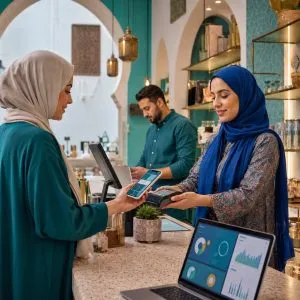
The model works like this: a vendor uses a QR code payment terminal to collect 15,000 DZD from a customer. The payment platform automatically deducts 150 DZD (1%) as a micro-insurance premium, covering the vendor against phone theft or inventory loss for that week. No enrollment form, no policy document, no annual renewal. The coverage is embedded in the commercial relationship.
3. Takaful-Compatible Products: Unlocking the Religious Barrier
The 84.3% growth of Takaful in 2025 is not an anomaly — it is evidence that Algerian consumers have high latent demand for insurance when the product is structured compatibly with Islamic principles. Conventional insurance is considered by many Algerian Muslims to involve gharar (uncertainty) and riba (interest), making it religiously impermissible. Takaful resolves this by structuring insurance as a mutual solidarity fund where participants contribute to a pool and excess contributions are returned rather than kept as profit.
An insurtech startup that builds micro-Takaful products for informal SMEs — positioning coverage as a community solidarity mechanism rather than a commercial transaction — can unlock the segment of the market that has historically refused conventional insurance on religious grounds. The Takaful segment’s 84.3% growth rate in 2025 demonstrates that this positioning works commercially, even without deep product innovation. Adding parametric trigger logic to a Takaful structure creates a product with no precedent in Algeria: fully Sharia-compatible, no documentation required, instant payment on trigger events. The atlas-mag.net market analysis confirms Takaful’s dramatic growth is the fastest-moving segment in the entire Algerian insurance market.
Advertisement
What Algerian Insurtech Founders Must Know Before Building
1. Regulatory Approval Is a 12-18 Month Process — Start It Immediately
Insurance in Algeria is regulated by the National Insurance Council (CNA) and requires a license before any product can be sold commercially. The licensing process takes 12-18 months and requires evidence of minimum capital (500 million DZD for general insurance companies). The path for startups is to partner with a licensed carrier as a distribution and technology layer — not to seek a standalone license. This means identifying an existing insurer (SAA, CAAT, or Cardif El Djazaïr) willing to underwrite micro-products designed and distributed by the startup.
2. Price at Maximum 2% of Revenue — Never More
The iron rule of micro-insurance economics is that premiums must feel invisible. Research across African microinsurance markets shows that voluntary uptake collapses above 2% of a customer’s daily revenue. For an informal vendor turning over 3,000 DZD/day, that means a maximum monthly premium of 1,800 DZD ($13.50). Build products priced at 200-500 DZD/month and test price sensitivity before scaling. The UNDP’s 2023 Algeria inclusive insurance snapshot documents that premium unaffordability is the primary barrier to uptake in Algeria’s informal sector.
3. Use UNDP and IFC Partnerships to De-Risk the First Tranche
The UNDP’s Insurance and Risk Finance Facility (IRFF) operates an active program in Algeria focused on expanding inclusive insurance access. The IFC’s SME Finance Program similarly provides technical assistance for financial inclusion products. These organizations cannot provide commercial capital, but they can provide technical grants (500,000-2,000,000 DZD equivalent), distribution partnerships with government agencies, and regulatory introductions that compress the approval timeline. A startup that enters with a UNDP co-design agreement has a fundamentally different conversation with a licensed insurer than one arriving cold. The UNDP’s February 2026 regional diagnostic identifies Algeria as one of the highest-priority markets for inclusive insurance expansion in the Arab world.
The Correction Scenario: What Could Go Wrong
The most likely failure mode for Algerian micro-insurance startups is the distribution partnership that never activates. Many African insurtech companies signed embedding agreements with mobile money platforms that listed the product but never actively promoted it, resulting in near-zero uptake. The lesson: the fintech partner must have a direct commercial incentive — not just a revenue share on a product they don’t believe in — to actively push enrollment. This means either giving the fintech partner equity upside in the insurance startup or structuring the premium as a default opt-in rather than an opt-in requiring affirmative consent.
The second failure mode is pricing complexity at scale. A parametric product sounds simple until you define the trigger: which weather station, what threshold, what measurement period, who audits the data feed. These questions require actuarial expertise that most Algerian startup founding teams do not have internally. Founders should budget for an actuarial consultant from the project start — not after the first regulatory rejection.
Frequently Asked Questions
Why is Algeria’s informal sector so difficult to insure with traditional products?
Traditional insurance requires documentation that informal businesses cannot provide — purchase invoices, registered business addresses, balance sheets. Claims verification is impossible without this paper trail, so conventional insurers refuse to underwrite informal SMEs. Parametric insurance bypasses this problem by paying on observable trigger events (weather data, GPS coordinates, device telemetry) rather than documented losses, making it the structurally correct product for the informal economy.
How large is Algeria’s informal economy in 2025?
The IMF’s 2025 Article IV Consultation for Algeria estimates the informal sector at approximately 32% of GDP, with other analyses (including World Bank estimates) placing it at 40-50% of economic activity. Algeria has approximately 2 million+ informal micro-enterprises across trade, construction, transport, and artisanal production. None of these businesses hold commercial insurance policies.
What is the Takaful growth trend telling us about insurance demand in Algeria?
The 84.3% growth of Takaful (Islamic-compatible insurance) in 2025 — reaching 1.4 billion dinars — shows that Algerian consumers do want financial protection products when structured compatibly with Islamic principles. This growth rate far outpaces the overall market’s 8.8% expansion, indicating a significant pent-up demand that conventional insurance products have failed to capture. Insurtech startups that design micro-Takaful products with parametric triggers are positioned to access this fast-growing segment.
—
Sources & Further Reading
- Algeria Insurance Market Exceeds $1.5 Billion in Premiums — Financial Afrik
- Algeria’s Fintech Ecosystem in 2026 — The Fintech Times
- UNDP Insurance and Risk Finance Facility — Algeria
- Regional Diagnostic: Insurance in Arab States — UNDP
- Inclusive Insurance and Risk Financing in Algeria — UNDP SDG Finance Hub
- Algeria Tech Startup Ecosystem — AlgeriaTech
🔗 Related Intelligence

ANADE’s $75K Playbook: How Algerian Micro-Entrepreneurs Can Stack Three Financing Schemes in 2026
Embedded Insurtech in Algeria: Micro-Insurance for Deliveries, Rides, and Gig Workers in 2026

Algeria’s Startup Fund: 100+ Investments and the Case for a Second, Larger Vehicle

Algeria’s InsurTech Startups: Digitizing Car, Health, and Agricultural Insurance