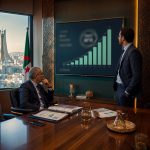
The Exit That Changes the Narrative
In December 2025, at the African Startup Conference in Algiers, two things happened that should matter to every founder, investor, and institution watching Algeria’s tech ecosystem. Völz — a four-year-old travel-tech startup founded by Mohamed Abdelhadi Mezi and Hacene Seghier in 2022 — announced a 600 million DZD ($5 million) Series A round led by Tell Group and Groupe Industriel Babahoum Algérie (GIBA). And the Algerian Startup Fund disclosed a 3.35x return on its initial investment in the company.
Neither fact alone would be noteworthy in a mature venture market. Together, in Algeria’s context, they constitute something more significant: proof that public venture capital in Algeria can complete a full cycle — invest, support, and exit with a real financial return — within a timeframe that makes the model credible to the next generation of co-investors.
Völz’s story is worth understanding in detail, because the company succeeded precisely by solving a problem that is uniquely Algerian: the inability of most citizens to pay for international flights using foreign currency. Algeria’s strict capital controls mean that many travellers cannot use international credit cards or foreign currency accounts to purchase tickets on major airlines. Völz built an Online Travel Agency (OTA) that allows users to book flights on international carriers — including Turkish Airlines, with which it has a commercial partnership for corporate rates — while paying in Algerian Dinar (DZD). The platform also offers Cash-on-Delivery options to reach the substantial unbanked segment of the population. The product is not a copy of Booking.com applied to Algeria: it is a fundamentally different architecture built around Algerian payment reality.
Why the 3.35x Return Matters More Than the Number
A 3.35x return in a public venture fund is modest by international VC standards, where funds target 10x on winners. But the number’s significance lies not in its magnitude — it lies in what it proves.
Before this exit, a reasonable objection to investing in Algerian startups was that the ecosystem lacked a monetisation path. Capital could enter through ASF tickets or angel rounds, but what happened next was unclear: would startups grow to a scale that attracted follow-on capital? Would international investors participate in Algerian rounds? Would family offices and industrial conglomerates like GIBA treat tech as an investable asset class? The Völz round answers all three questions affirmatively. Tell Group, an investment firm active across the MENA region, led the round — providing international validation. GIBA, a Biskra-based industrial conglomerate best known for its Guedila mineral water brand, co-invested — signalling that Algerian family capital is beginning to rotate into tech. And the ASF exited profitably, creating a recycling mechanism: returns flow back into the fund and can be redeployed into the next cohort of startups.
Völz CEO Mohamed Abdelhadi Mezi has framed the round’s ambition explicitly: the $5 million positions Völz “to become the first Algerian unicorn in this field in Africa.” Whether that ambition is achievable depends on how aggressively the company can expand its market coverage and deepen its airline partnerships. But the framing itself — an Algerian founder, in Algiers, targeting unicorn status — is a signal about how founders are beginning to think about scale.
Advertisement
The Investors Behind the Round: What Their Participation Signals
The composition of Völz’s Series A investor group deserves attention, because each participant represents a different segment of the capital market that was previously inactive in Algerian tech.
Tell Group is the most significant participant in terms of ecosystem signalling. As a regionally active investment firm, Tell Group’s participation indicates that Algerian startups are now appearing on the deal pipeline of MENA-oriented investors — a community with capital and expertise that has historically concentrated on Egypt, Morocco, the UAE, and Saudi Arabia. If Tell Group deploys in Algeria once and achieves a return, they will do it again and bring other regional investors with them.
GIBA represents an even more consequential shift: the conversion of Algerian industrial capital into tech investment. Algeria’s family conglomerates and industrial groups control substantial balance sheets, but have historically deployed capital in real estate, manufacturing, and import-export rather than technology. GIBA’s participation in a tech round — alongside a stated transition from viewing tech as “a service provider” to viewing it as “an asset class” — marks a structural change in how non-tech Algerian capital is beginning to think about the sector.
The ASF’s exit role rounds out the picture. By returning capital at a multiple and freeing the fund to redeploy, the exit validates the public venture fund model as a mechanism for catalysing private participation — which is precisely what ASF was designed to do.
What Algerian Founders and Investors Should Take Away
The Völz exit is not just a data point — it is a template. The pattern it demonstrates is reproducible, and the lessons it contains are actionable for the founders and investors who come next.
1. Build for Algerian Friction First, Not for a Generic Market
Völz succeeded because it diagnosed a structural problem specific to Algeria — currency control barriers to international flight booking — and built a product engineered around that friction. The OTA market is globally competitive and dominated by Booking.com, Expedia, and local adaptations like Wego. A generic Algerian OTA would have struggled. An OTA that works within DZD payment constraints and serves the unbanked through Cash-on-Delivery is protected by the same regulatory environment that makes Algeria a difficult market for foreign entrants. Founders should look for similar structural asymmetries in insurance, remittances, legal services, healthcare, and logistics — sectors where Algerian regulatory or infrastructure specificity creates a moat that foreign platforms cannot easily cross.
2. Target Industrial Conglomerates as Strategic Co-Investors, Not Just Customers
GIBA’s participation in the Völz round demonstrates that Algerian family capital can be mobilised into tech investment — but it needs to see a fit with the investor’s strategic interests. GIBA is in logistics and distribution; Völz gives it a stake in the travel distribution chain. Founders building in sectors adjacent to Algeria’s major industrial groups — food processing, construction materials, energy services, healthcare — should approach those groups not just as enterprise customers but as potential strategic investors with both capital and distribution advantages. A family office that invests in your startup also becomes your distribution partner, your pilot customer, and your reference for the next institutional investor.
3. Plan Your ASF Exit Strategy Before Your First ASF Ticket
The Völz exit demonstrates that the ASF’s investment model includes an exit mechanism — the fund is not designed to be a permanent equity holder. Founders taking ASF capital should understand the exit conditions from the beginning: what events trigger ASF exit rights, what the expected holding period is, and what return multiple ASF considers satisfactory. Planning for a Series A that provides ASF an exit opportunity — as Völz did — should be built into the founding capital strategy, not discovered during negotiations. Founders who structure their cap table with ASF exit mechanics in mind will find the fundraising process at Series A significantly less complicated.
4. Use the Turkish Airlines Partnership Model as a Template for B2B Revenue
Völz’s commercial partnership with Turkish Airlines — accessing corporate rates and a partner programme — is the company’s path to higher-margin B2B revenue that supplements the consumer booking business. The partnership model (distribution access in exchange for market reach) is applicable across multiple Algerian startup sectors. Founders in logistics, insurance, fintech, and enterprise software should identify which international companies want Algerian market access but lack local distribution capability, and structure partnerships that give the international partner reach while giving the startup preferential commercial terms. This approach generates B2B revenue without requiring Algerian founders to build sales teams targeting international markets directly.
Where This Fits in Algeria’s 2026 Ecosystem
The Völz exit and the December 2025 African Startup Conference in Algiers together mark a specific moment in the Algerian ecosystem’s development: the point at which the infrastructure built between 2020 and 2025 — the ASF, the startup label, the ANADE and ANSEJ support mechanisms — began to produce verifiable financial outcomes.
The next milestone is not another exit, necessarily. It is replication: ten more startups that achieve the product-market fit and investor-readiness that Völz demonstrated, across different sectors and different wilayas. The ASF’s portfolio spans 41 of 58 provinces and 20-plus business sectors. The fund’s model now has proof of concept. The question for 2026 and 2027 is whether the portfolio contains the next Völz, and whether the capital rotation from industrial Algeria into tech Algeria continues at the pace GIBA’s participation suggests it might.
For founders watching from the outside, the takeaway is straightforward: the infrastructure for a real exit exists. Use it deliberately.
Frequently Asked Questions
What is the Algerian Startup Fund and how does it invest?
The ASF is a public venture fund established in 2020 and operationalised in 2021 under Algeria’s Ministry for Knowledge Economy and Startups. It offers investment tickets up to 150 million DZD per project, operates through partnerships with six public banks, and targets startups that have obtained the official startup label. The fund is designed to de-risk early private investment and create a pathway to Series A — as it did with Völz.
Who led Völz’s Series A round and why does it matter?
Tell Group, a MENA-oriented investment firm, led the round alongside Groupe Industriel Babahoum Algérie (GIBA). Tell Group’s participation signals that Algerian startups are now appearing on regional investors’ deal pipelines — a development that could bring significantly more capital into the ecosystem. GIBA’s participation signals that Algerian industrial capital is beginning to treat tech as an investable asset class rather than a service cost.
What does 3.35x mean in practice for the ASF?
A 3.35x return means the ASF received back 3.35 times the amount it originally invested in Völz when the Series A round provided an exit opportunity. The returned capital goes back into the ASF’s investment pool and can be redeployed into new startup investments — creating a recycling mechanism that makes the fund more sustainable and demonstrates to potential co-investors that public venture capital in Algeria generates real returns, not just grant-equivalent subsidies.
Sources & Further Reading
- Algeria’s Public Startup Fund Scores First Exit as Travel-Tech Völz Raises $5M — Launch Base Africa
- Völz Raises $5M And Delivers Algeria’s First Public Startup Fund Exit — TechBuild Africa
- Algerian Travel-Tech Startup Völz Raises $5M — Arab Founders
- Algeria’s VOLZ Raises $5 Million in Landmark Funding — Wamda
- VOLZ Raises Algeria’s Largest Startup Funding Round in Local Currency — TechCabal
- Algerian Startup Fund Overview — Startup Algeria
🔗 Related Intelligence

ASF’s First Big Exit: How the VOLZ 3.35x Return Validates Algeria’s Startup Fund

VOLZ’s $5M Series A and Algeria’s First Public VC Exit: The Venture Capital Turning Point

ASF’s First Exit: How Algeria’s Startup Fund Is Building a Series A Pipeline
Völz 3.35x Validates ASF: How Cohort 2 Should Be Built Differently