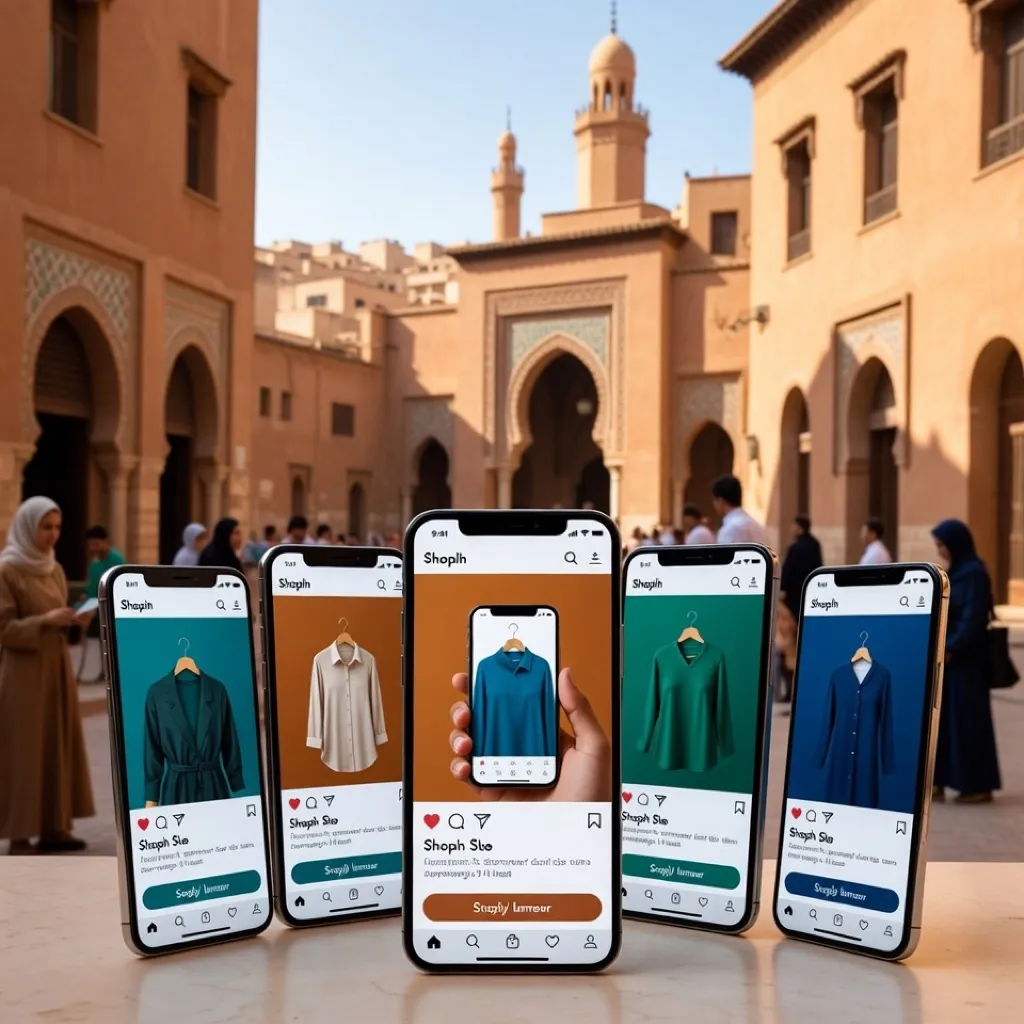
Algeria’s largest e-commerce channel is not an app. It is not a website. It is a Facebook page. Tens of thousands of informal sellers operate through Facebook pages, Facebook groups, and Instagram accounts, collectively moving goods worth billions of dinars annually — and doing so almost entirely outside the formal economy. They do not have websites. Most do not have CNRC registration numbers. They take orders by WhatsApp, collect cash at the door, and run returns policy by personal goodwill. The market is enormous, it is fast-growing, and building a consumer protection framework around it is the next regulatory layer.
Facebook as Algeria’s Biggest Marketplace
Algeria has 25.6 million Facebook users — 54.2% of the total population and 83.5% of all adults aged 18 and over, according to DataReportal’s Digital 2025 Algeria report. Algerians spend an average of three hours per day on social media. Mobile accounts for over 95% of retail website visits in the country.
At this scale, Facebook is not a social network with some commerce on the side — it is the primary discovery engine for Algerian consumer purchasing. When an Algerian wants to buy a phone case, a traditional dress, a kitchen gadget, or a pair of trainers, the journey often begins with a Facebook post, a Facebook group search, or a Facebook page they follow. The behavior is deeply embedded, generationally consistent, and entirely absent from official e-commerce statistics.
For context: Algeria’s formal e-commerce market — tracked platforms, registered businesses, structured marketplaces — generates an estimated $799 million in revenue (2024, per ECDB). The social commerce layer is not separately quantified in any official data. Industry observers and platform-side analysts consistently describe it as comparable in scale to, or larger than, the formal e-commerce sector.
How Social Commerce Works in Algeria
The Algerian social commerce flow is a chain of informal touchpoints that would be familiar to anyone who has bought something from a small Instagram seller anywhere in the world — except that each link in the chain has been adapted for Algeria’s cash-dominant, low-trust, high-mobile environment.
Discovery happens through Facebook pages (a seller posts product photos), Facebook groups (community-based buying and selling forums organized by category — clothing, electronics, cosmetics, homewares), and paid Facebook advertising. CPM rates for Facebook advertising in Algeria are significantly lower than Western markets — estimates suggest $1–4 per thousand impressions versus $8–20 in Europe or North America. This makes paid social media a remarkably accessible customer acquisition channel for small sellers with limited budgets.
Ordering is handled through direct message (Facebook Messenger, Instagram DM) or WhatsApp. The seller confirms the product, price, and delivery address by chat. No formal order confirmation exists; the transaction record is a WhatsApp message thread.
Payment is almost universally cash-on-delivery (COD), which represents 90–95% of all e-commerce transactions in Algeria. The seller arranges delivery through a logistics startup (Maystro, Batolis’s delivery network, Yalidine, TemTem, or an independent courier) who collects cash from the buyer at handover and remits it to the seller, minus a delivery fee.
Returns and disputes have no formal mechanism. The buyer’s protection is the option to refuse the package at delivery (useful if the product visibly does not match the description) or to complain publicly on the seller’s Facebook page (reputational leverage). Neither route guarantees recourse.
Seller Archetypes
Algeria’s social commerce ecosystem is not monolithic. Four distinct seller types operate within it, each with different economics, risks, and formalization trajectories.
The reseller is the most common archetype. They source products — typically clothing, electronics accessories, or cosmetics — from wholesale markets (Algiers’ Hammamet market, Oran’s Médina Jdida), from Chinese suppliers via AliExpress or intermediary importers, or from travelling contacts abroad. They list products on Facebook with their own photography, manage customer inquiries by phone, and use a local logistics startup for delivery. Margins are typically 30–50% on each unit, but COD return rates of 20–40% (anecdotal, no official data) make net margins considerably thinner.
The artisan sells handmade goods — Kabyle jewelry, traditional embroidered clothing, handmade leather goods, artisanal food products. For artisans, Facebook and Instagram are genuine business lifelines: platforms where a craftsperson in Tizi Ouzou can reach buyers in Algiers, Oran, or even the diaspora in France. The artisan has typically invested no capital in a platform, but has deep product expertise and authentic branding. Their challenge is scaling beyond personal production capacity.
The dropshipper operates a page that sells products they never hold in inventory. They list products sourced from AliExpress or similar, take orders, purchase from the supplier, and route delivery to the customer — ideally without the customer ever seeing the supplier’s branding. This model requires international payment access (a Visa card) and is more exposed to shipping delays and supplier quality failures. Academic research published by Algerian scholars has confirmed dropshipping is a growing model in the local digital economy, though it remains poorly understood by regulators.
The small business owner uses social media as their primary storefront. They may or may not have a physical location — a boutique, a repair shop, a specialty food producer — and use Facebook/Instagram to drive awareness and orders. This archetype is closest to the formalization boundary: they often have CNRC registration for their physical activity and are transitioning online.
Advertisement
The Consumer Trust Problem
The absence of consumer protection in Algeria’s social commerce market is not hypothetical — it creates real, recurring harm. Common failure modes include: products delivered that bear no resemblance to the Facebook listing photo, orders that are charged and never shipped, products of substantially lower quality than advertised, and sellers who disappear after payment for pre-order items.
Algeria’s consumer protection framework — primarily Law No. 89-02 on general consumer protection rules — predates digital commerce and provides no enforcement mechanism for online transactions. The 2018 e-commerce law creates obligations for registered online retailers but does not reach informal Facebook sellers. Facebook’s own enforcement mechanisms (review teams, fraud detection, account disabling) are reactive and primarily calibrated for its large markets. Algerian consumers who are defrauded by a Facebook seller have three realistic options: leave a negative review on the seller’s page, complain to the seller’s telecom provider about financial fraud (rarely effective), or accept the loss.
This structural gap has paradoxically created a market for reputation management. Algerian Facebook sellers who want to build lasting businesses invest heavily in positive customer testimonials, video unboxing content, and responsive customer service as reputational signals. Buyer-side norms have also evolved: experienced Algerian social shoppers request that sellers go live on video showing the actual product before they confirm an order, or ask for video evidence that the package matches the listing before permitting delivery.
Platform Economics
Facebook advertising in Algeria has been the primary customer acquisition tool for informal sellers — cheap access to a large, demographically targetable audience. But the platform economics are shifting. Rising competition for Algerian advertising inventory has pushed CPM rates up from historical lows. Instagram’s more visual format suits certain product categories (fashion, home decor, beauty) better than Facebook’s text-and-group architecture.
TikTok, with 21.1 million users aged 18 and over in Algeria, is the emerging frontier. The “make me buy it” content format — where creators showcase products in entertaining short videos — has generated measurable purchasing intent on Algerian TikTok. TikTok Shop, the platform’s integrated commerce feature, has not yet officially launched in Algeria (it is live in Egypt, the UK, the US, and Southeast Asia), but the groundwork is being laid. When TikTok Shop does arrive in Algeria — which the platform’s track record of geographic expansion makes likely within 24 months — it will offer a native commerce layer for a platform that already reaches 68.9% of Algerian adults.
The Formalization Question
The tension in Algeria’s social commerce market is between an informal system that works — for sellers at least — and a formal system that the sellers have strong rational incentives to avoid.
Registering with the CNRC under code 607.074 (e-commerce activities) requires choosing a legal structure (sole proprietorship, EURL, or SARL), paying registration fees, and accepting tax obligations. The informal seller is trading a small compliance cost against a significant tax and administrative exposure. For a Facebook seller moving DZD 500,000–1,000,000 per month (roughly $3,700–$7,400 at current rates), formalization becomes a serious decision with real financial stakes.
The evidence that formalization is occurring — under market pressure, not regulatory coercion — is visible in Shopify’s growth numbers. Shopify stores in Algeria grew 81–85% year-on-year in Q2-Q3 2025, reaching 4,256 active stores. Apparel dominates with 22.72% of stores. The most common formalization trajectory is: Facebook page → Instagram account → Shopify store → CNRC registration → logistics partnerships → potential ASF startup funding. Each step represents an investment in permanence and professionalism that informal sellers make when their revenue warrants it.
The IMF estimates Algeria’s informal economy at 30–50% of GDP. Social commerce is not the cause of that informality — it is a digital expression of structural conditions that long predate Facebook. Effective formalization policy will require positive incentives (simplified registration, tax exemptions for small digital businesses in their first years, access to digital payment infrastructure) rather than enforcement alone.
Frequently Asked Questions
What does “The Facebook Shop Economy” mean?
The Facebook Shop Economy: How Algerians Are Selling Billions Informally Online covers the essential aspects of this topic, examining current trends, key players, and practical implications for professionals and organizations in 2026.
Why does the facebook shop economy matter?
This topic matters because it directly impacts how organizations plan their technology strategy, allocate resources, and position themselves in a rapidly evolving landscape. The article provides actionable analysis to help decision-makers navigate these changes.
How does how social commerce works in algeria work?
The article examines this through the lens of how social commerce works in algeria, providing detailed analysis of the mechanisms, trade-offs, and practical implications for stakeholders.
Sources & Further Reading
- Digital 2025: Algeria — DataReportal
- Shopify Stores in Algeria — StoreLeads
- Dropshipping in Algeria: Everything You Need to Know — AliDropship
- The Role of Drop Shipping in E-Commerce: The Algerian Case — ResearchGate
- Algeria — eCommerce — US International Trade Administration
- How to Start an E-commerce Business in Algeria in 2025 — Webdispo
- Top E-Commerce Trends in Algeria You Should Know — World of Content Hub
- E-commerce Market in Algeria Surpasses $1.5 Billion — AL24 News
- Study: Fraud Trends in African E-Commerce — Tech in Africa
- Top 100 Shopify Stores in Algeria 2025 — SellerCenter