An Addressable Market Hiding in Plain Sight
Algeria’s fintech conversation has focused on payments infrastructure — interbank card growth, internet payment volumes, QR-code merchant acceptance. These are real and important gains. But they are gains happening within the 43% of Algerian adults who already hold formal financial accounts. The 57% who do not — approximately 20 million adults — are largely invisible to the formal financial system, and therefore invisible to most fintech product strategies.
According to World Bank Global Findex data, account ownership in Algeria sits at approximately 43% of adults, compared to the global average of 79% and the MENA regional average of 53%. The gender breakdown is particularly striking: women’s financial account ownership is approximately 29-31%, meaning roughly 71% of Algerian women have no formal financial account. This is not primarily a connectivity problem — Algeria’s mobile penetration exceeds 100% and internet penetration is near 77%. It is a product-market fit problem: the formal banking system was not designed to serve low-income, informally employed, or rural adults, and most digital payments products have simply replicated that exclusion.
The three-tier wallet framework is the Bank of Algeria’s attempt to break that pattern.
What the Three-Tier Wallet Framework Actually Does
The framework — detailed in regulatory guidance issued by the Bank of Algeria as part of the Fintech Strategy 2024-2030 implementation rules — creates three distinct product tiers with different identity verification requirements, transaction limits, and eligible providers.
Tier 1 requires only a national ID number (CNI) for enrollment. Transaction limits are set low enough to manage fraud risk without KYC depth: typically a monthly ceiling of 50,000 DZD. Eligible providers include licensed telecoms, licensed fintechs, and Algérie Poste. This tier is designed specifically for the unbanked population — adults who have an ID card but have never completed formal bank account KYC.
Tier 2 adds one additional document — a utility bill, employer letter, or birth certificate — and unlocks higher transaction limits (up to 200,000 DZD monthly) and additional product features including savings capabilities. This tier bridges Tier 1 users toward the formal banking relationship without requiring a full bank account opening.
Tier 3 is equivalent to a full bank account with complete KYC, AML/CFT compliance, and unrestricted transaction volumes. Users graduate from Tier 2 to Tier 3 as their financial history builds and their needs scale.
According to Statista’s Algeria payments outlook, Algeria’s mobile payment transaction value is expected to grow significantly through 2028 as wallet adoption scales. The three-tier design addresses the most common reason unbanked adults cite for not opening bank accounts: inability to meet documentation requirements at first contact.
Advertisement
What the 57% Opportunity Means for Builders and Operators
The three-tier wallet framework creates a structured commercial opportunity. It is not a charity play — it is an infrastructure decision that transforms 20 million non-customers into addressable users. Here is how different stakeholders should move:
1. Telecoms Should Launch Tier 1 Wallets Before Banks Enter the Space
Algérie Télécom, Djezzy, and Ooredoo collectively serve approximately 47 million SIM subscribers. They have the distribution, the existing billing relationships, and — crucially — the trust relationships with rural and low-income users that banks do not. The Tier 1 enrollment requirement (CNI only) maps exactly to what telecoms already collect during SIM registration. Djezzy and Ooredoo should move immediately on Tier 1 wallet licensing before commercial banks pivot their digital teams toward the unbanked segment. The window for telecom-led wallet dominance is roughly 18-24 months — once bank-backed fintech wallets achieve distribution at postal branches, the telecom first-mover advantage closes.
2. Fintechs Should Design Tier 1-to-Tier 2 Graduation as the Core Product Loop
The framework’s real commercial value is not the Tier 1 onboarding — it is the upgrade path. A user who starts on Tier 1 with 50,000 DZD monthly capacity and upgrades to Tier 2 after six months of activity is worth 4x more in transaction revenue and significantly more valuable as a credit candidate. According to World Bank research on digital financial services in Algeria, users who maintain active digital wallets for 12+ months show measurable improvement in financial resilience metrics and are more likely to take formal micro-loans. Fintechs should build the Tier 1 wallet as a discovery product — free onboarding, immediate utility (airtime top-up, bill payment, P2P transfer) — and design the Tier 2 graduation prompt around the moment the user first hits a Tier 1 limit. That friction moment, handled well, is the conversion event.
3. Address the 71% Female Exclusion Rate with Agent-Network Design, Not App Features
The gender gap in Algerian financial inclusion is not solved by a better smartphone app. Research on comparable markets — Egypt, Morocco, and sub-Saharan African mobile money deployments — consistently shows that women’s adoption of digital financial services is driven by two factors: social trust in the enrollment agent, and proximity of the access point. Women are more likely to enroll when the agent is female and the enrollment location is a market, pharmacy, or school rather than a bank branch or telecom store. Fintechs targeting female enrollment should partner with women-led micro-enterprise associations, women-staffed Algérie Poste branches, and community organizations — not just hire female influencers for social media campaigns. The GSMA’s Mobile Money for Women toolkit documents specific agent-selection and location-selection criteria that increase female enrollment by 35-60%.
The Structural Lesson from Sub-Saharan Africa
Algeria’s three-tier framework parallels the tiered KYC models that drove mobile money adoption across sub-Saharan Africa in the 2010s. M-PESA’s Tier 1 equivalent — a basic account requiring only national ID — enrolled 6 million Kenyans in its first 18 months. GhanaLink’s tiered wallet system, launched with Tier 1 onboarding in 2020, drove financial inclusion from 57% to 71% of Ghanaian adults in four years.
The common thread across successful deployments was not product sophistication — it was agent density. Kenya’s M-PESA reached scale because there was one cash-in/cash-out agent for every 400 adults in rural areas. Algeria’s equivalent network — Algérie Poste branches, telecom shops, and licensed fintech agents — needs to reach comparable density in the wilaya capitals and rural communes where unbanked adults are concentrated.
The Bank of Algeria’s framework provides the regulatory permission. The telecoms have the distribution. The fintechs have the product design capability. The next building block is a coordinated agent-training and agent-certification program that can scale faster than each player rolling out their own network independently. Putting that coordination layer in place is the most important structural lever in Algeria’s financial inclusion picture in 2026 — and it will determine whether the Fintech Strategy’s 60% inclusion target is reached by 2030 or pushed to 2035.
Frequently Asked Questions
What is Algeria’s three-tier digital wallet framework and who can offer wallets?
The Bank of Algeria’s three-tier wallet framework creates three levels of digital wallet products with different KYC requirements and transaction limits. Tier 1 requires only a national ID (CNI) and has a monthly transaction cap around 50,000 DZD — designed for the unbanked population. Tier 2 adds one more document and unlocks up to 200,000 DZD monthly. Tier 3 is equivalent to a full bank account. Eligible providers include licensed telecoms (Djezzy, Ooredoo, Algérie Télécom), licensed fintechs, and Algérie Poste.
Why does Algeria have such a high rate of unbanked adults compared to regional peers?
Algeria’s 57% unbanked rate (versus a MENA average of 47% with a bank account) reflects a combination of structural factors: the formal banking system was historically designed for salaried public-sector workers with stable documentation, while informal employment dominates large segments of the economy. Physical bank branch density is low outside major cities, and the traditional account-opening process requires multiple documents, in-person visits, and minimum balance requirements that exclude low-income and rural adults. The three-tier wallet framework addresses the documentation barrier specifically.
How does the gender gap in financial inclusion affect Algeria’s digital economy growth?
With approximately 29% of Algerian women currently holding formal financial accounts, the upside of bringing the remaining 71% on-board is the largest single inclusion opportunity for consumer-facing digital businesses: each newly-banked woman unlocks online payments, digital salary receipt, and formal credit access. This is what drives the 95% cash-on-delivery rate in Algerian e-commerce and shapes how gig-economy platforms pay female workers today. Closing the gender gap in financial inclusion is not only a social policy priority — it is the lever for scaling the digital economy beyond the 43% of adults already banked.
—
Sources & Further Reading
- How Digital Financial Services Can Provide a Path Toward Economic Recovery in Algeria — World Bank Arab Voices
- Algeria’s Fintech Ecosystem in 2026: Building Momentum — The Fintech Times
- Algeria Payments Outlook — Statista
- Digital Payment Services Regulation & Consumer Rights in Algeria — AlgeriaTech
- Algeria Digital Finance Country Data — World Bank Digital Finance
🔗 Related Intelligence

Financial Exclusion in Algeria: Why 65% Unbanked Blocks the Digital Economy
Algeria’s Cashless 2030 Strategy: Tiered Wallets, Mobile Banking, and the Path to Financial Inclusion
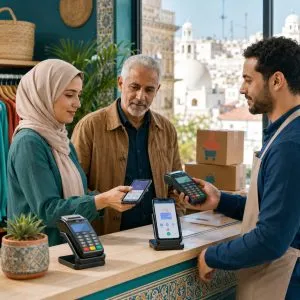
Algeria’s 57% Unbanked: How PSP Wallets Are Bridging the Financial Exclusion Gap
Algeria Payments: The 179% Surge and What Merchants Must Do in 2026