The Anchor Demand Thesis
Historically, energy grid modernization in Africa has been driven by population growth and industrial demand — electricity follows people and factories. The 2026 data center boom introduces a third driver: large, predictable, commercially creditworthy electricity demand from digital infrastructure operators.
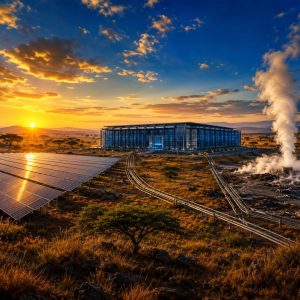
The logic of anchor demand works as follows. A 100-megawatt data center requires a long-term, guaranteed power supply — typically a 15-25 year power purchase agreement with a utility or energy developer. That guaranteed revenue stream allows the energy developer to finance the grid infrastructure (transmission lines, substations, generation capacity) that the data center requires. Once that infrastructure exists, it serves the surrounding region: industrial users, residential customers, and public services that previously had no reliable power access.
The Africa Data Centres Association’s 2026 economic report quantifies the current state: 360 MW of active data center capacity across the continent, 238 MW under construction, and 656 MW planned. Africa accounts for only 0.6% of global data center capacity — a number that reflects both the scale of the opportunity and the infrastructure gap that the current investment cycle is beginning to close. The African Energy Chamber projects that data center power demand will reach 2 GW by 2030, a 9% compound annual growth rate from current levels.
South Africa leads continental capacity with 56 facilities, followed by Kenya with 19 and Nigeria with 17. These three countries account for 41% of the continent’s total data center capacity. Their combined infrastructure advantages — relative political stability, improving connectivity, growing tech talent bases — have attracted the largest concentration of cloud investment, but the expansion is now spreading to West Africa, East Africa, and North Africa as secondary markets develop.
Case Studies: Three Different Energy Integration Models
The data center–energy grid relationship plays out differently across Africa’s diverse energy markets. Three country examples illustrate the range of integration models emerging in 2026.
Kenya: The Geothermal Foundation. Kenya’s grid exceeds 60% renewable energy, with geothermal generation supplying nearly half the nation’s power — a structural advantage rooted in the East African Rift Valley’s geothermal resources. Microsoft and G42 have committed $1 billion to a planned 100 MW green data center in Naivasha, Kenya — a site chosen partly because it can access renewable geothermal power at competitive rates. iXAfrica’s collaboration with Oracle to create Kenya’s first public cloud region further anchors cloud investment in a market where renewable power availability removes one of the major data center operating cost variables. Kenya’s IT load capacity of approximately 40 MW is projected to grow at 30% CAGR through 2028.
South Africa: The Solar Scaling Model. South Africa’s data center market leads the continent, but its energy grid has historically been constrained by Eskom’s coal-heavy generation and load-shedding challenges. The data center investment wave is catalyzing solar adoption — Africa Data Centres and Distributed Power Africa jointly developed a 12 MW solar farm in South Africa, demonstrating the public-private partnership model for renewable energy investment. Microsoft and AWS already operate cloud zones in South Africa; Google’s expansion is anticipated. The competition between hyperscalers for data center capacity has created a procurement signal large enough to attract renewable energy developers who might otherwise have waited for grid conditions to improve.
West Africa: The Leapfrog Opportunity. Côte d’Ivoire’s Boundiali solar plant delivers 37.5 MWp of capacity toward the country’s 45% renewable target by 2030. Senegal hosts West Africa’s largest wind project at Taiba N’Diaye. Nigeria’s 17 data center facilities require approximately 137 MW in 2025 — a demand figure that is growing rapidly as Lagos establishes itself as West Africa’s primary digital hub. The pattern across West Africa is leapfrogging: rather than building coal or gas baseline generation and retrofitting with renewables later, newer grid additions in the region disproportionately use renewable sources because the investment economics have shifted in their favor.
Advertisement
What This Means for Enterprise Cloud Buyers and Infrastructure Investors
Africa’s data center expansion creates opportunities and obligations for two distinct groups: enterprise organizations that need cloud and colocation services, and infrastructure investors evaluating the digital infrastructure asset class.
1. Enterprise Cloud Buyers: Evaluate Regional Colocation Before Defaulting to Global Hyperscalers
African enterprises and multinationals with significant African operations have historically defaulted to AWS, Azure, or Google Cloud regions in Europe or South Africa for their primary infrastructure. As regional data center capacity matures in Kenya, Nigeria, Ghana, and Morocco, the latency, data sovereignty, and cost case for regional colocation improves. A company with operations across East Africa that colocates in Naivasha rather than routing through London or Johannesburg reduces round-trip latency from 150-200ms to under 30ms — a difference that matters for real-time applications, payment processing, and interactive AI services.
The over-40 countries that have enacted data protection laws across Africa — a figure cited in the Africa Data Centres Association’s 2026 report — creates a regulatory pressure to keep data within specific jurisdictions that will further accelerate regional data center demand. Enterprises with African operations should include African regional providers in their next infrastructure evaluation cycle.
2. Infrastructure Investors: Data Centers as Grid Anchor Assets
The anchor demand thesis makes data centers attractive as infrastructure assets beyond their direct returns. A data center that signs a 20-year power purchase agreement with a renewable energy developer creates a revenue guarantee that enables that developer to finance solar or wind generation that serves the broader grid. The data center investor effectively catalyzes infrastructure improvements in the surrounding region, which improves the operating environment (better power reliability, lower grid carbon intensity) and increases the commercial value of subsequent capacity expansions.
African Energy Week 2026 — scheduled for Cape Town in October 2026 — will feature the continent’s first AI and Data Center track, led by the African Energy Chamber. AEC Executive Chairman NJ Ayuk’s framing is explicit: data centers are “anchor demand capable of unlocking large-scale power generation,” positioning the technology as an energy sector investment rather than a pure tech investment.
3. Renewable Energy Developers: Data Center Demand as Financing Signal
Power purchase agreements from data center operators provide the long-term contracted revenue that renewable energy projects need to access debt financing. In markets where grid-scale renewable projects have historically struggled to find creditworthy off-takers — the entity that commits to buying the power — data center operators provide exactly that creditworthiness. The Africa Data Centres and Distributed Power Africa solar partnership in South Africa is a template: a data center operator anchors the energy project, the energy project gets financed, and the output serves both the data center and the surrounding grid.
The Structural Challenge: 0.6% of Global Capacity
Despite the investment momentum, Africa’s data center market faces a structural constraint that the current expansion cycle will not fully resolve: the continent holds only 0.6% of global data center capacity, and the Africa Data Centres Association’s own 2026 report acknowledges that planned expansions will “maintain — rather than increase — Africa’s global share” because the rest of the world is also expanding rapidly.
The implication is that Africa’s data center growth is real, transformative for local economies, and significant in absolute terms — but it is not closing the gap with North America, Europe, or Asia Pacific. The 64% digital usage gap that persists across Africa (despite narrowing internet connectivity gaps) reflects this infrastructure deficit. Closing that gap requires not just data center investment but also last-mile connectivity, device access, digital skills, and content in local languages — a broader development challenge that data center investment alone cannot solve.
For enterprises and investors focused on Africa, the realistic framing is not “Africa is becoming a global data center hub” but rather “Africa is building the digital infrastructure foundation that its economy requires, and data centers are a critical component of that foundation.” That is a significant opportunity — it just requires appropriate timeline expectations.
Frequently Asked Questions
How does Africa’s data center growth compare to the rest of the world?
Africa currently holds 0.6% of global data center capacity, with 360 MW active and 656 MW planned, according to the Africa Data Centres Association’s 2026 report. While this represents significant growth — the market is projected to reach $6.81 billion by 2030 from $3.49 billion in 2024 at an 11.79% CAGR — the expansion will maintain rather than increase Africa’s global share because other regions are also growing rapidly. The continental significance is therefore primarily domestic and regional: data center investment is transforming energy grids and digital access within Africa, even if it is not closing the gap with leading global markets.
Why are data centers effective at driving energy grid modernization in Africa?
Data centers provide what energy infrastructure developers call “anchor demand” — large, long-term, commercially creditworthy electricity demand that enables renewable energy projects to access debt financing. A 100 MW data center signing a 20-year power purchase agreement gives a solar or wind developer the guaranteed revenue stream needed to finance grid infrastructure that then serves the surrounding region. This mechanism has worked in Kenya (where Microsoft and G42’s $1 billion green data center investment aligns with geothermal power development) and South Africa (where hyperscaler presence has accelerated solar PPA activity).
What data center opportunity exists specifically for North Africa?
North Africa — including Algeria, Morocco, Egypt, and Tunisia — is positioned between Sub-Saharan Africa’s growing digital economies and Europe’s cloud regions. Morocco has established itself as a regional hub with connectivity advantages and political stability. Egypt has attracted hyperscaler attention given its large domestic market. Algeria has the strongest solar resources on the continent and improving backbone connectivity but limited colocation capacity. The regional opportunity is to establish data center capacity that serves North African enterprise demand (currently routing through European cloud regions), captures spillover from European data sovereignty requirements, and potentially serves as a green energy hub given the solar resource base.
—
Sources & Further Reading
- Data Centres in Africa 2026: The Economic Report — Africa Data Centres Association
- Data Centers Could Be the Spark Africa’s Power Sector Needs — African Energy Chamber
- African Energy Week 2026 Launches AI and Data Center Platform — Hipther
- Power, Performance, and Profit: Optimising Africa’s Data Centre Operations — Mining Weekly
- Africa Data Centres Power Market — Tech Africa