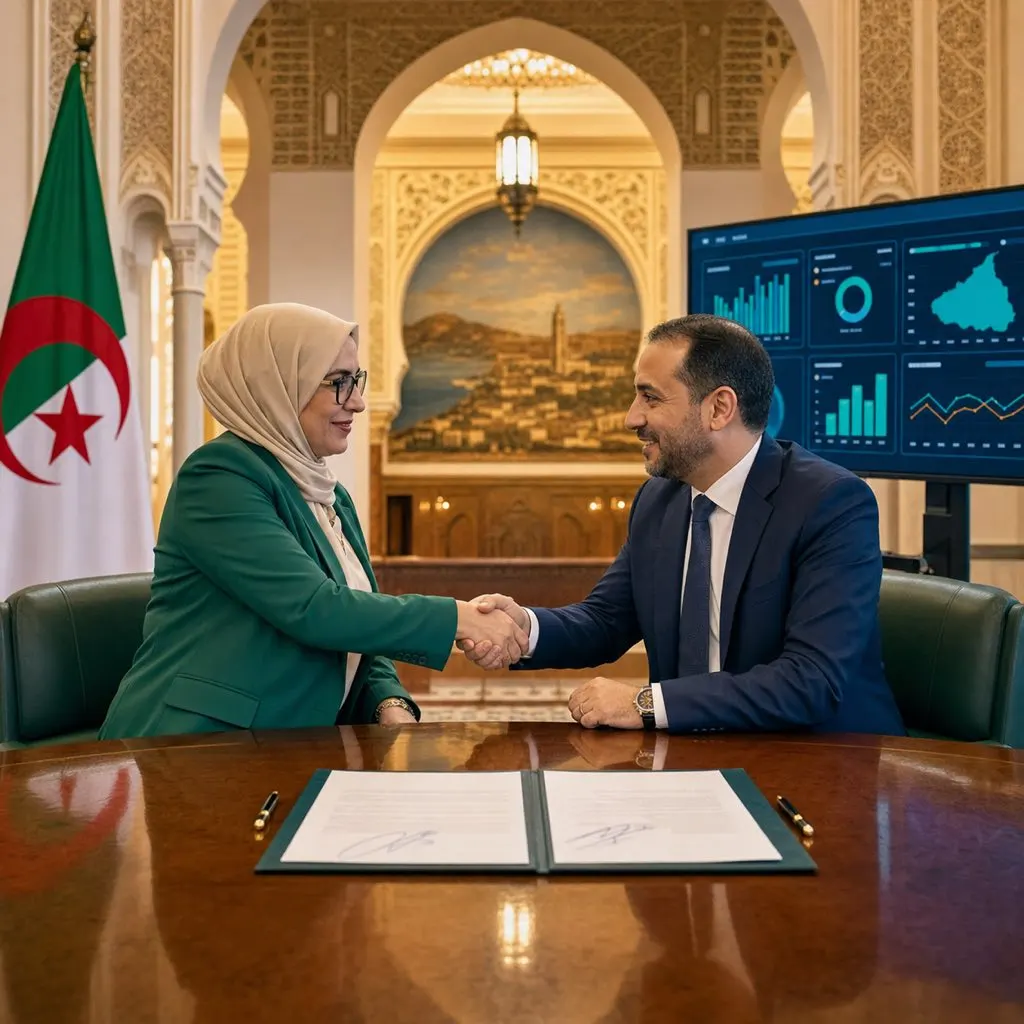
The Demand Engine Government Has Become
Algeria’s public sector is undergoing the most significant technology procurement transformation in a generation. The country’s digital transformation mandate, administered at the highest political level, has converted ministries, wilaya administrations, national agencies, and state-owned enterprises from passive observers of the startup ecosystem into active procurement clients. The shift is structural, not cyclical — government agencies are being measured on digitisation targets, and the fastest path to meeting those targets is often a startup with a vertical solution, not a sprawling systems integrator contract.
The institutional evidence is visible in three places. First, the Startup Label framework under Executive Decree No. 20-254 (September 2020) explicitly carved out dedicated public procurement quotas for labeled startups — a provision that would be meaningless if government agencies weren’t buying tech from startups in the first place. Second, the Algerian Startup Fund, with its 2.4 billion DZD capital base and portfolio of over 100 funded startups across 20 sectors, has consistently backed companies with mixed public/private revenue models, validating that government contracts reduce the risk profile of early-stage Algerian companies enough to warrant venture investment. Third, the Ministry of Knowledge Economy’s 7,800-company startup.dz registry and 124 active university incubators are now feeding a steady pipeline of technically capable teams into sectors — e-health, e-education, smart transport, digital identity — where government is the primary buyer.
The Algerie Telecom AI Fund, launched in February 2025 with 1.5 billion DZD, further signals where state capital expects commercial returns: AI-native infrastructure and platforms that can be deployed at scale within Algeria’s public sector network. Algerie Telecom itself is simultaneously a connectivity provider, a state-owned enterprise client, and a co-investor — a configuration that gives AI startups funded by its fund a built-in path to a first enterprise customer that happens to have national reach.
What the GovTech Opportunity Actually Looks Like in 2026
The GovTech market in Algeria spans five distinct verticals that are each experiencing active procurement activity:
E-Government Services: Ministries are under mandate to migrate citizen-facing services online. Document submission, administrative status tracking, permit management, and fee payment are all in active procurement cycles. Startups with UX capabilities and Arabic-French bilingual interfaces have a categorical advantage over foreign vendors who have not invested in localisation.
E-Health: The Ministry of Health has signalled intent to digitise patient records, appointment scheduling, and pharmaceutical supply chain tracking across the public hospital network. DabaDoc DZ, CareAlgeria, and MediTrack DZ (all named in the 2025 ecosystem overview) represent the early cohort of startups now positioned to compete for these contracts.
Smart Transport and Logistics: Urban mobility management for cities with over 500,000 residents (Algiers, Oran, Constantine, Annaba, Sétif) is a procurement priority at the wilaya level. TemTem’s model — 4,000 active drivers, 200,000+ clients, 21 wilayas — demonstrates that a startup can achieve the operational scale needed to credibly bid for public transport management contracts.
Digital Identity and Financial Inclusion: Algeria’s estimated 47.4 million-person population includes a large unbanked segment. The government’s financial inclusion agenda is driving procurement for digital identity verification, mobile payment infrastructure, and agent banking network management — all areas where fintech startups (which raised $200M in 2024) have built the technical capability.
Education Technology: With 124 active university incubators and a digitisation agenda that reaches secondary schools, procurement for learning management systems, assessment tools, and digital curriculum delivery is expanding rapidly beyond the capital.
Advertisement
A Four-Stage Framework for Winning Government Contracts
Algerian startups that have successfully penetrated public-sector procurement share a consistent sequencing pattern. Founders who attempt shortcuts — approaching ministries without a label, pitching without references, or skipping the pilot stage — consistently lose to more patient competitors who have worked the institutional sequence.
1. Secure the Label Before the First Ministry Meeting
The Startup Label under Decree 20-254 is not optional for government procurement — it is the gating requirement that separates startups entitled to dedicated procurement quotas from those competing against large systems integrators without structural protection. The label grants: VAT and customs exemptions on R&D equipment, R&D tax deductions up to 30% of expenses (capped at 200 million DZD annually), free IP registration through INAPI, and access to the dedicated public procurement quota. The Ministry of Knowledge Economy processes applications within three months for companies under eight years old. Any founder approaching a ministry without this label is voluntarily entering a procurement competition on the worst possible terms — without IP protection, without the quota advantage, and without ASF eligibility for the follow-on capital that a government contract will require to execute.
2. Use the ASF and Algerie Telecom Fund to De-Risk the Pilot Contract
Government contracts are won on references, not features. The fastest way to build a reference in Algeria’s public sector is to complete a funded pilot — a three-to-six-month deployment at a single ministry, wilaya, or state-owned enterprise, delivered on time and within budget, with a documented outcome. The Algerian Startup Fund (2.4 billion DZD, tiers of 2M, 5M, up to 20M DZD) and the Algerie Telecom AI Fund (1.5 billion DZD, launched February 2025) both provide the capital structure to absorb pilot-stage losses without forcing founders to make the product free or deeply discounted to win the first reference. Founders who combine ASF backing with a Algerie Telecom partnership — even an informal technical integration — arrive at government procurement conversations with both a funded balance sheet and a state-adjacent validator. That combination shortens procurement decision timelines from twelve months to four.
3. Build the Relationship Network at the Wilaya Level First
The directional instinct of most GovTech founders is to target the largest possible client: a national ministry, a state-owned enterprise with 50,000 employees, or a national agency. This is the wrong sequence. Wilaya-level digital transformation offices have smaller procurement values (typically 5 to 20 million DZD per contract), faster decision cycles (three to six months versus twelve to eighteen for national ministries), and far more tolerance for early-stage product imperfections. The 48 wilayas are executing digital transformation mandates from the central government with local implementation budgets. A startup with two wilaya-level references is dramatically more competitive in a national ministry procurement cycle than a startup with zero references but a stronger product deck. TemTem’s expansion across 21 wilayas before pursuing national-scale contracts follows exactly this logic.
4. Document Impact in DZD Terms, Not User Metrics
Government procurement committees evaluate vendors on cost savings, compliance metrics, and operational efficiency gains — not monthly active users, NPS scores, or growth percentages. Startups that pitch government clients with consumer-style metrics consistently lose to competitors who can say: “Our deployment at Wilaya X reduced administrative processing time by 40%, saving an estimated 8 million DZD in staff overhead annually.” Founders should instrument their pilots to capture the metrics that matter in public procurement evaluation: processing time reduction, error rate reduction, citizen satisfaction scores, and cost-per-transaction improvement. These are the numbers that convert a pilot into a renewal and a renewal into a framework agreement across multiple wilayas.
Where This Fits in Algeria’s 2026 Ecosystem
The GovTech wave is not a niche within Algeria’s startup ecosystem — it is the most reliable path to early revenue at scale for a majority of B2B startups, because the public sector represents the single largest technology buyer in the country. The digital transformation mandate, backed at the presidential level, means that ministries are not choosing whether to buy technology from startups — they are choosing which startups to buy from. The dedicated procurement quotas under Decree 20-254 exist precisely because the government wants this money flowing to labeled Algerian companies, not to foreign vendors or legacy system integrators. The opportunity is not theoretical; it is a procurement budget with a statutory preference for Algerian startups. The 2,300 companies currently holding the Startup Label are the primary beneficiaries of that preference — which is exactly why the Ministry’s 20,000-by-2029 labeling target matters to every founder who hasn’t yet applied.
Frequently Asked Questions
What public procurement advantages does the Startup Label give Algerian founders?
The Startup Label under Decree 20-254 grants labeled companies access to dedicated public procurement quotas — a statutory preference that prevents them from competing head-to-head with large systems integrators for government contracts. Beyond procurement access, it also provides VAT and customs exemptions on R&D equipment, tax deductions up to 30% of R&D expenses (capped at 200M DZD/year), and free IP registration through INAPI. The label is the prerequisite for Algerian Startup Fund eligibility and for the ASEP international expansion program. The Ministry of Knowledge Economy processes applications in approximately three months.
Which GovTech sectors have the most active procurement in Algeria in 2026?
The five most active GovTech procurement verticals in 2026 are: e-government services (citizen-facing administrative digitisation), e-health (patient records, appointment systems, supply chain), smart transport and urban mobility, digital identity and financial inclusion infrastructure, and education technology (learning management systems, digital curriculum). Procurement at the wilaya level (48 administrative units) offers faster cycles (3-6 months) and more tolerance for early-stage products than national ministry contracts, making wilaya offices the recommended first target for GovTech founders.
How should founders instrument a government pilot to win follow-on contracts?
Government procurement renewals and framework agreements are won on public-sector-relevant metrics: processing time reduction, error rate reduction, cost-per-transaction improvement, and staff overhead savings in DZD terms. Consumer-style metrics (MAU, NPS, growth %) do not resonate with procurement committees. Founders should build outcome measurement into the pilot contract from day one, targeting at least one headline metric (e.g., “40% reduction in administrative processing time, saving 8M DZD annually”) that procurement decision-makers can present internally to justify renewal. The Algerian Startup Fund’s follow-on capital tiers (up to 20M DZD) can fund the instrumentation and reporting infrastructure required to capture these metrics professionally.
—
Sources & Further Reading
- Algeria Tech & AI Startup Scene — AlgeriaTech
- The 6 Most Important Mechanisms Every Algerian Startup Should Know in 2025 — LeanCubator
- Algeria Startup Ecosystem in 2025: A Year of Resilience and Transformation — Stats & Market Insights
- Algeria’s Public Startup Fund Scores First Exit as Travel-Tech Völz Raises $5M — Launch Base Africa
- Understanding the Business Climate in Algeria — AFSIC