The Grid Cannot Keep Pace With Compute
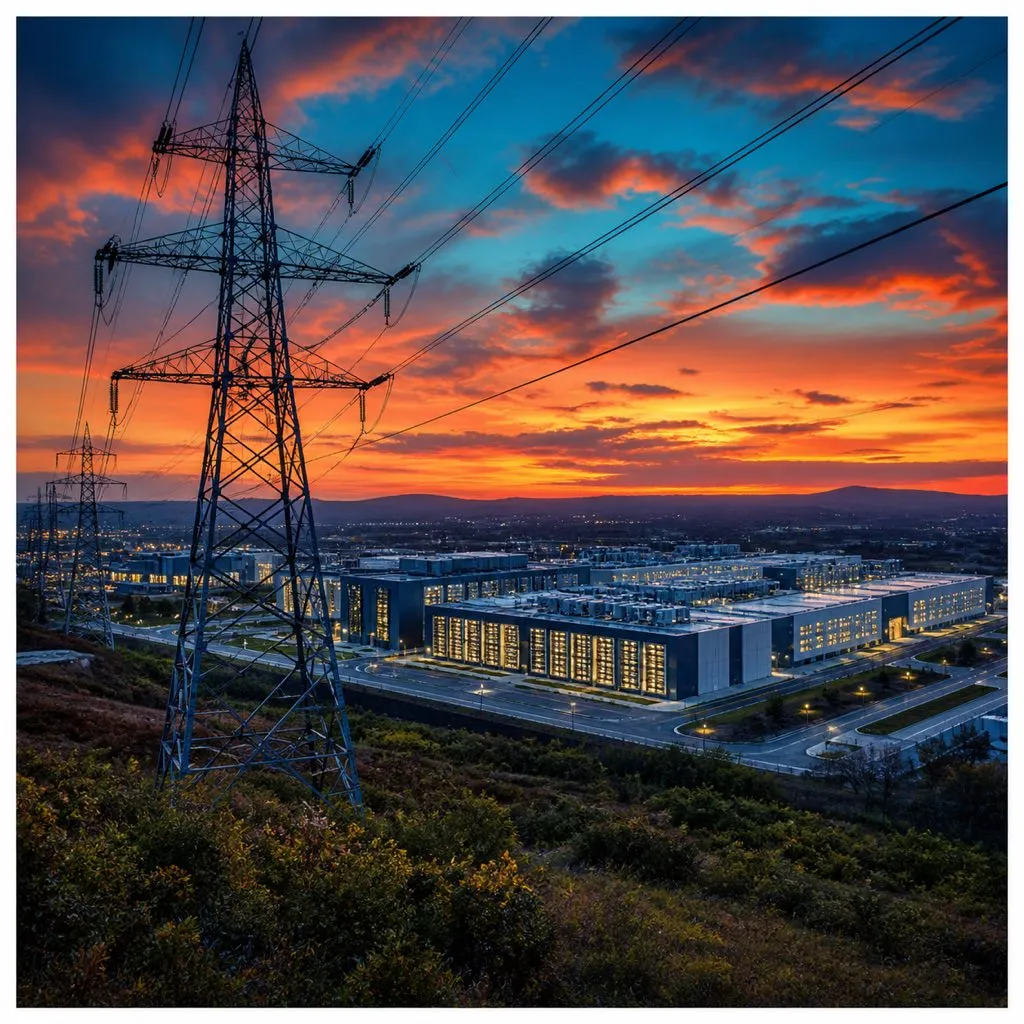
For most of data center history, power was a cost to manage, not a constraint to engineer around. Operators selected sites with cheap grid electricity, designed facilities to standard power-usage-effectiveness targets, and assumed the grid would scale with demand. That assumption collapsed between 2024 and 2026.
The International Energy Agency reports that global data center electricity consumption reached approximately 485 TWh in 2025, a 17% increase from 2024’s 415 TWh. AI-focused data centers grew 50% in the same period. Five major technology firms surpassed $400 billion in combined capital expenditure in 2025, with a further 75% increase anticipated in 2026. The aggregate demand that this capital creates — for GPU clusters, for inference infrastructure, for the cooling and power conversion systems that surround them — is arriving at substations faster than utility companies can build transmission lines and transformers.
Morgan Stanley Research forecasts US data center demand could reach 74 GW by 2028. At existing grid connection points, the available power access is approximately 25–29 GW — a shortfall of 45–49 GW depending on the estimate. Grid connection queue wait times in Northern Virginia (the world’s largest data center market), Phoenix, and Chicago now run 2–5 years. The Uptime Institute’s 2026 predictions identify power as the single defining constraint on data center growth globally, projecting that AI-associated data center power load will reach 10 GW by end of 2026 — not because demand plateaus, but because grid and generation capacity cannot be built fast enough.
This is not a temporary growing pain. It is a structural deficit that will persist until the late 2020s absent fundamental acceleration in grid buildout, permitting reform, and on-site generation deployment.
Five Engineering Strategies Operators Are Using Now
The response to the grid bottleneck is not a single solution but a portfolio of strategies, each addressing a different dimension of the power access problem. Hyperscalers and their specialist data center operators are deploying all five simultaneously.
Strategy 1: On-Site Gas Generation and Microgrids
Operators in grid-constrained markets are increasingly supplementing or bypassing grid connection with on-site generation. Combined cycle gas turbines, aeroderivative gas turbines designed for fast dispatch, and diesel backup systems are being sized not as emergency backup but as primary power sources for facilities that cannot wait for a grid connection. This approach trades carbon footprint for speed — a facility that needs to be operational in 18 months cannot wait 36 months for a transmission upgrade. Several major Virginia data center campuses announced in 2025 are explicitly designed as behind-the-meter microgrids drawing primarily on natural gas.
Strategy 2: Liquid Cooling to Cut Power per GPU
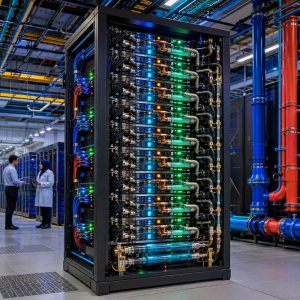
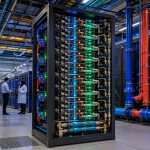
The GPU racks powering large language models and AI training clusters reach power densities of 40–100+ kilowatts per rack — compared to 3–8 kW/rack for standard servers. Conventional air cooling cannot remove this heat efficiently at scale; the cooling infrastructure consumes nearly as much power as the compute it serves. Direct liquid cooling (DLC) and immersion cooling — circulating water or dielectric fluid directly across processor die surfaces — reduce cooling energy overhead by 30–50% compared to air cooling. Google, Meta, and Microsoft are deploying liquid cooling as the default for new high-density AI racks, not as a premium option. The power saved by liquid cooling directly reduces the facility’s total power draw, alleviating grid load.
Strategy 3: Demand Response and Temporal Shifting of AI Workloads
Not all AI workloads require instant execution. Training runs, batch inference, and data processing jobs can be shifted temporally — run during off-peak grid hours when power is cheap and grid load is low. Hyperscalers are building demand response management systems that automatically shift appropriate workloads to cheaper, greener off-peak windows. Google has published that its TPU training clusters operate with significant temporal flexibility; Meta’s AI Research SuperCluster uses similar scheduling. The effective result is that a data center drawing 1 GW at peak can have an average draw of 700–800 MW if workloads are flexibly scheduled — a 20–30% reduction in grid impact without reducing total compute output.
Strategy 4: Site Selection Around Power Generation Assets
The traditional data center site selection model prioritized fiber connectivity, tax incentives, and land cost. The new model adds a fourth criterion: proximity to power generation assets. Wind farms in Texas and the Midwest, hydroelectric resources in the Pacific Northwest and Scandinavia, and geothermal resources in Iceland and East Africa are now primary site selection drivers for major new capacity. Microsoft’s Kenya data center partnership with G42 is explicitly geothermal-powered. The 5-gigawatt Abu Dhabi AI campus is designed around the UAE’s renewable energy buildout. Co-locating with generation assets rather than serving load from the grid eliminates the connection queue problem entirely.
Advertisement
What Engineering Leaders Should Do About It
The power bottleneck affects not just hyperscalers but any organization operating its own significant compute infrastructure — financial institutions, healthcare systems, defense contractors, and large enterprises running on-premise AI infrastructure. The engineering responses are different at each scale tier.
1. Add a power timeline to every data center project’s critical path
A new data center facility that requires a new grid connection should add 24–36 months to its project timeline for grid connection approval and infrastructure buildout in constrained markets. This is not a worst-case scenario; it is the current average in Northern Virginia, Phoenix, and Chicago. Engineering leaders who begin projects without accounting for this lead time will face either construction delays or forced use of expensive interim generation solutions. The fix is straightforward: engage the local utility at project concept stage, not at facility design completion.
2. Mandate liquid cooling specifications for any GPU rack above 20 kW/rack density
Air cooling at densities above 20 kW/rack is economically and physically inefficient. The power consumed by fans, chillers, and CRAC units to cool a 40 kW AI rack via air cooling is approximately 40–60% of the rack’s own power draw. Liquid cooling at the same density reduces cooling overhead to 5–10%. At scale, this difference compounds: a 10-MW GPU cluster using liquid cooling rather than air cooling reduces total facility power draw by approximately 1.5–2 MW — enough to service 1,500 additional residential homes on the same grid connection. Engineering leaders specifying new AI infrastructure should make direct liquid cooling the default, not the exception.
3. Engage your utility for demand-response rate structures before you need them
Utilities in grid-constrained markets are actively seeking large industrial customers willing to participate in demand-response programs — accepting curtailment during peak demand events in exchange for lower average rates. For organizations running AI training workloads with temporal flexibility, this is a straightforward value trade: schedule training jobs during off-peak windows, accept occasional peak-hour curtailment, receive 15–25% lower average power costs. The qualification and contracting process takes 6–12 months; organizations that wait until they face a grid constraint have already missed the optimal rate negotiation window.
Where This Fits in 2026’s Infrastructure Landscape
The power bottleneck is the most consequential near-term constraint on the pace of AI deployment. A GPU cluster that cannot get power cannot train models or serve inference — regardless of how sophisticated the silicon is. The engineering strategies outlined above are responses to a problem that is already active in the most compute-dense markets, and that will spread to secondary markets within 12–24 months as AI infrastructure demand diffuses geographically.
The deeper structural implication is that data centers are transitioning from passive electricity consumers to active participants in energy system design. A hyperscaler that signs a power purchase agreement, builds behind-the-meter generation, and participates in demand-response programs is no longer simply a load on the grid — it is a generator, a storage operator, and a grid stabilization service simultaneously. This transformation will fundamentally alter the relationship between cloud infrastructure and energy policy in every jurisdiction where it occurs.
For engineering leaders, the actionable frame is this: the cost of solving the power problem proactively — engaging utilities early, specifying liquid cooling now, participating in demand-response programs — is a small fraction of the cost of being caught by grid constraints during a critical infrastructure build. The 49 GW shortfall is not an abstraction. It is already manifest in the queue at the Northern Virginia substation.
Frequently Asked Questions
What does the 49 GW US data center power shortfall mean for enterprise cloud buyers?
The shortfall means that new data center capacity in the most constrained US markets (Northern Virginia, Phoenix, Chicago) is being delayed by grid connection queue times of 2–5 years. Hyperscalers are securing capacity ahead of enterprises by signing power agreements and building behind-the-meter generation. Enterprise buyers who need GPU capacity in the 2027–2029 window should reserve it with hyperscalers now rather than waiting, as available capacity in constrained regions will tighten further.
Is liquid cooling safe for GPU hardware compared to air cooling?
Yes. Direct liquid cooling (DLC) circulates water to cold plates attached directly to the processor, without the water contacting electrical components. Immersion cooling submerges servers in non-conductive dielectric fluid. Both are deployed at commercial scale by Google, Meta, and Microsoft for AI GPU racks. Liquid cooling actually reduces thermal stress on semiconductors compared to air cooling because it provides more consistent, lower-temperature operation. The major deployment challenge is the plumbing infrastructure, not hardware compatibility—most modern AI server designs from NVIDIA and AMD include DLC port interfaces.
How much can demand-response programs reduce a data center’s power costs?
Organizations participating in utility demand-response programs — accepting curtailment during peak demand events in exchange for reduced rates — typically save 15–25% on average power costs, depending on the utility’s rate structure and the organization’s workload flexibility. For a 10 MW data center drawing 87,600 MWh annually, a 20% reduction represents approximately $1–2 million in annual savings at typical commercial power rates. The qualification and contracting process takes 6–12 months; organizations must demonstrate sufficient flexible load to qualify for commercial demand-response rates.
—
Sources & Further Reading
- Powering AI: Energy Market Outlook 2026 — Morgan Stanley
- Data Centre Electricity Use Surged in 2025 — IEA
- Morgan Stanley Warns of Looming 45-Gigawatt US Power Shortage — MLQ.ai
- Morgan Stanley Sees Up to 20% Shortage of US Power for Data Centers Through 2028 — Investing.com
- Global Data Center Power Demand to Double by 2030 on AI Surge — S&P Global
- An Analysis of Small Modular Reactors for Commercial Electricity Generation — Yale Clean Energy Forum