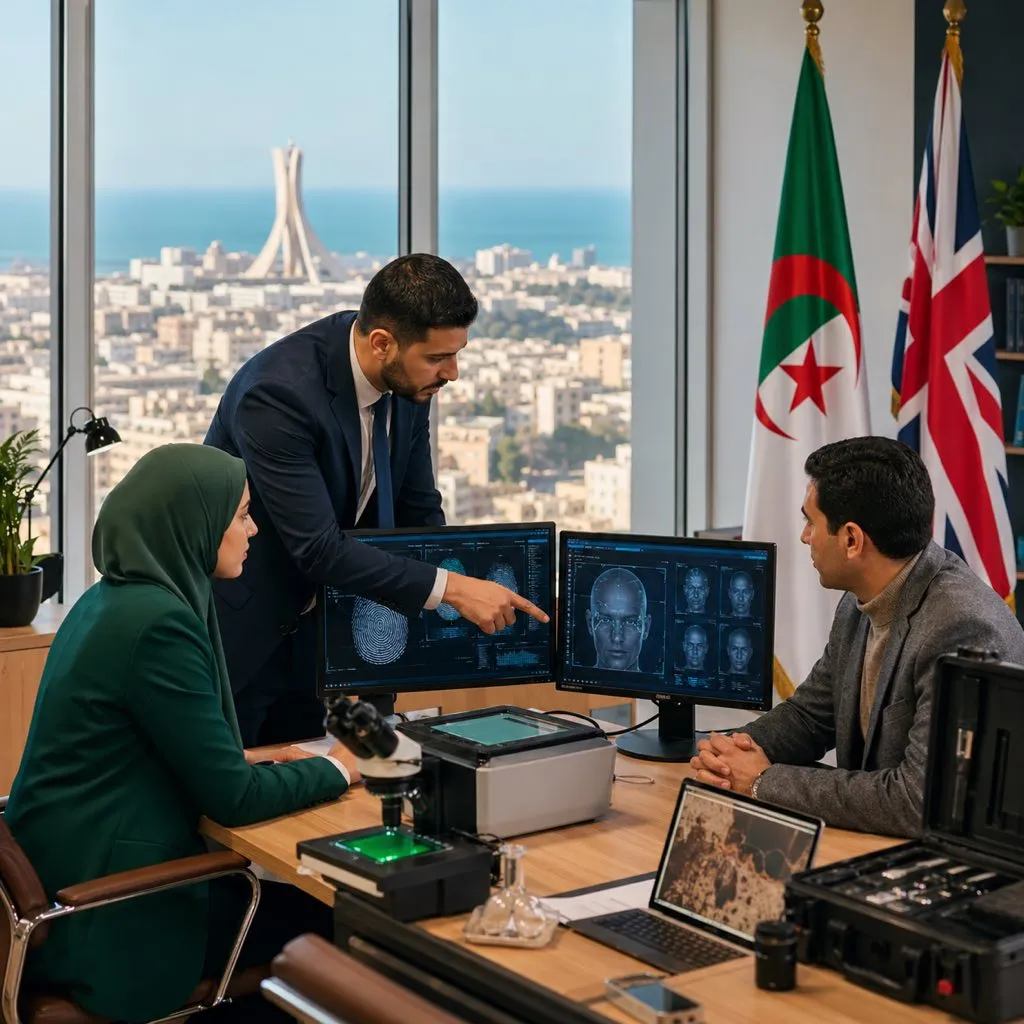
What the November 2025 MoU Actually Covers
According to BiometricUpdate, the MoU signed in November 2025 between Ali Badaoui (Director General of National Security, DGSN) and Alex Norris (UK Minister of State for Borders and Asylum) commits the UK to support Algeria’s police force on two specific domains: digital forensics for criminal investigations and biometric identification for policing. The published scope mentions digital fingerprint analysis and identity recognition and verification capabilities.
The MoU is light on numbers — the article does not specify the duration of the program, the number of officers to be trained, or the value of the cooperation. What it does specify is a knowledge-exchange framework, including a visit by Director Badaoui to the UK’s National Crime Agency to observe operational deployments. That detail matters: when senior leadership tours the partner’s operational floor before the agreement is signed, the curriculum that follows tends to be modeled on the partner’s actual procedures rather than on a generic syllabus.
For Algeria, the operational reference point is Council of Europe’s CyberSouth program, which since 2017 has been the main multilateral channel for Algerian law-enforcement cybercrime training. The UK MoU sits alongside CyberSouth, not against it — but it brings a different operational tradition (UK NCA, College of Policing) into the curriculum design.
Why DGSN Needs This Capacity Build, Now
The DGSN, the Gendarmerie Nationale, and the Ministry of Justice’s investigative units are the three Algerian bodies that handle e-evidence in criminal cases. Their volume has been rising for years. According to Council of Europe assessments, Algeria’s annual cybercrime-and-e-evidence reports document a steadily expanding caseload across financial fraud, ransomware against businesses, child-protection investigations, and OSINT-driven counter-terror work.
The bottleneck is not the laws — Law 09-04 (2009) on cybercrime and Law 18-07 (2018) on personal-data protection have given investigators legal hooks. The bottleneck is the technical staff who can actually image a phone, recover a deleted partition, parse a cloud-account export, or run a 1:N face match against a national database under chain-of-custody rules that hold up in court. Those skills are scarce in Algeria — public training in DFIR (digital forensics and incident response) is still concentrated in a handful of institutions and the certified-examiner population is measured in the dozens, not the hundreds.
The UK side brings an established DFIR doctrine: the Association of Chief Police Officers’ (now NPCC) digital-evidence principles, the College of Policing’s specialist training pathways, and the National Crime Agency’s operational playbooks. That doctrine is what gets transferred — not just tools.
What “Digital Forensics” and “Biometric Policing” Actually Mean as Job Descriptions
In a UK or French police force, the careers behind these labels split into roughly four families:
The first family is the digital forensic examiner — the person who sits in front of a write-blocked imaging station, runs Magnet AXIOM or Oxygen Forensic Detective extractions on seized devices, validates hash chains, and produces an evidentiary report. Entry-level roles in the UK start at NCA grade 7 or police constable level with a specialist allowance; mid-career examiners hold the College of Policing’s Mainstream Forensic Investigation Programme accreditation.
The second family is the incident response analyst — closer to the cybersecurity world, focused on live network intrusions where the evidence is still being generated. Skills overlap with SOC analysis but with court-admissibility constraints layered on top.
The third family is biometrics specialist — fingerprint examiners (latent-print comparison), facial-recognition operators (1:N database queries on detained individuals or suspects), and DNA profile analysts. The UK Home Office’s Biometrics and Surveillance Camera Commissioner role frames the governance side of these jobs.
The fourth family is OSINT and intelligence analyst — the one that has expanded most rapidly across Europe, blending social-media analysis, geolocation, blockchain tracing, and traditional intelligence tradecraft.
For Algerian engineers eyeing a public-sector pivot, the UK MoU is most likely to open formal capacity in the first and third families first — examiner and biometrics specialist — because those map directly to existing DGSN organizational charts.
Advertisement
The Salary and Recognition Reality
DGSN technical grades follow a published pay grid. A specialist technician (technicien spécialisé) entering with a BTS or DEUA in IT sits in a different band than a “préposé technique” without specialization. The biometrics and digital-forensics designation, when formally created inside the corps, typically carries a prime de spécialité — a specialty allowance — that adds 15-30% to base salary depending on the bracket, similar to what cybersecurity specialists already receive in Sonatrach’s IT corps.
Internationally certified examiners — those holding GIAC Certified Forensic Analyst (GCFA), Magnet Certified Forensic Examiner (MCFE), or AccessData Certified Examiner (ACE) — also become eligible for parallel career tracks in private incident-response firms, which pay materially higher than the public sector. The MoU itself doesn’t grant these certifications — the UK side trains in a doctrine that aligns with them, and individual engineers fund or earn the formal certs separately.
What This Means for Algerian Engineers Eyeing the Public-Sector Pivot
1. Start with the entry-level DGSN technical concours, then specialize after admission
The DGSN’s technical recruitment concours opens annually, typically in the autumn for the following intake. Engineers with a Master’s in IT, cybersecurity, or telecommunications who pass the concours enter at a specific grade and then become eligible to volunteer for the DFIR or biometrics specialty track once inside. Trying to pivot from a private-sector cyber role directly into a senior DGSN specialist post is structurally harder — the corps prefers to grow its specialists from within. Watch for the 2026-2027 concours announcement and the new spécialité forensique numérique line if and when it appears in the published openings.
2. Build the open-source toolchain skills before the proprietary ones
Magnet AXIOM, Oxygen Forensic Detective, and MSAB XAMN are the proprietary tools most UK police forces deploy. They are also expensive enough that an Algerian engineer cannot practice on them at home. The realistic preparation path is to build the skill on open-source equivalents — Autopsy, FTK Imager (free version), Volatility, PhotoRec, Sleuth Kit, and the Plaso forensic timeline tool — and to validate the skill against the SANS DFIR posters and Magnet’s free CTF challenges. Once inside DGSN, the proprietary tools are provided; the cognitive skills transfer directly.
3. Pursue MSAB XAMN, EnCase, or GCFH certification through international online training
The UK College of Policing’s specialist accreditations are formally restricted to UK officers. But the underlying body of knowledge (the ACPO/NPCC digital-evidence principles, ISO/IEC 27037, ISO/IEC 27042) is fully public. International commercial certifications — GIAC’s GCFE and GCFH, the ACE from Exterro, MSAB’s XAMN — are open to anyone who can pay the exam fee. An Algerian engineer who walks into a 2027 DGSN specialty interview holding a GCFE has a measurably stronger case than one without. The cost is real — exam fees run €700-1,500 — but smaller than a Master’s program, and the credential transfers to private-sector consulting later.
4. Track the Council of Europe CyberSouth annual cybercrime report cycle
CyberSouth runs annual workshops in Algeria on the preparation of cybercrime and e-evidence situation reports. Attendance at these workshops is a softer entry than a concours — they admit civilian researchers, prosecutors, and academic representatives alongside DGSN officers. Engineers from universities (USTHB, ESI, École Supérieure du Numérique, École Nationale Supérieure de Police) can present case studies and become known to the operational community. The next workshop cycle, sequenced around the UK MoU’s first deliverables, will be a useful access point for engineers building a public-sector profile from outside the corps.
What Comes Next
The MoU is signed, the doctrine transfer has a partner, and the legal framework already exists. What is still missing is the formal corps structure — the published specialty designation inside DGSN’s table of organization, the specific training calendar for the first cohort, and the public concours that creates the salaried positions.
If the partnership runs on the typical UK Home Office cooperation timeline, the first observable milestones will appear in late 2026: a UK delegation training program for an initial cohort of DGSN officers, follow-on by a specialty designation in the 2027 organizational chart, and a public concours opening in 2027 or early 2028. Engineers who use the 2026 window to build certifications and operational portfolios will arrive at that concours with a credential profile DGSN does not currently produce internally — and that is the structural opportunity the MoU creates.
The second-order opportunity is private-sector. Algeria’s law firms, banks, and insurance companies are already buying DFIR services from European firms because there is no domestic capacity. Once DGSN’s training program produces examiners who later leave for private practice, a domestic DFIR consulting market becomes possible — currently it does not exist at scale. That is a 5-10 year horizon, but it begins with the cohort the UK MoU trains first.
Frequently Asked Questions
What did the November 2025 MoU between DGSN and the UK Home Office actually cover?
According to BiometricUpdate, DGSN Director General Ali Badaoui and UK Minister of State Alex Norris signed an MoU committing the UK to support Algeria’s police force on digital forensics for criminal investigations and biometric identification — including digital fingerprint analysis and identity recognition systems. The MoU establishes a knowledge-exchange framework but does not specify duration, officer headcount, or budget.
What certifications should an Algerian engineer pursue to qualify for a future DGSN digital-forensics role?
The internationally recognized DFIR credentials open to civilians include SANS/GIAC’s GCFE (Certified Forensic Examiner) and GCFH (Forensic Hacker), Exterro’s ACE (AccessData Certified Examiner), and MSAB’s XAMN. These align with the UK College of Policing’s specialist body of knowledge that the MoU is expected to transfer.
When is the first DGSN concours likely to open with a digital-forensics specialty?
There is no published announcement yet. Based on typical UK Home Office cooperation timelines, the first training cohorts are likely from late 2026, with formal specialty designations entering DGSN’s organizational chart in 2027, and a public concours opening 2027-2028. Watch the DGSN’s official concours portal and APS announcements for the specialty line item.