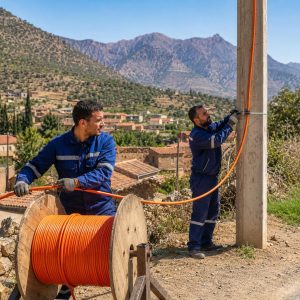
Why Outbound Bandwidth Suddenly Matters
For most of the last decade, Algerian cloud strategy was constrained by a single number: the international transit capacity available to Algerie Telecom and its handful of partners. Whatever the local FTTH plan promised — and the entry tier doubled to 100 Mbps in April 2026 — every cloud-bound packet eventually had to leave the country through a small set of submarine cables. When those cables congested at peak hours, latency to Frankfurt, Marseille, or Madrid spiked from a comfortable 30 ms to a punishing 200 ms, and SaaS apps that worked fine at 10 a.m. became unusable by 3 p.m.
That ceiling is now lifting. According to coverage in The Africa Report and Developing Telecoms, Algeria’s plan calls for international fibre-optic capacity to roughly double during 2026, driven by two new cable systems entering service and by upgrades on existing routes. The shift coincides with the AI workload boom: cross-border inference traffic, multi-region SaaS, and hyperscaler peering all consume far more international bandwidth than the legacy mix of email, video conferencing, and file sync.
For Algerian CTOs, this is the first time in years that international transit will not be the binding constraint on cloud architecture decisions. The real bottlenecks are moving downstream — to data centre power, peering arrangements, and ARPCE compliance — and the planning assumptions need to move with them.
The Three Capacity Layers Coming Online
Algeria’s international fibre is not a single asset; it is a stack of submarine cable systems whose combined headroom defines outbound capacity.
The legacy layer comprises SEA-ME-WE 4 (landing at Annaba, used heavily for Marseille traffic), Alpal2 (Algiers to Palma de Mallorca), and the older ORVAL system. These have carried the bulk of Algerian internet traffic for over a decade and remain critical for redundancy.
The doubling layer is the ALVAL/ORVAL upgrade, which according to SubTel Forum delivers up to 40 Tbps of available transmission capacity — described as “nearly 20 times the current needs of Algeria.” This system protects and effectively doubles the existing Algiers-Palma and Annaba-Marseille routes, providing failover headroom that simply did not exist before.
The 2026 expansion layer is two new systems. Africa-1, with a nominal capacity between 200 and 300 Gbps per fibre pair, links Algeria to a long Mediterranean and Asian footprint. Medusa, whose first phase is scheduled to enter service in 2026 and which uses up to 24 fibre pairs at 20 Tbps per pair, gives Algeria a direct, modern pipe to Southern European hubs. Both cables land at Algerian sites operated under Algerie Telecom’s submarine cable subsidiary and have been described in ministerial statements as core to the country’s “digital sovereignty” agenda.
Why AI and SaaS Traffic Behave Differently
The reason this matters more in 2026 than it did in 2022 is that the workload mix has changed. A Microsoft 365 tenant in Frankfurt, an Anthropic Claude API call to a US region, or an inference request to OpenAI’s o-series models each consumes between two and ten times more international bandwidth per active user than the equivalent task did three years ago.
Concretely: a single GPT-4-class chatbot session for a knowledge worker can move 50–200 KB of payload per minute when the model is doing tool-use or retrieval; a multi-region SaaS suite syncs hundreds of megabytes of telemetry per user per day; AI-assisted code completion tools (Cursor, Copilot, Claude Code) can stream tens of megabytes of context with every prompt. Multiply by 50,000 knowledge workers across Algiers, Oran, and Constantine, and the international transit bill rises sharply.
The capacity doubling is what keeps that bill from translating into latency penalties or rate-limit events. Without it, Algerian users of SaaS and AI APIs would have hit a quality cliff sometime in 2026; with it, the country has roughly two more years of runway before bandwidth becomes the binding constraint again.
Advertisement
What Is Still a Bottleneck
The capacity expansion does not solve every problem, and pretending it does is a setup for disappointment.
Peering quality remains thin. Even after Medusa and Africa-1 light up, Algerian traffic to Google, Microsoft, and Meta typically transits through a small number of European carriers rather than going to a local IXP-style peering point. There is no Algerian equivalent of the Marseille or Frankfurt internet exchange where hyperscalers maintain dedicated cache nodes.
Last-mile distribution is still uneven. Rural wilayas, the Hauts Plateaux, and the Saharan south have minimal terrestrial fibre backhaul. The 100 Mbps FTTH baseline upgrade, announced effective April 13, 2026 by Algerie Telecom, applies only where the fibre footprint exists — and in many areas, it does not.
Hyperscaler in-country presence is non-existent. None of AWS, Microsoft Azure, Google Cloud, or Oracle Cloud operates a region in Algeria. The closest comparable presence is Oracle’s Casablanca region, announced April 13, 2026, which adds North African hyperscaler capacity but still requires international transit from Algerian users. Egypt has a Microsoft cloud presence; Morocco now has Oracle; Algeria does not yet have any hyperscaler region.
What This Means for Algerian Decision-Makers
1. Re-architect cloud strategy around generous outbound, not scarce outbound
For five years, Algerian cloud architectures were shaped by the assumption that international egress was expensive and unreliable. That meant heavy on-prem caching, careful workload segmentation, and reluctance to adopt SaaS-first models. With the 2026 capacity doubling, the cost-benefit shifts. CTOs should re-evaluate workloads they previously kept on-prem because of bandwidth concerns: large-document collaboration, video-heavy training, AI coding assistants, and multi-region analytics now make sense in the cloud. The discipline is not to over-correct — egress is still metered, and a single misconfigured data pipeline can burn through a quarter’s bandwidth budget — but the default assumption should flip from “keep it local unless we have to” to “use the cloud unless there’s a compliance reason not to.”
2. Negotiate peering and CDN arrangements before signing SaaS contracts
The capacity doubling helps the average case, not the tail latency. For latency-sensitive applications — interactive AI agents, real-time collaboration, financial trading interfaces — Algerian users still suffer from thin peering. Before signing a SaaS contract worth more than $50,000 a year, Algerian buyers should ask the vendor where their nearest CDN node or PoP is, what the typical RTT to Algiers is, and whether they offer European-region tenants. A vendor with Frankfurt or Marseille presence will deliver materially better latency than one routing through London or Amsterdam.
3. Treat ARPCE compliance and cross-border data flow as the new binding constraint
The bandwidth bottleneck is being replaced by the regulatory bottleneck. ARPCE’s evolving cloud directives, the still-pending personal data law, and ministerial guidance on data residency all impose constraints on what Algerian organisations can move offshore. CTOs who liberated their architecture from bandwidth limits in 2026 will find themselves running into compliance limits in 2027. Build the regulatory map now: catalogue which datasets must remain in country, which can move freely, and which need contractual safeguards. The companies that do this in 2026 will save themselves a forced migration in 2028.
Where This Fits in Algeria’s 2026 Digital Stack
The capacity doubling is one of three concurrent infrastructure shifts. The 100 Mbps FTTH baseline upgrade lifted the consumer floor; the 400G optical backbone deployed nationwide with Huawei expanded inland transport; the international cable stack now removes the outbound ceiling. None of these moves alone would change Algerian cloud strategy. Together, they reframe the country from a “bandwidth-constrained” market into something closer to a Mediterranean peer of Tunisia or pre-Oracle Morocco.
The work is not finished. Without an in-country hyperscaler region, without a national IXP at the scale of Marseille’s MIX, and without resolved cloud-residency rules, Algeria still trades latency and choice for sovereignty. But the question Algerian CTOs face in 2026 is no longer “can we get the bandwidth?” — it is “are we using it well?” That is a much better question to be wrestling with.
Frequently Asked Questions
What is Algeria’s current international fibre-optic capacity?
Public figures from operators and regulators are aggregated rather than itemised, but reporting from The Africa Report and Developing Telecoms indicates that Algeria operated through a small number of submarine cables (SEA-ME-WE 4, Alpal2, ORVAL) until the 2026 expansion. The ALVAL/ORVAL upgrade alone delivers up to 40 Tbps of available transmission capacity, described by SubTel Forum as roughly 20 times Algeria’s current needs.
When will Medusa and Africa-1 enter service in Algeria?
Both cables are scheduled for 2026 service entry. Medusa’s first phase activates with up to 24 fibre pairs at 20 Tbps per pair, while Africa-1 carries between 200 and 300 Gbps of nominal capacity per fibre pair. Specific commissioning dates have not been published, but Algerie Telecom and ministerial statements confirm 2026 as the target.
Does this mean Algerian users will get faster access to AWS or Google Cloud?
Indirectly. The capacity doubling reduces congestion-related latency on the international leg, which improves average response times to European-region cloud services. But none of AWS, Azure, Google Cloud, or Oracle Cloud operates a region in Algeria, so all traffic still routes through Europe. The closest North African hyperscaler region, Oracle’s Casablanca launch, is in Morocco. Algerian organisations seeking sub-30 ms latency to a hyperscaler must still rely on European regions.
Sources & Further Reading
- Algeria wants to double its international fibre-optic capacity — The Africa Report
- More subsea cable connectivity planned for Algeria — Developing Telecoms
- ALVAL/ORVAL Cable System in Service — SubTel Forum
- Internet Access in Algeria — TS2 Tech Briefing
- Algeria — Data Center Map
- Algérie Télécom — Wikipedia