The Ransomware Threat Algerian SMEs Cannot Ignore
Algeria’s small and medium enterprises are under siege. With over 1.2 million registered SMEs forming a major pillar of the national economy, these businesses are critical to Algeria’s non-hydrocarbon growth. Yet the vast majority operate with zero dedicated cybersecurity staff, no incident response plan, and backup strategies that amount to little more than an external hard drive on the CEO’s desk. They are, by every measure, ideal targets for Ransomware-as-a-Service (RaaS) operators.
The numbers tell a grim story. INTERPOL’s 2025 Africa Cyberthreat Assessment recorded 1,671 ransomware detections in Algeria, placing the country among the most targeted in the region. Kaspersky’s 2024 data revealed 70 million cyberattacks against Algeria, ranking it 17th globally for cyber threat exposure. Global data from Coveware shows the average ransomware payment reaching $376,941 in Q3 2025, while Sophos reports that organizations with 100-250 employees face average recovery costs of $638,536. For small businesses specifically, average ransom demands hover around $5,900, though total recovery costs are far higher. Groups like LockBit 5.0, Akira, Play, and RansomHub dominate the current RaaS landscape, and Algeria’s weak defensive posture makes its SMEs attractive targets.
This playbook is designed for the Algerian SME that has no CISO, no SOC, and possibly no IT department beyond a single administrator. It provides a structured 72-hour response framework that can mean the difference between business survival and permanent closure.
Phase 1: Detection and Containment (Hours 0-4)
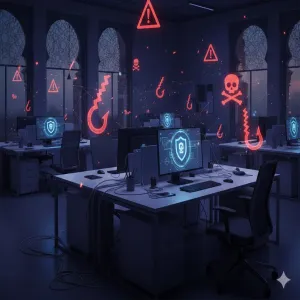
The first four hours after ransomware detonation are the most critical. Every minute of delay expands the blast radius. The initial indicator is usually unmistakable: encrypted files with unfamiliar extensions, ransom notes appearing on desktops, or a sudden inability to access shared drives. Once confirmed, the priority is containment, not investigation.
Step one is network isolation. Physically disconnect affected machines from the network by pulling Ethernet cables and disabling Wi-Fi adapters. Do not power off the machines, as volatile memory may contain decryption keys or forensic artifacts. If your organization uses Algerie Telecom or Djezzy corporate connections, contact your ISP immediately to request temporary IP blocking if lateral movement to cloud services is suspected. Document everything with photographs and timestamps from the moment of discovery.
Step two is notification. Internally, alert all staff to stop using company systems immediately. Externally, contact CERT Algeria ([email protected]) within the first two hours. Presidential Decree 26-07 on the security of information systems establishes cybersecurity units within public institutions and mandates cybersecurity policies for public entities. While private SMEs are not directly bound by this decree, it signals the direction of national cybersecurity policy, and all organizations benefit from CERT Algeria’s technical guidance and threat intelligence sharing. If you have a relationship with a local IT services provider such as Ayrade, Icosnet, or Algerie Telecom’s enterprise cybersecurity division, activate that contract now. The first four hours determine whether you are managing an incident or drowning in one.
Advertisement
Phase 2: Forensic Triage and Assessment (Hours 4-24)
Once containment is established, the next twenty hours focus on understanding what happened and what you are dealing with. This is not a full forensic investigation; it is a triage designed to inform recovery decisions. Identify the ransomware variant by uploading the ransom note and a sample encrypted file (not containing sensitive data) to ID Ransomware or VirusTotal. Knowing the variant tells you whether free decryptors exist. As of early 2026, decryptors are available for older strains like Dharma, GandCrab, and some Conti variants through the No More Ransom project.
Assess the scope of encryption. Map which servers, workstations, and shared drives are affected. Determine whether Active Directory domain controllers have been compromised, as this dictates whether a simple restore is possible or a full domain rebuild is required. Check backup integrity immediately. If backups were stored on network-attached storage connected to the same domain, assume they are compromised until verified offline. Algerian SMEs using cloud backup services through local Acronis resellers, Algerie Telecom’s cloud offerings, or Google Workspace should verify backup timestamps predate the infection.
Critically, assess data exfiltration. Modern ransomware operations employ double extortion: encrypting data and threatening to publish stolen files. Check outbound network logs for large data transfers to unfamiliar IP addresses in the days preceding the attack. If customer data, financial records, or employee personal information was exfiltrated, Law 18-07 on the protection of personal data creates notification obligations to the national authority. This legal dimension is one most Algerian SMEs are completely unprepared for.
Phase 3: Recovery Decisions and Business Continuity (Hours 24-72)
The recovery phase forces the hardest decisions. The central question is straightforward but agonizing: pay or rebuild? In Algeria, this question carries an additional legal dimension that most international playbooks ignore entirely. The 2018 Finance Law (Article 117) banned cryptocurrency purchases, and Algeria significantly escalated its stance in July 2025 with Law No. 25-10, which criminalizes all digital asset activity including possession, trading, mining, and promotion, with penalties of 2 months to 1 year imprisonment and fines of 200,000 to 1,000,000 DZD. Paying a Bitcoin ransom would expose the company and its directors to criminal prosecution, even as the business faces existential threat from the attack itself.
The recommended path is always recovery from backups when possible. Rebuild affected systems from clean media, restore data from verified backups, and reset all credentials across the organization. For SMEs without viable backups, the situation is more complex. Some organizations have quietly engaged intermediaries in Tunisia or the UAE to handle ransom payments, though this carries both legal and operational risk. The DGSN (Direction Generale de la Surete Nationale) cybercrime division has investigated several such cases, and prosecution remains a real possibility.
Business continuity during recovery requires creativity. Switch to mobile-based communications using personal devices. Prioritize restoring the systems that generate revenue: point-of-sale systems, invoicing platforms, or whatever drives daily cash flow. Communicate transparently with key clients and suppliers; silence breeds worse speculation than honest disclosure. Finally, document every cost, as this documentation becomes the foundation for any future cyber insurance claim and for the post-incident review that must follow.
Building Pre-Incident Resilience
The best incident response is the one you never need to execute. For Algerian SMEs, the minimum viable cybersecurity posture requires five investments. First, implement the 3-2-1 backup rule: three copies of data, on two different media types, with one stored offline and offsite. Second, deploy endpoint detection and response (EDR) on all systems; solutions like Microsoft Defender for Business or Kaspersky Small Office Security are affordable and effective. Third, enable multi-factor authentication on every account that supports it, especially email and financial systems.
Fourth, conduct quarterly tabletop exercises. Gather your key staff for a two-hour scenario walkthrough: “It is Sunday morning, and our server shows a ransom note. What do we do?” The value is not in perfecting the plan but in identifying gaps before they matter. Fifth, establish relationships with incident response resources before you need them. CERT Algeria, the DGSN cybercrime unit, and qualified local IT security firms should be in your contacts list with tested communication channels.
The cybersecurity landscape facing Algerian SMEs will only intensify as digital transformation accelerates under programs like Algeria Startup and the government’s broader digitization agenda. Ransomware preparedness is no longer optional; it is a business survival requirement.
Frequently Asked Questions
What is ransomware preparedness for algerian smes?
Ransomware Preparedness for Algerian SMEs: A Practical 72-Hour Incident Response Playbook covers the essential aspects of this topic, examining current trends, key players, and practical implications for professionals and organizations in 2026.
Why is ransomware preparedness for algerian smes important for Algeria?
This topic is significant for Algeria because it intersects with the country’s digital transformation goals, economic diversification strategy, and growing technology ecosystem. The article provides specific context for Algerian stakeholders.
How does phase 1: detection and containment (hours 0-4) work?
The article examines this through the lens of phase 1: detection and containment (hours 0-4), providing detailed analysis of the mechanisms, trade-offs, and practical implications for stakeholders.
Sources & Further Reading
- INTERPOL Africa Cyberthreat Assessment 2025
- Kaspersky: 70 Million Cyberattacks Against Algeria in 2024 — El Moudjahid
- Sophos State of Ransomware 2025
- Coveware Quarterly Ransomware Reports
- No More Ransom Project — Decryption Tools
- Algeria Law 18-07 on Protection of Personal Data
- Algeria Decree 26-07 on Information System Security — ARPCE
- Algeria Enacts Sweeping Crypto Ban Under Law No. 25-10 — TechInAfrica
- Algerie Telecom Enterprise Cybersecurity Packs
- ID Ransomware Identification Service