The Missing Rung on Algeria’s AI Ladder
Algeria’s AI talent conversation has, until now, centered almost entirely on the university pipeline: ENSIA, the grandes écoles, and the 74 AI master’s programs across 52 universities. That pipeline is strong, but it solves only one part of the problem. The other part — the larger part, numerically — is the millions of Algerian workers and jobseekers who will not pass through a five-year engineering cycle but who still need credentialed skills in cloud, cybersecurity, and applied AI to be employable in the 2026-2030 economy.
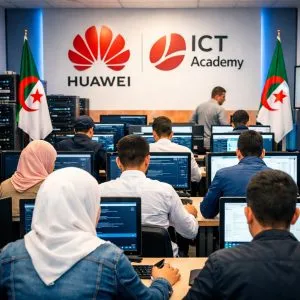
The September 2026 launch of a joint Ministry-Huawei vocational diploma fills that gap. It is the first structured non-academic credential in Algeria that specifically certifies competence in the three technology verticals that employers now list on almost every senior and mid-level IT job posting.
What the Diploma Actually Is
The diploma was formalized through a memorandum of understanding signed between Algeria’s Ministry of Vocational Training and Education and Huawei, building on an earlier cooperation that had already trained roughly 8,000 Algerians in ICT topics through Huawei’s regional programs. Under the new arrangement, the Ministry and Huawei jointly issue the credential — meaning the document carries official state recognition alongside Huawei’s industry stamp.
Three institutes anchor the rollout in its first year:
- The National Specialized Institute for ICT in Rahmania (Algiers area)
- The National Institute for Vocational Training (INSFP) in Bou Smail (Tipaza province, west of Algiers)
- The African Institute for Vocational Training in Boumerdes (east of Algiers)
This three-institute geography matters. It places the diploma inside the greater Algiers corridor, where the largest concentration of Algerian employers — telecoms, banks, insurers, state-owned firms, and the growing startup base — actually hire. Trainees will graduate near their future employers, not in cities with thin labor markets.
Alongside the diploma, the national vocational catalogue will add nearly 30 new digital-technology specialties for the upcoming academic year, reflecting a broader reskilling push inside the Ministry of Vocational Training.
Who It Is For
The vocational diploma is structurally different from an ENSIA engineering degree, and it is designed for a different demographic:
- Young jobseekers without a bachelor’s degree who want a credentialed path into IT roles. This is the largest cohort and the one Algerian employers chronically underserve.
- Mid-career IT practitioners in roles like system administration, network operations, or helpdesk who need formal upskilling in cloud and security to move into higher-paying roles.
- SME employees whose firms cannot afford multi-year external training but can release staff for structured vocational courses aligned with a Huawei certification track.
The curriculum covers cloud computing fundamentals (networking, storage, virtualization, identity), cybersecurity (SOC operations, endpoint protection, basic incident response), and applied AI (ML operations, data preparation, integration with common business systems). It is more practical and less theoretical than a university AI master’s — intentionally so.
Advertisement
Why Employers Should Pay Attention
Three reasons make this diploma practically important for Algerian hiring managers right now.
First, it creates a standardized credential that did not previously exist. Until now, hiring managers evaluating non-university candidates in cloud or cybersecurity had to rely on ad-hoc certifications whose quality varied widely. The Ministry-Huawei stamp establishes a baseline, which reduces hiring risk.
Second, it unlocks a much larger pool. Algeria’s annual tertiary AI output is roughly 5,000 graduates. Vocational enrollment in IT-adjacent specialties is larger and cycles faster. A diploma that specifically targets cloud, cybersecurity, and AI can plausibly place several thousand credentialed candidates per year into the labor market once the three institutes scale — and as additional institutes are added in future cohorts.
Third, it aligns with enterprise modernization roadmaps. Algerian banks, insurers, telecoms, and state-owned firms are all investing in cloud migration, cybersecurity maturity, and AI-assisted process automation. Hiring credentialed vocational graduates is often the only way to staff the operational layers of these programs without importing consultants.
What Founders and CTOs Should Do
For startup founders, the diploma creates a hiring channel for roles that do not require an ENSIA-level engineer: junior cloud operators, SOC analysts, data engineers, MLOps support, and integration specialists. Building relationships with the three anchor institutes now — before the first graduation cycle — can lock in recruiting pipelines at favorable terms. Internship programs and final-project sponsorships are the standard entry points.
For enterprise CTOs, the diploma is an opportunity to reshape the organization’s internal mobility story. Rather than hiring junior cloud or security staff exclusively through external recruiting, companies can send existing employees to the vocational track as part of a formal career path — a low-cost way to retain talent that might otherwise leave.
For the country’s broader digital-economy plan, the diploma matters because it moves credentialing closer to employers. Well-structured vocational systems in small, fast-growing economies (Singapore’s ITE/polytechnic model is the canonical reference) have historically been decisive in turning raw labor-force participation into productive digital output. Algeria’s September 2026 launch is the first real instance of that pattern at scale in the country.
What Algerian Hiring Managers and CTOs Should Do Before September 2026
The diploma launches in six months. Organizations that move first will secure the best intake of graduates; those that wait will compete against better-positioned employers. The following four actions convert the announcement into a concrete 2026-2027 hiring advantage.
1. Formally Contact All Three Anchor Institutes Before the Academic Year Opens
The three anchor institutes — the National Specialized Institute for ICT in Rahmania, INSFP Bou Smail, and the African Institute for Vocational Training in Boumerdes — are finalizing their industry partnership structures before the September 2026 intake. A company that submits a formal letter of intent for internship placement or final-project sponsorship before July 2026 will appear in the institute’s employer directory from day one, giving it first access to the graduation cohort. ESI and ENSIA already operate competitive internship programs with reserved slots for early-registering companies. Vocational institutes follow the same model — early registration is the mechanism, not networking after the fact. Organizations with multiple hiring needs should target all three institutes, since each has a slightly different catchment area and alumni network in the greater Algiers corridor.
2. Create a Defined Junior Cloud or SOC Role That Maps to the Diploma Curriculum
The most common hiring failure for new vocational credentials is that employer job descriptions do not match the credential’s scope. A job posting that asks for a “junior cloud engineer with 3 years’ experience and AWS Associate certification” excludes vocational diploma holders before screening begins. Rewrite one junior cloud operations or SOC analyst role description to explicitly list the Ministry-Huawei diploma as a qualifying credential, alongside any technical screening test your team uses. This is not lowering the bar — it is calibrating the description to the actual skill level the role requires. Algeria’s banking sector, which has been the most aggressive adopter of vocational IT credentials in past cycles, typically runs a 3-month structured onboarding for vocational graduates that supplements diploma training with firm-specific tooling. That model is replicable by any organization running a cloud migration or building out a SOC function.
3. Map Internal Mobility Paths So the Diploma Is a Promotion Track, Not Just a Hiring Channel
The diploma’s second value is internal mobility. Organizations that currently send junior staff to ad-hoc cloud vendor trainings — often at high per-seat cost — can replace that spend with a structured partnership where employees attend the vocational institute part-time and earn the joint credential. This creates a formal career path from operations support to credentialed cloud or SOC practitioner, which is one of the highest-impact retention tools available to mid-sized Algerian tech employers. Sonatrach, Djezzy, and the major Algerian banks all run internal technical academies. The Huawei vocational diploma provides an external credentialing layer that makes internal promotions legible and auditable — employees can demonstrate their skills to any future employer, not only within the firm that trained them.
4. Budget for the First Cohort Now — Vocational Intake Cycles Are Short
The first diploma graduates will complete their program in mid-to-late 2027, assuming a 12-18 month curriculum. Organizations that want those graduates should include headcount for junior cloud, SOC, and data-engineering roles in their 2027-2028 hiring budget, approved in the current planning cycle. Algerian government-linked enterprises operate on multi-year budget cycles, and adding a new credential category to the approved headcount list typically requires two or three budget planning rounds. Private companies have more flexibility, but the same principle applies: a hiring decision that appears in the budget before the first graduation cohort is funded; one that is added reactively competes for slots that better-prepared employers have already reserved.
Where This Fits in Algeria’s 2026 Ecosystem
The Huawei vocational diploma launches inside a cluster of aligned moves. The Sidi Abdellah AI and cybersecurity startup cluster, opened April 2026 under three ministerial supervisions, needs exactly the operational profile the diploma produces: cloud operators, SOC analysts, and MLOps support staff who can maintain infrastructure that deep-tech startups cannot afford to staff with senior engineers. Algeria Venture’s SEAAL pilot, the national water innovation call, and Algérie Télécom’s AI and cybersecurity fund all create demand-side entry points for diploma holders within 24 months of graduation.
Singapore’s ITE and polytechnic system is the canonical international reference — a structured, employer-linked vocational pipeline that produced enough credentialed digital workers to support Singapore’s rapid cloud and financial-technology sector growth from 2010 to 2020. Algeria’s September 2026 launch is the first time the country has attempted that model at scale in digital technology. The three anchor institutes, the Huawei credential co-sign, and the nearly 30 new specialty additions to the national vocational catalogue together form the chassis of a system. Whether it becomes Singapore’s ITE or another well-intentioned credential with low employer uptake will be determined not in September 2026 but in the 2027-2028 hiring cycles, when the first graduates meet the market.
The employers who engage now — with formal institute partnerships, defined job descriptions, and internal mobility plans — will shape the credential’s market reputation before the first graduation cohort arrives. That reputational foundation is the structural reason to act this year rather than wait for the first class to graduate.
Frequently Asked Questions
What is the Algeria-Huawei vocational diploma?
It is a jointly issued credential from Algeria’s Ministry of Vocational Training and Education and Huawei, covering cloud computing, cybersecurity, and artificial intelligence. It launches in September 2026 at three anchor institutes — Rahmania, Bou Smail, and Boumerdes — and represents the first structured state-recognized non-academic credential in these three fields.
How is this different from an ENSIA or university AI master’s?
ENSIA and university AI master’s programs are five-year engineering or postgraduate tracks aimed at producing AI researchers and senior engineers. The vocational diploma is shorter, more applied, and aimed at jobseekers and mid-career professionals who need credentialed operational skills in cloud, security, and applied AI — a different slice of the labor market.
Why should Algerian employers care?
The diploma creates a standardized hiring pipeline for junior cloud operators, SOC analysts, and applied-AI integrators — roles that most Algerian enterprises and scale-ups struggle to fill. It also gives employers a formal internal mobility track they can use to retain and upskill existing staff.
Sources & Further Reading
- Algeria and Huawei forge strategic partnership to modernize vocational training in ICT — SAMENA Daily News
- Why Algeria is Positioned to Become North Africa’s AI Leader — New Lines Institute
- Algeria Expands Vocational Training to Meet Growing Cybersecurity Demand — TechAfrica News
- Ministry of Vocational Training and Education — Official Portal
- Algeria builds talent pipeline through AI and cybersecurity cluster — Ecofin Agency