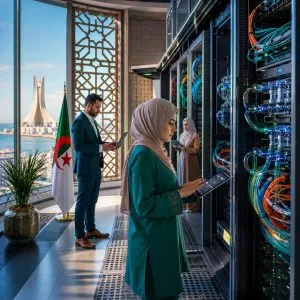
From a Copper Country to a Fiber Country in Six Years
On February 20, 2026, Minister of Post and Telecommunications Sid Ali Zerrouki confirmed that Algeria had reached 3 million households connected to FTTH, up from roughly 53,000 households in 2020. The full “All Fiber” plan targets generalized fiber coverage and the phase-out of copper lines by the end of 2027, with a stated goal of 7 million households on fixed internet.
The speed upgrade arriving with the new network is just as consequential as the coverage. Effective April 13, 2026, Algérie Télécom raised the baseline FTTH tier from 60 to 100 Mbps and doubled ADSL from 10 Mbps to 20 Mbps, at no additional cost to end users. At the top of the ladder, Algeria became the first African market to offer a 1.6 Gbps residential FTTH tier when Algérie Télécom launched it in August 2025.
Taken together, these moves reset the bandwidth baseline for every consumer-facing product built in Algeria.
What Gigabit Fiber Changes for Cloud-Native Builders
The ceiling on what Algerian founders can build has been raised in five practical ways:
- SaaS works at home. A 100 Mbps connection is the pragmatic minimum for running a modern SaaS stack — CRMs, observability dashboards, real-time collaboration — without the UI jank that used to push customers off the product.
- Developer workflows become remote-viable. Cloud IDEs (GitHub Codespaces, Coder, JetBrains Gateway), container builds, and large Docker image pulls that used to take an afternoon now finish in minutes. Remote-first engineering teams stop being a Western-market-only phenomenon.
- Video-first products unlock. Telemedicine, EdTech live classes, and creator-economy tooling — categories that consistently stalled at adoption in Algeria — now have a realistic consumer bandwidth floor.
- On-device AI plus cloud AI becomes practical. Running Whisper locally while offloading heavier inference to a cloud endpoint is bandwidth-hungry in exactly the way Algerian home connections could not handle in 2022.
- Real-time B2C applications. Ride-hailing, delivery, live commerce, and interactive fintech benefit from both the end-user and merchant sides being on usable last-mile connections simultaneously.
As analysts have noted about the broader continental shift, Africa’s cloud-native adoption curve has flipped from “late” to “clean-slate advantaged” — there is no legacy to refactor, only modern architectures to deploy. For Algerian founders, fiber is the access-layer prerequisite that makes that story executable at home.
Advertisement
Infrastructure Still Missing Around the Fiber
Bandwidth alone is not a platform. Three adjacent layers still need work if the 1.6 Gbps tier is going to translate into durable Algerian digital products:
- Domestic peering and CDN caches. A 1.6 Gbps pipe that reaches content in Marseille still spends most of its round-trip latency on the submarine cable. Without an active IXP and local CDN caches, the last-mile speed upgrade is partly wasted.
- Carrier-neutral colocation. Cloud-native startups need somewhere to place production workloads that is close to both Algerian users and the international backbone. Local data center capacity is growing, but carrier-neutral square-meterage remains thin.
- Payment rails and sovereign cloud choices. A gigabit user base is only monetizable if merchants can charge them digitally, and if startups can host data on-shore where regulation demands it. Both are active policy frontiers in Algeria.
These are the pieces that turn “3 million homes on fiber” from a telecom headline into a startup flywheel.
The Founder’s Checklist
For a cloud-native founder planning the next 12 months in Algeria, the fiber rollout changes the inputs to several key decisions:
- Benchmark your product’s bandwidth floor. Target the new 100 Mbps baseline, not the legacy 5–10 Mbps ADSL reality. Products that were over-engineered to work on 2 Mbps can now exploit richer interactions.
- Design for the 1.6 Gbps long tail. A small premium segment with gigabit fiber will pay for higher-quality video, larger file workflows, and gaming-adjacent use cases — a testing ground for features before they reach the mid-tier.
- Plan for the copper cutoff. With copper lines slated to be phased out by end of 2027, any service that depends on DSL modems, fax bridges, or legacy VPN endpoints inherits a two-year sunset.
- Colocate where your users are. Until a domestic peering and CDN layer matures, every 10 ms shaved off latency is a conversion-rate lever. For Algerian-audience startups, that means tracking the local data center and IXP conversation as actively as AWS region pricing.
Fiber in itself is necessary but not sufficient. Algeria’s gigabit rollout is the most significant infrastructure tailwind Algerian software founders have received in a decade — and the companies that move first to rebuild their product assumptions around it will have a measurable head start.
Frequently Asked Questions
How big is the difference between the old and new FTTH baseline in Algeria?
The baseline FTTH tier moved from 60 Mbps to 100 Mbps on April 13, 2026, a 67% speed bump at no extra cost, while ADSL customers went from 10 Mbps to 20 Mbps. Combined with the 1.6 Gbps premium tier launched in August 2025, Algeria now has the widest FTTH speed range in North Africa.
What categories of Algerian startups benefit most from gigabit fiber?
Categories that previously had bandwidth-dependent adoption ceilings benefit the most: telemedicine (live video + imaging), EdTech (live class streaming), creator-economy tooling, live commerce, cloud IDE-based remote engineering, and any real-time B2C application such as delivery, ride-hailing, or interactive fintech. Pure document-based SaaS sees less uplift but still gains smoother UX.
Is fiber enough on its own, or do startups still need other infrastructure?
Fiber is necessary but not sufficient. Without a functional local Internet Exchange Point, CDN caches hosted in Algeria, and carrier-neutral colocation, much of the speed gain is spent on international round-trips. Payment rails and on-shore hosting options are the other missing pieces — startups should treat these as active vendor-selection criteria alongside AWS region pricing.
Sources & Further Reading
- Algeria Reaches Milestone as 3 Million Households Connect to Fibre Broadband — TechAfrica News
- Algeria Hits 3 Million Fiber Homes as Nationwide Rollout Continues — Ecofin Agency
- Algeria Increases Fixed-Line Internet Speeds, Fiber Upgraded to 100 Mbps — Ecofin Agency
- Algeria Telecom Leads Africa’s Internet Race with 1.6 Gbps FTTH — TechAfrica News
- Algeria to Phase Out Copper, Switch to Fiber by 2027 — We Are Tech
- The Paradox of Late Adoption: Africa’s Cloud-Native Revolution — Intelligent CIO Africa
- Ministry of Post and Telecommunications — Generalization of Access to Fixed Internet