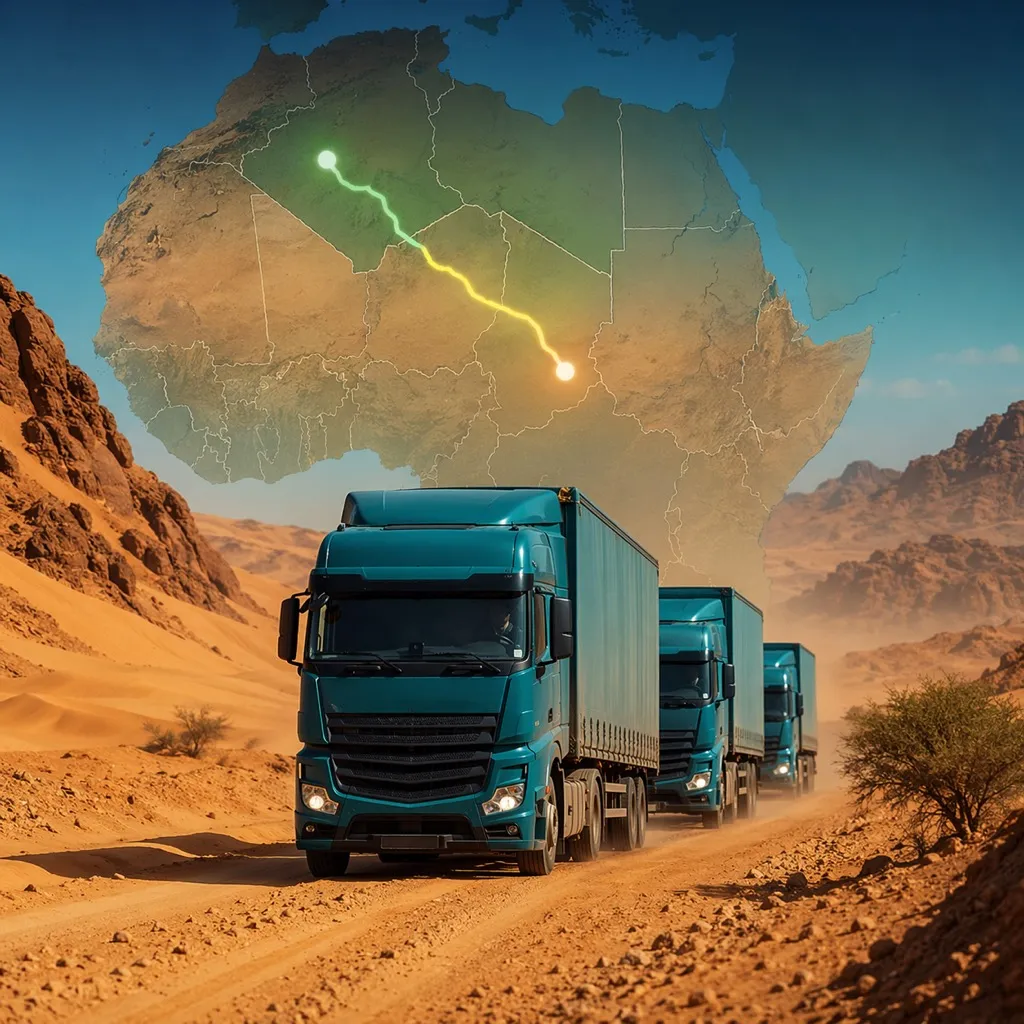
The Corridor That Unlocked Everything
For two decades, the Sahel was a geography Algerian founders could admire but not serve. The missing piece was never demand — it was asphalt. That changed with the Trans-Saharan Highway, a 4,500 km transnational corridor connecting Algiers to Lagos via Mali, Niger, Chad, and Nigeria. Algerian officials confirm the Algerian section (2,400 km from the Mediterranean to Tamanrasset and beyond) is fully complete, and overall corridor completion sits above 90% as of 2025.
Add to that Algeria’s preferential access to 47 African markets under the African Continental Free Trade Area (AfCFTA) — including Guided Trade Initiative partners like Cameroon, Ghana, Kenya, Rwanda, and South Africa — and a clear commercial thesis emerges: Algerian logistics and mobility startups have both the roads and the trade rules to credibly move south.
Yassir — Algeria’s best-known super app — validated the thesis first. With over 6 million users, 130,000 partners, and operations spanning Algeria, Morocco, Tunisia, Senegal, South Africa, France, and Canada, Yassir has already built the playbook: start with mobility, layer delivery and payments, then reuse the fleet and merchant network for cross-border logistics. Senegal is the key West African beachhead, and the next frontier for Algerian founders.
Who’s Following Yassir’s Route
Several Algerian ventures are now positioning around the Sahel opportunity, typically along three patterns:
1. Super app extensions. Temtem One — Algeria’s earlier super app pioneer — already operates mobile top-up services in six African countries (Algeria, Tunisia, Morocco, Senegal, Mali, Côte d’Ivoire) and has stated pan-African ambitions targeting Egypt, Nigeria, Kenya, and Morocco. Ride-hailing in 39 Algerian cities gives Temtem a fleet base similar to Yassir’s; the jump to cross-border parcel delivery from Tamanrasset and Adrar into Niger and Mali is a natural extension of the existing driver network.
2. B2B freight and last-mile specialists. A younger cohort of Algerian logistics startups — many graduates of incubators at ESI Algiers, Algeria Venture, and the Startup Label program — is focused specifically on B2B freight forwarding and last-mile delivery in Algeria’s southern wilayas (Adrar, Tamanrasset, Illizi). These aren’t household names yet, but they are building the truck dispatch software, customs-clearance workflows, and cash-on-delivery systems that Sahel trade actually needs. The business case is straightforward: Algerian consumer goods, pharmaceuticals, and construction materials command premium prices in Niamey and Bamako, and formal logistics has historically been replaced by informal traders.
3. Fintech-first cross-border players. Payments is often the hardest leg of any logistics expansion. Algerian fintech efforts — including those aligned with Algérie Poste’s BaridiMob rails and the Switch Mobile interoperability infrastructure — are essential to making cross-border commerce work. Senegal’s mobile money maturity (Wave, Orange Money) means any Algerian platform going south must bridge two very different payment cultures.
Advertisement
Why the Sahel Now
Three tailwinds converge in 2026:
- Completed corridor. The Algerian 2,400 km Trans-Saharan section is finished; Niger’s section is described by the African Development Bank as “almost complete” and already opening new economic opportunities for local populations.
- Renewed Algerian diplomatic engagement. Since early 2026, Algeria has stepped up its diplomatic outreach to Niger and Burkina Faso, aiming to reassert its role in the Sahel. Warmer government relations generally translate into smoother customs procedures and easier visa frameworks for Algerian business travelers — small frictions that kill logistics margins if unresolved.
- AfCFTA preferential tariffs. Algerian-made goods can now enter multiple African markets duty-free under the Guided Trade Initiative, tilting unit economics in favor of formal exporters over informal trans-shipment.
The Operational Playbook
What does a credible Sahel expansion look like for an Algerian logistics startup in 2026? Based on the pattern Yassir established and what early-stage teams are signaling publicly:
- Beachhead city, not country. Yassir didn’t expand to “Senegal” — it expanded to Dakar. The right first move for a southern expansion is likely Niamey (Niger), Nouakchott (Mauritania), or Bamako (Mali) individually, not a multi-country rollout.
- Diaspora-led demand. There are tens of thousands of Algerian and Sahelian workers moving between these corridors. Remittance-plus-parcel is a proven first product.
- Currency hedging. The CFA franc zone (Niger, Mali) is stable vs EUR, but Algerian dinar convertibility remains a bottleneck. Early movers route settlements through USD or EUR hubs in Tunis, Casablanca, or Dakar.
- Algerian goods, not foreign transshipment. Building on Algerian agri-food exports, pharmaceuticals (Saidal has a growing regional footprint), cement, and steel is a more defensible angle than competing with established pan-African freight forwarders on generic cargo.
- Local partners over greenfield. Mauritanian, Malian, and Nigerien logistics firms with existing licenses and customs relationships are faster to plug into than building wholly-owned subsidiaries.
What This Means for the Algerian Ecosystem
The Sahel opportunity changes what “success” looks like for an Algerian startup. For a decade, the ceiling was “dominate Algeria” — a 45-million-person market constrained by FX controls and import restrictions. Yassir showed that a well-capitalized team can turn Algiers into a launching pad for French-speaking Africa; Temtem has demonstrated a similar regional trajectory with mobile top-ups.
If even three more Algerian logistics or fintech startups succeed in Niger, Mali, or Mauritania over the next 24 months, the narrative shifts from “Algeria has one champion” to “Algeria is a platform for Sahel-focused venture building.” That’s the kind of story that attracts regional VC, brings returnee talent back from Paris and Montreal, and starts to make Algiers a plausible hub for Francophone-Africa founders who today default to Dakar or Abidjan.
The highway is built. The next move is commercial.
Frequently Asked Questions
Why is the Trans-Saharan Highway so important for Algerian startups?
The highway is a 4,500 km corridor connecting Algiers to Lagos via Mali, Niger, Chad, and Nigeria. Algeria’s 2,400 km section is fully complete and overall completion is above 90%. Without physical road infrastructure, formal logistics and e-commerce across the Sahel simply did not work — which is why Algerian founders could never credibly promise cross-border delivery at scale until now.
Which countries should an Algerian logistics startup target first?
Niger, Mali, and Mauritania are the priority Sahel markets because of geographic proximity, AfCFTA preferential tariffs, and existing Algerian diaspora networks. Yassir’s playbook suggests picking one beachhead city (Niamey, Bamako, or Nouakchott) rather than attempting multi-country rollouts. Senegal’s Dakar is a useful West African hub but is already served by Yassir directly.
How do Algerian startups handle cross-border payments into the Sahel?
The CFA franc zone (Niger, Mali) is stable versus EUR, but Algerian dinar convertibility is still a bottleneck. Early movers route settlements through USD or EUR hubs in Tunis, Casablanca, or Dakar, and layer in mobile money rails (Wave, Orange Money) for the local consumer leg. Algeria’s own DZMobPay interoperability and BaridiMob rails handle the domestic side.
Sources & Further Reading
- Yassir — Y Combinator Company Profile
- Yassir pulls in $150M for its super app — TechCrunch
- Trans-Sahara Highway — Wikipedia
- Algeria says 90% of Trans-Saharan Highway completed — Zawya
- Trading Under the AfCFTA — a Guide for Algeria (tralac)
- Algerian startup Temtem One launches all-in-one app — Ventureburn
- The Trans-Saharan Road Corridor — UNCTAD