A Revenue Gap That Closed Faster Than Anyone Modeled
At the start of 2025, OpenAI’s revenue was roughly 10x Anthropic’s. Twelve months later, that ratio has collapsed to barely 1.3x. According to The Information, OpenAI hit $25 billion in annualized revenue in February 2026, up from $20 billion at year-end 2025. Anthropic, meanwhile, crossed $19 billion in annualized revenue by March, adding $6 billion in a single month — a datapoint CEO Dario Amodei confirmed at the Morgan Stanley TMT conference.
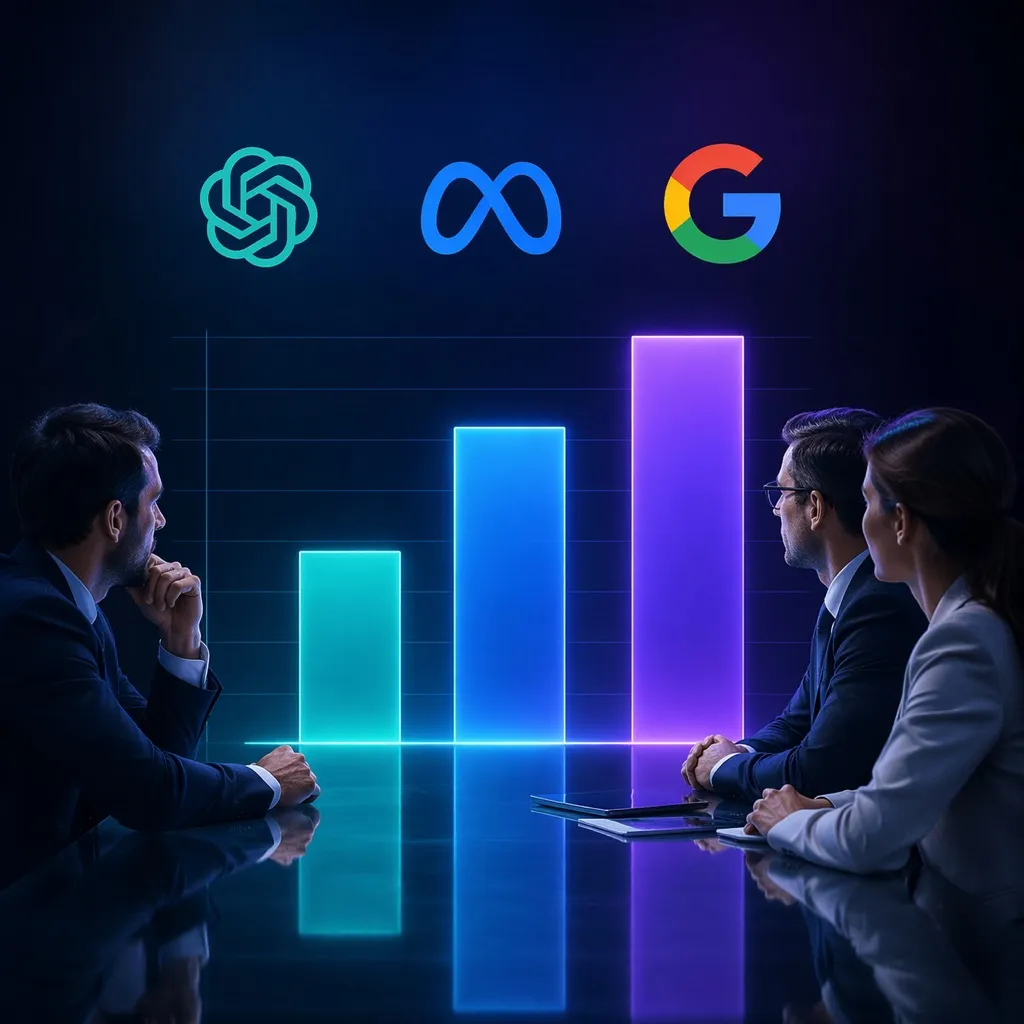
Put those numbers alongside Google’s Gemini, which monetizes through Workspace bundles and Cloud API rather than standalone subscriptions, and you have what Wall Street is now openly calling an AI duopoly-plus-one: two pure-play labs at the commercial frontier and one hyperscaler with unmatched distribution. Together they sit at the center of a $700 billion AI capex cycle that will define enterprise tech through the rest of the decade.
OpenAI: Consumer Machine Becoming Enterprise Machine
OpenAI’s revenue story is still being driven by ChatGPT’s extraordinary consumer pull. Weekly active users climbed to 910 million by early 2026, up from 800 million in October 2025 and 700 million in July. Paying business users crossed 9 million, up from 5 million in August 2025. Those are distribution numbers that no other AI product comes close to.
What changed in 2026 is the revenue mix. OpenAI’s Chief Revenue Officer told analysts that enterprise now makes up more than 40% of total revenue, up from roughly 25% a year earlier. The company’s pivot — layering agentic workflow products, the ChatGPT Enterprise tier, and specialized vertical offerings on top of the consumer funnel — is starting to show. OpenAI still leads in gross revenue, but its enterprise share is growing slower than Anthropic’s, and the gap between consumer weekly users (910M) and paying subscribers (roughly 5% of that) remains a structural unit-economics problem that Sam Altman has openly acknowledged.
The cautionary note: OpenAI is still loss-making at scale, burning cash on training, inference infrastructure, and a compute commitment to Microsoft-plus-Oracle-plus-SoftBank that looks like the largest infrastructure spend in the history of technology. The $25B ARR is real; the path to profitability is still debated.
Anthropic: The Enterprise-Native Challenger
Anthropic’s trajectory is the clearest “no-precedent” growth story in enterprise software. Revenue went from roughly $1 billion in early 2024 to $9 billion at the end of 2025 to $14 billion in February 2026 to $19 billion in March. That is 10x annual growth for three consecutive years — a pace no SaaS company has ever sustained at this scale.
The driver is enterprise adoption and, specifically, Claude Code. Anthropic’s agentic coding tool, launched publicly in May 2025, hit $2.5 billion in annualized run-rate revenue by February 2026, making it the fastest product ramp in B2B software history. Enterprises account for roughly 80% of Anthropic’s revenue, serving over 300,000 business customers. Large accounts generating more than $100,000 in run-rate revenue have grown nearly 7x year-over-year.
The market-share data tells the same story from a different angle. According to Ramp’s AI Index and Menlo Ventures’ enterprise spending analysis, Anthropic’s share of enterprise AI spending rose from 24% to 40% over the past year while OpenAI’s fell from 50% to 27%. Among companies buying enterprise AI tools for the first time, Anthropic now captures over 73% of initial spend. On developer API spending specifically, Anthropic controls roughly 80% — a near-complete flip from July 2025 when OpenAI held 95%.
Anthropic is reportedly preparing for an IPO as early as October 2026 at a target valuation north of $60 billion. Axios has called Anthropic’s revenue growth “unprecedented.”
Advertisement
Google Gemini: Distribution as a Weapon
Google’s approach is fundamentally different. Rather than compete on standalone subscription revenue (where OpenAI and Anthropic are playing), Gemini is being integrated into every Google surface — Search, Workspace, Android, Pixel, YouTube, and now AI Overviews at the top of billions of daily search results. The strategic bet: if Gemini is default-on across Google’s distribution, it does not need to win a subscription war.
The consumer numbers show the strategy working. Gemini surpassed 750 million monthly active users by early 2026, and ChatGPT’s app market share fell from 69.1% in January 2025 to roughly 45% in early 2026, while Gemini’s climbed from 14.7% to over 25% in the same period. Similarweb’s app-tracker data shows Google gaining share every month.
Gemini’s enterprise share sits around 20% — meaningful but behind both competitors. Where Google wins decisively is in the Google Cloud Platform’s AI-adjacent revenue: Vertex AI, Gemini in Workspace, and the AI infrastructure layer (TPUs, storage, data platforms) that competing AI labs themselves rely on. That indirect monetization is harder to benchmark against pure-play ARR but may ultimately be the most valuable position in the market.
What the Numbers Miss
A pure ARR comparison understates how different these three companies are.
OpenAI is still primarily a consumer product whose enterprise arm is growing fast but from a smaller base. Its TAM includes the entire global subscription and prosumer market — the largest addressable audience in AI.
Anthropic has built an enterprise-first company whose consumer presence (Claude.ai) is almost incidental. Its revenue concentration in large accounts is both a strength (high retention, expansion potential) and a risk (customer concentration). “OpenAI is a consumer company building enterprise products. Anthropic is an enterprise company that has a consumer product,” one analyst succinctly put it.
Google does not break out Gemini revenue. Its AI monetization is buried in Cloud ($40B+ annual run rate), Workspace upsells, and Search ad monetization — all of which are growing off AI features but are impossible to isolate. Assume Gemini is contributing mid-single-digit billions directly, with the real AI-related revenue lift inside Alphabet being several times larger.
Enterprise Adoption Hit a Tipping Point
The broader context matters: U.S. enterprise AI adoption crossed 50% in March 2026, according to Ramp’s AI Index. Half of all U.S. businesses now maintain paid subscriptions to AI models and tooling. The hyperscaler AI capex cycle is projected to reach $700 billion in 2026, driven largely by Microsoft, Google, Amazon, and Oracle.
This is no longer a market that any single player will dominate. But it is also not a fragmented market — the top three labs capture well over 90% of enterprise AI spend. The implication for buyers: portfolio approaches (using two or three models for different tasks) are now the norm, and lock-in risk is being actively managed at every procurement conversation.
The Next Twelve Months
Three questions will define the rest of 2026:
Can OpenAI sustain its consumer funnel while aggressively growing enterprise? The revenue math requires it. If consumer subscription growth stalls, the $25B number becomes a ceiling rather than a milestone.
Can Anthropic maintain 10x annual growth? Historically, no enterprise software company has sustained that pace past the $20B mark. The next meaningful milestone — $30-40B ARR by year-end — will test whether Claude Code’s adoption curve holds.
Will Google monetize Gemini directly or keep bundling it? A standalone Gemini subscription tier could add tens of billions in annualized revenue, but it would put the free, default-on distribution strategy at risk.
For everyone else — Mistral, Cohere, Meta’s Llama ecosystem, xAI, and the Chinese labs — the window to break into the top tier is narrowing fast. Capital is consolidating around the leaders, and enterprise procurement is treating “OpenAI plus Anthropic plus Google” as the default shortlist. The AI market of 2026 is not a dozen serious players. It is three, and the gap is widening.
Frequently Asked Questions
How did Anthropic close the revenue gap with OpenAI so quickly?
Anthropic’s growth was driven almost entirely by enterprise adoption of Claude Code — its agentic coding tool — which alone reached $2.5 billion in annualized run-rate revenue within ten months of launch. Enterprises now account for ~80% of Anthropic’s revenue, and its share of developer API spending flipped from 5% to roughly 80% over the past year.
Why isn’t Google Gemini listed with similar revenue numbers?
Google does not break out Gemini revenue. Its AI monetization is bundled inside Google Cloud (Vertex AI, TPUs, data platforms), Workspace upsells, and Search ad monetization. Gemini is now estimated to have over 750M monthly active users and 25%+ of consumer AI app market share, but its direct subscription revenue is deliberately kept low to preserve default distribution.
What does the OpenAI–Anthropic–Google concentration mean for enterprise buyers?
The top three labs capture over 90% of enterprise AI spend, making portfolio procurement (two or three models for different tasks) the dominant pattern. Buyers are actively managing lock-in risk through vendor abstraction layers, model-agnostic tooling, and contractual portability clauses — approaches now baked into most Fortune 500 AI procurement playbooks.
Sources & Further Reading
- OpenAI Tops $25 Billion in Annualized Revenue as Anthropic Narrows Gap — The Information
- Anthropic ARR Surges to $19 Billion on Claude Code Strength — Yahoo Finance
- Anthropic’s Unprecedented Growth — Axios
- OpenAI Says Enterprise AI Is Already 40% of Its Revenue — Yahoo Finance
- Anthropic Turns the Tables on OpenAI in Critical Revenue Category — Axios
- ChatGPT’s Market Share Is Slipping as Google and Rivals Close the Gap — Fortune
- The Tipping Point: Business AI Adoption Hits 50% — FinancialContent