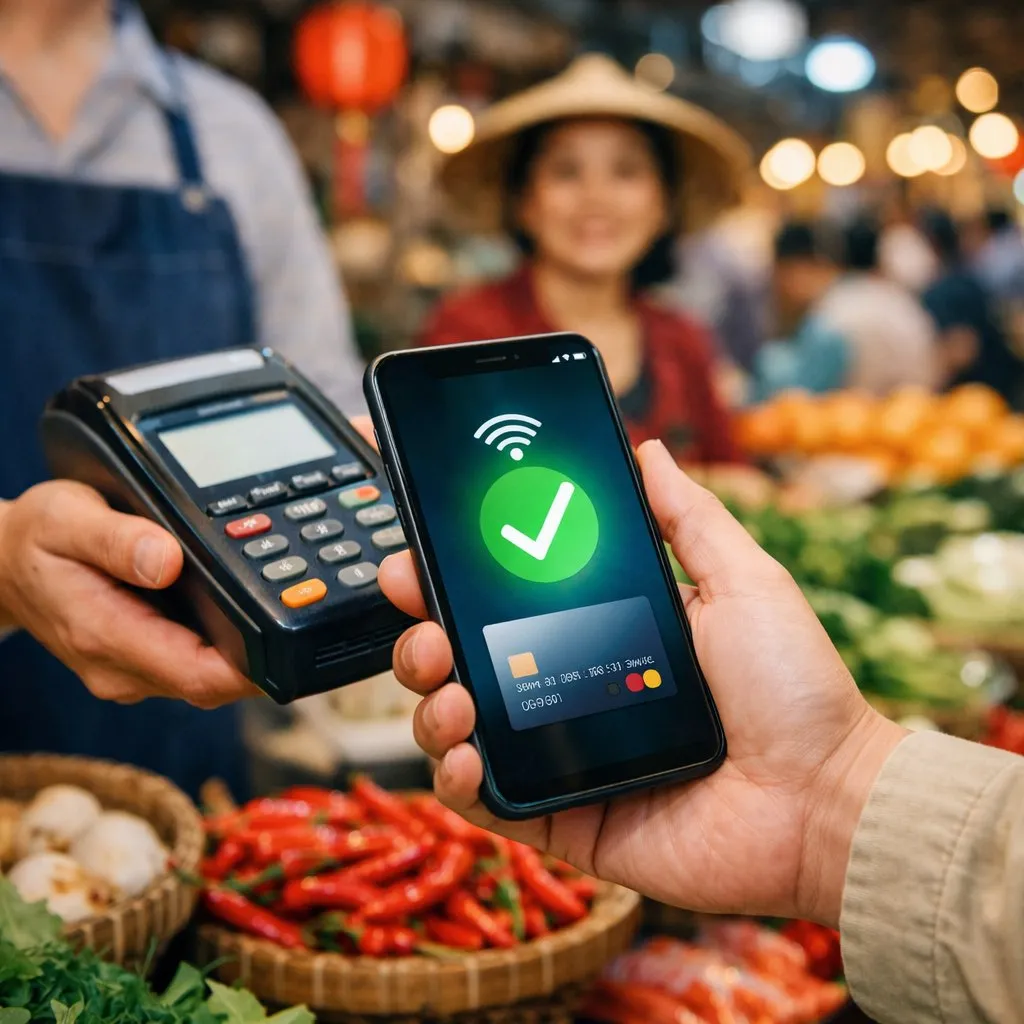
The credit card, that ubiquitous rectangle of plastic that defined consumer payments for half a century, is becoming a relic in Asia. Across the continent’s mega-cities — from Jakarta to Mumbai, Seoul to Bangkok — digital wallets have not just caught up with credit cards; they have decisively surpassed them. The numbers in 2026 tell a story of structural displacement, not gradual transition.
The Scale of Displacement
By 2026, digital wallet users are expected to reach 5.2 billion globally, representing over 60% of the world’s population. In Asia-Pacific, adoption exceeds 75% in several countries, with more than 85% of the population in top Asian mega-cities using at least one digital wallet daily.
The projection for 2030 is even more dramatic: digital wallets are expected to capture 80% of APAC online payments, while credit cards are expected to fall to just 7%. This is not a forecast about a distant future — it reflects trends already visible in payment data today. Mobile wallet transaction volume in Asia is expected to increase by 19.7% annually from 2025 to 2029.
Country-level data tells the story most clearly. India leads digital wallet adoption with 90.8% of consumers using wallets, followed by Indonesia at 89.8% and Thailand at 89.0%. Southeast Asia records the fastest growth trajectory, with a projected 311% cumulative increase in mobile wallet adoption.
Why Asia Leapfrogged Cards
The Asian digital wallet revolution is not a simple technology upgrade from cards to phones. In many markets, it represents a leap from cash directly to mobile payments, bypassing the credit card era entirely.
Several structural factors enabled this leap. First, many Asian consumers never had credit cards. In India, credit card penetration remains below 5% of the adult population, while UPI (Unified Payments Interface) processes over 14 billion transactions monthly. The wallet became the first digital payment tool for hundreds of millions of people who were never part of the card ecosystem.
Second, government digital identity and payment infrastructure programs created the rails. India’s UPI, Singapore’s PayNow, and Thailand’s PromptPay provided real-time, zero-cost payment interoperability that credit card networks could not match on price or speed.
Third, super-apps integrated payments into daily life. When your ride-hailing app, food delivery service, e-commerce marketplace, and messaging platform all share the same wallet, switching costs become prohibitive. WeChat Pay and Alipay demonstrated this model; GrabPay, GoPay, and Paytm replicated it across Southeast Asia and India.
The Credit Card Pushback
Credit card issuers are not surrendering quietly. Visa and Mastercard have pivoted their strategy from competing with wallets to embedding within them. The new model positions cards as the funding source behind the wallet — the consumer taps their phone, the wallet debits their card. This keeps card networks in the transaction flow even as plastic usage declines.
In Singapore, where digital wallet adoption is among the highest in the developed world, cards remain critical as funding instruments. The key insight is that cards and wallets are not necessarily competitors at the infrastructure level — they compete at the consumer interface level. Whoever owns the tap moment wins the customer relationship.
However, this strategy faces limits in markets where wallets are funded by bank accounts, real-time payment rails, or stored value rather than cards. In India, the vast majority of UPI transactions are bank-to-bank, with no card network involved. This disintermediation is the existential threat that card networks face in Asia.
Advertisement
Beyond Payments: The Wallet as Financial Platform
The most consequential shift is the wallet’s evolution from payment tool to financial services platform. Leading wallets in Asia now offer savings products, insurance, investments, lending, and cross-border remittances — all within the same interface.
This creates a flywheel. More services attract more users, generating more data, enabling better credit scoring, leading to more financial products. GrabPay in Southeast Asia, Paytm in India, and KakaoPay in South Korea have all expanded from payments into full-service financial platforms.
For incumbent banks, this represents a profound channel threat. When consumers manage their financial lives through a wallet rather than a banking app, the bank becomes a back-end utility — still processing transactions but losing the customer relationship and the associated data.
Cross-Border Wallet Interoperability
A major development in 2026 is the push for cross-border wallet interoperability within Asia. Bilateral agreements between countries’ real-time payment systems — Singapore-Thailand, Singapore-India, Thailand-Malaysia — are enabling instant cross-border transfers at near-zero cost.
This interoperability challenges the dominance of traditional cross-border payment channels like SWIFT and Western Union, which charge significantly higher fees. For the millions of Asian migrant workers sending remittances home, wallet-to-wallet transfers represent meaningful savings.
Implications for the Global Payment Landscape
Asia’s wallet dominance is not staying within the continent. Chinese tourists using Alipay and WeChat Pay abroad have pushed European and North American merchants to accept wallet payments. Indian UPI’s expanding international acceptance — now live in Singapore, UAE, and several European countries — is creating a truly global wallet network.
The pattern is clear: payments infrastructure that wins in Asia — the world’s largest and fastest-growing digital economy — eventually shapes global payment standards. The credit card’s 50-year dominance of consumer payments is ending, and the replacement is already in 5.2 billion pockets.
Frequently Asked Questions
How many people use digital wallets in 2026?
Digital wallet users reached 5.2 billion globally in 2026, representing over 60% of the world’s population. Adoption exceeds 75% in Asia-Pacific countries, with India leading at 90.8% consumer adoption, followed by Indonesia (89.8%) and Thailand (89.0%).
Why are digital wallets replacing credit cards in Asia?
Many Asian consumers leapfrogged credit cards entirely, moving from cash to mobile wallets. Government payment infrastructure (India’s UPI, Singapore’s PayNow), super-app integration, and zero-cost real-time transfers made wallets faster, cheaper, and more accessible than credit cards, which had low penetration in most Asian markets.
Will digital wallets replace credit cards globally?
The displacement is most advanced in Asia but spreading worldwide. By 2030, wallets are projected to capture 80% of APAC online payments with credit cards falling to 7%. In Europe and North America, the transition is slower but directionally similar, with wallets increasingly becoming the primary payment interface while cards serve as funding sources behind them.
Sources & Further Reading
- Global Payments Market Report 2026-2031: Digital Wallets Dominate — GlobeNewsWire
- Digital Wallet Statistics 2026: Users, Growth Rate and Trends — Capital One Shopping
- Digital Payment Trends and Methods in Singapore and APAC 2026 — Sumsub
- Worldpay Global Payments Report 2026: Digital Wallets, QR Adoption, Real-Time Payments — Treasury Today
- Cards, Digital Wallets, or Both? — Visa Singapore