5G Goes Live: The $492 Million Spectrum Bet
Algeria officially inaugurated 5G mobile services on December 3, 2025, making it one of the last major North African economies to join the 5G era. The three licensed operators — Mobilis (the mobile arm of state-owned Algerie Telecom), Djezzy, and Ooredoo Algeria — collectively paid 63.9 billion dinars (approximately $492 million) for their spectrum licenses, signaling the scale of investment committed to next-generation wireless infrastructure.
The 5G rollout began in Algiers, Oran, and Constantine before expanding to other major cities throughout 2026. Initial coverage focuses on dense urban areas where demand for high-bandwidth, low-latency connectivity is highest — precisely the environments where edge computing delivers the most value.
For Algeria’s digital economy, 5G is not merely faster mobile internet. It is the connectivity layer that enables an entirely new class of applications: real-time industrial IoT, autonomous vehicle communication, remote surgery support, and — critically — edge computing at the network periphery.
Edge Computing at the Base Station
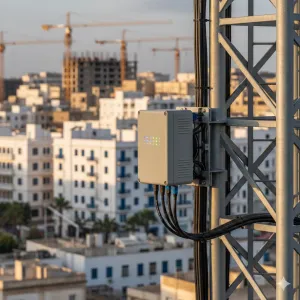
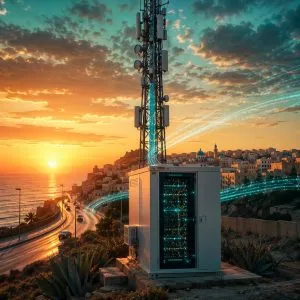
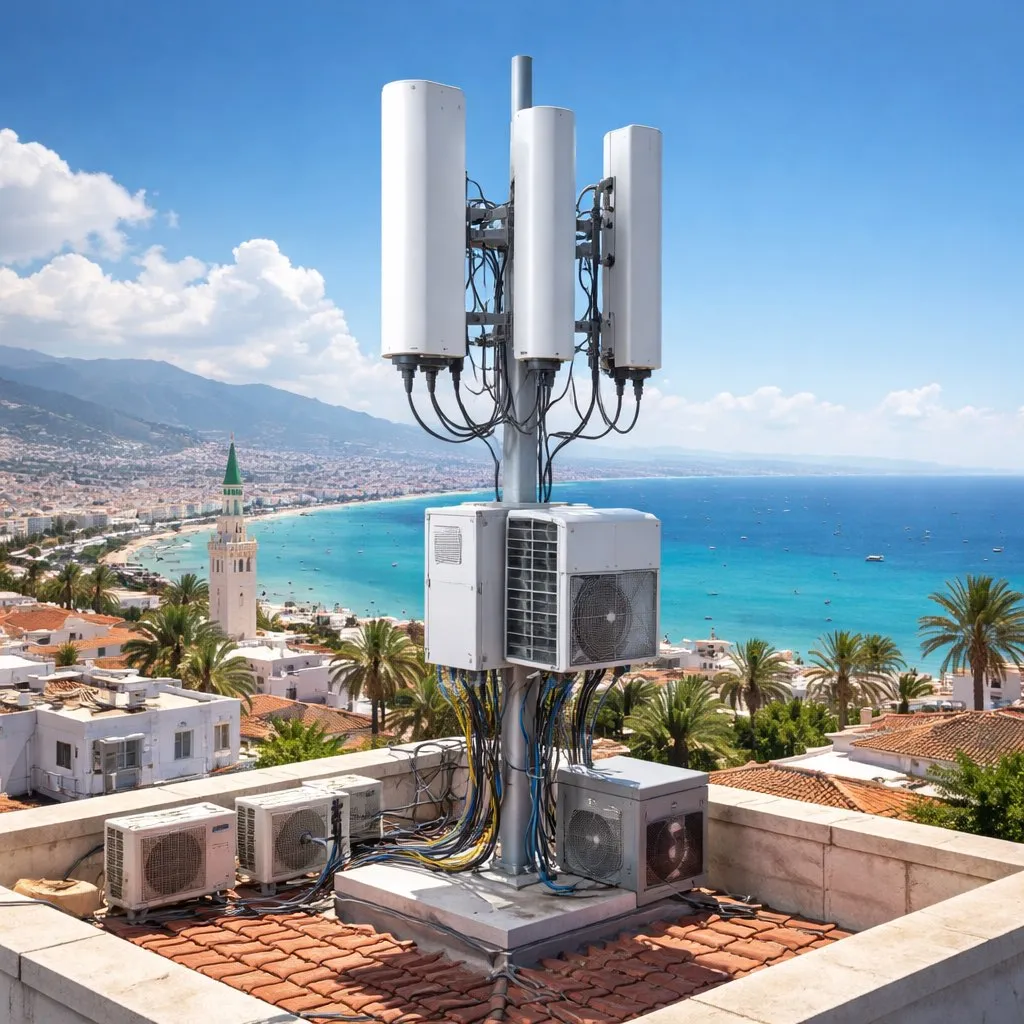
5G enables edge computing — processing data close to where it is generated rather than routing it to centralized data centers. Each of Algeria’s three operators will need to deploy edge computing nodes within their 5G base station infrastructure, creating a new market for cloud-at-the-edge services.
The architecture works by placing small compute servers — typically equipped with GPUs or specialized AI accelerators — directly at or near cell tower sites. When a factory floor sensor, a smart camera, or a connected vehicle generates data, that data can be processed at the nearest edge node in single-digit milliseconds rather than traveling to a data center hundreds of kilometers away, which might add 50-100 milliseconds of latency.
For Algeria’s industrial sector, this matters enormously. Sonatrach’s oil and gas operations, manufacturing plants in the industrial zones of Oran and Setif, and port logistics operations at Algiers and Bejaia all generate data that requires near-real-time processing. Cloud roundtrips to the nearest hyperscaler data centers — located in Europe — add latency and raise data sovereignty concerns.
Huawei Partnership: The 400G Backbone
In February 2025, Algerie Telecom partnered with Huawei to deploy a 400G WDM (Wavelength Division Multiplexing) all-optical backbone network. This infrastructure upgrade is foundational for edge computing: edge nodes are only as useful as the backhaul connecting them to core network functions and cloud resources.
The 400G backbone provides the bandwidth and low-latency connectivity needed to synchronize distributed edge nodes, transmit aggregated data to centralized analytics platforms, and maintain service-level agreements for latency-sensitive applications. Without this backbone upgrade, edge computing would remain constrained by the bottleneck of legacy 100G or slower transmission networks.
Huawei’s involvement extends beyond hardware supply. The company brings experience from deploying edge computing in Chinese 5G networks — the world’s largest — where multi-access edge computing (MEC) platforms process everything from live video analytics to industrial automation at the network edge.
Advertisement
The Edge Data Center Market Opportunity
The Algeria edge data center market was valued at USD 9.54 million in 2025 and is anticipated to reach USD 36.65 million by 2035, growing at a CAGR of 14.26%. While modest compared to global markets, this growth trajectory reflects the nascent but accelerating demand for local compute capacity driven by 5G deployment.
The market opportunity spans multiple segments: telecom operators deploying MEC platforms within their 5G infrastructure, enterprise customers requiring low-latency processing for industrial IoT, government agencies needing data sovereignty-compliant processing for smart city applications, and content delivery networks placing caching nodes closer to end users.
For Algeria’s telecom operators, edge computing represents a critical revenue diversification opportunity. Traditional voice and data revenue continues to face pressure from competition and OTT services. Edge computing services — renting compute capacity at the network edge to enterprise customers — create a new revenue stream that leverages existing tower infrastructure.
The 1.5 Billion Dinar Innovation Fund
In 2025, Algerie Telecom invested 1.5 billion dinars (approximately $11 million) to fund AI, cybersecurity, and robotics startups. This investment directly supports the edge computing ecosystem: startups developing edge-native applications — smart city sensors, industrial monitoring systems, connected agriculture solutions — need both 5G connectivity and edge compute resources to bring their products to market.
The fund signals a strategic recognition that 5G infrastructure alone is insufficient. The value of 5G networks scales with the applications running on them, and edge-native applications represent the highest-value use cases.
Challenges: Coverage, Cost, and Skills
Algeria’s 5G and edge computing ambitions face practical challenges. Coverage remains concentrated in major cities, leaving industrial zones and agricultural regions — where edge computing could deliver significant value — without 5G connectivity. Equipment procurement faces the same import restriction and currency control challenges that affect all technology imports.
The skills gap is particularly acute for edge computing. Deploying and managing distributed compute infrastructure requires expertise in container orchestration, edge-specific security models, and real-time systems engineering — skills that Algeria’s telecom workforce has not traditionally needed.
International partnerships — particularly with Huawei and potentially Ericsson or Nokia — will need to include significant knowledge transfer and training components to build local capacity for operating and maintaining edge infrastructure.
Sources & Further Reading
- 5G Is Here: How Algeria’s Network Revolution Will Reshape Cloud, IoT, and Enterprise Tech — AlgeriaTech
- Algeria Launches 5G Rollout — Connecting Africa
- Algeria to Get 5G as Mobilis, Djezzy and Ooredoo Commence Rollouts — Developing Telecoms
- Algeria Telecom Case Study — HPE Juniper Networking
- Algeria Edge Data Center Market Size and Forecast 2035 — DC Market Insights
Frequently Asked Questions
When did Algeria launch 5G?
Algeria officially launched 5G services on December 3, 2025, with Mobilis, Djezzy, and Ooredoo Algeria as licensed operators who collectively paid approximately $492 million for spectrum licenses.
What is edge computing and why does it matter for Algeria?
Edge computing places processing power at the network periphery — near 5G base stations — enabling sub-10ms response times. For Algeria’s industrial sector, this eliminates the need to route data to European cloud data centers.
How much is Algeria investing in the edge data center market?
The Algeria edge data center market was valued at $9.54 million in 2025, projected to reach $36.65 million by 2035. Algerie Telecom has also invested 1.5 billion dinars in AI and tech startups.